
Music makes bodies move. Jumping, swaying, spinning. Two common phrases invite movement. “Dance around” and “Move to music.” Both mean “move your body when music plays.” But one is wild and free. One is more controlled. Parents and kids can learn together. Dancing builds joy and coordination. The right words describe the type of movement. Let us explore these two movement expressions.
What Do These Expressions Mean? “Dance around” means “move your body to music in a free, joyful, sometimes playful way.” It is not structured. You can spin, hop, wiggle, or just bounce. It is fun and expressive.
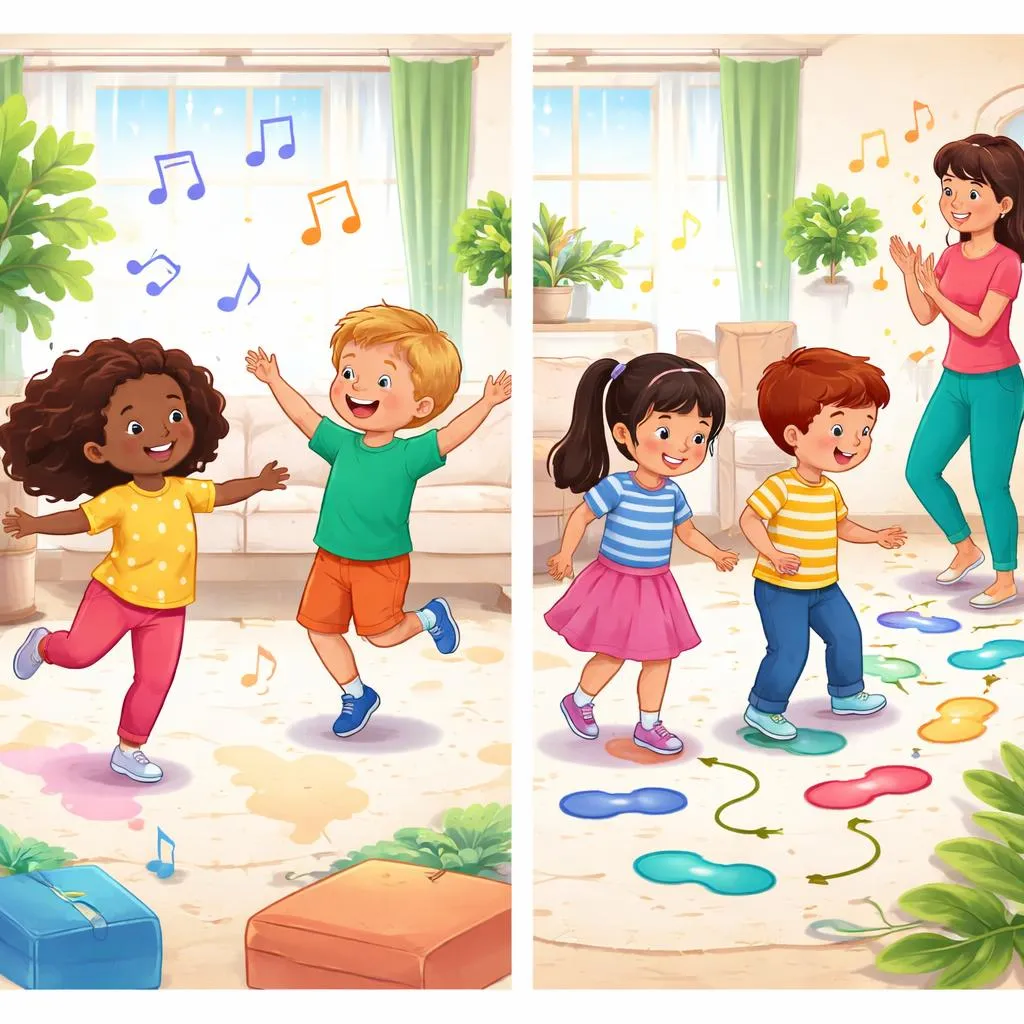
For a child, think of a room with music on. “Dance around” says “Let loose. Wiggle your arms. Spin in circles. Be silly. Enjoy.”
“Move to music” means “move your body in response to the rhythm or beat.” It is more general. It can be dancing, marching, swaying, or any movement. It can be structured or free.
For a child, think of an exercise class for kids. “Move to music” says “Follow the beat. You can march, jump, or clap. Stay with the rhythm.” Both phrases mean to move when music plays. Both say “let your body feel the beat.” They seem similar because people use both for music and movement. Yet one is free and wild. One is more general or structured.
What’s the Difference? The main difference is structure. “Dance around” is free and playful. No rules. No steps. Just joy. “Move to music” can be free or structured. You can move in a planned way (like exercise) or just feel the beat.
Another difference is energy. “Dance around” suggests happy, bouncy, sometimes silly movement. “Move to music” can be calm (swaying) or energetic (jumping).
One more difference is audience. You “dance around” alone or with family at home. “Move to music” is used in classes, therapy, or descriptions.
Also, “move to music” is more formal phrasing. “Dance around” is playful.
Teach children that both are wonderful. One is for free play. One is for any movement with music.
When Do We Use Each One? Use “Dance around” for fun, free play. “Let us dance around the living room.” “She danced around the kitchen while cooking.” “The toddler danced around to the silly song.”
Use “Dance around” to encourage silliness. “Dance around like a crazy chicken.”
Use “Dance around” for happy, unstructured movement.
Use “Move to music” for general instructions. “Let us move to music during gym class.” “He moves to music every morning for exercise.”
Use “Move to music” for structured activities. “The children moved to music by marching in a circle.”
Use “Move to music” for calming activities. “Sway back and forth as you move to the slow music.”
Parents can model both. Say “dance around” for joyful free play. Say “move to music” for any movement with a beat.
Example Sentences for Kids Here are simple sentences children can say.
Dance around:
I love to dance around when my favorite song plays.
Let us dance around the room like butterflies.
She danced around with a scarf in her hand.
Dance around and be silly. No one is watching.
The puppy danced around when he saw his leash.
Move to music:
In gym class, we move to music by jumping and marching.
The baby moved to music by bouncing up and down.
Let us move to music slowly with our eyes closed.
He moves to music every morning before school.
You can move to music by swaying side to side.
Read these aloud. Notice how “dance around” sounds joyful and free. Notice how “move to music” is more general.
Common Mistakes to Avoid Children make mistakes with these phrases. Here are common errors.
Mistake 1: Saying “dance around” for structured dance. “Dance around the ballet studio” is wrong. Ballet is structured. Correct: Say “dance” or “perform ballet.”
Mistake 2: Saying “move to music” for very wild dancing. “Move to music like a crazy monkey” is fine. But “dance around” is more fun. Correct: Use “dance around” for wild, free movement.
Mistake 3: Forgetting that movement can be small. You can move to music with just your finger or head. Correct: Any movement counts.
Mistake 4: Thinking you need skill. No skill is needed to dance around. Just joy. Correct: Everyone can dance around.
Mistake 5: Not playing music. Music makes movement more fun. Correct: Turn on music. Any music works.
Easy Memory Tips Here are simple memory tricks.
Memory tip 1: Think of a wildflower and a metronome. “Dance around” is a wildflower. Free, wild, joyful. “Move to music” is a metronome. Can be structured or free.
Memory tip 2: Use your hands. Flap your arms wildly for “dance around.” Tap your finger to the beat for “move to music.”
Memory tip 3: Ask “is it silly or serious?” Silly fun = “dance around.” Any movement = “move to music.”
Memory tip 4: Draw two pictures. A child spinning with arms out = “dance around.” A child marching in place = “move to music.”
Memory tip 5: Use the “class” test. In a gym class, the teacher says “move to music.” At home, you say “dance around.”
Practice these tips during music time. Dance around together. Then move to music with marching.
Quick Practice Time Try these exercises. Parents read aloud. Children answer.
Exercise 1: Choose the best phrase.
You want to have silly, free dancing time at home. Do you say: a) Dance around b) Move to music
An exercise video for kids says “Now let us _____.” Do you say: a) dance around b) move to music
A baby bounces to a song. Do you say: a) Dance around b) Move to music
Answers: 1(a), 2(b — “move to music” is common in exercise), 3(a or b — both fine)
Exercise 2: Fill in the blank.
“Let us __________ like happy monkeys.” (wild, free)
“In preschool, we __________ by clapping and stomping.” (any movement with rhythm)
Answers: 1. dance around, 2. move to music
Bonus: Play the “Free or Structured” game. Turn on music. First, say “Dance around!” and let your child move wildly. Then say “Move to music by marching in place.” Then “Move to music by swaying.” Then “Dance around like a leaf in the wind.” Talk about the difference between free dancing and structured movement.
Wrap-up Use “dance around” for joyful, free, silly, unstructured movement to music. Use “move to music” for any kind of body movement in response to rhythm, whether structured or free, calm or energetic. Both celebrate music and body. One is wild and free. One is general. Teach children that moving to music is natural. Every child dances around when happy. Every child can move to music in class. So turn on the music. Dance around the living room. Move to music in the kitchen. Feel the beat in your bones. Let your body speak. Joy is movement. Music is the key. Now stand up. Press play. Move. Dance. Be free. That is the rhythm of life. Enjoy every step, bounce, and spin. You are a dancer. Always have been. Now show the world. Dance around. Move to music. Be happy. That is all.