
Children hold things. A glass. A book. A toy. Then they need to place them somewhere. Two common phrases ask for careful placement. “Put it down” and “Set it down.” Both mean “place an object onto a surface.” But one is general. One suggests extra care. Parents and kids can learn together. Placing things gently prevents breaking. The right words teach care. Let us explore these two placement expressions.
What Do These Expressions Mean? “Put it down” means “place the object onto a surface.” It is general. It does not say how gently. It just means release it from your hand onto something.
For a child, think of putting a book on a table. “Put it down” says “Let go of it so it rests on that surface.”
“Set it down” also means “place the object onto a surface.” But “set” suggests more care. It means to place it gently and deliberately. Not dropping. Not throwing. Just carefully.
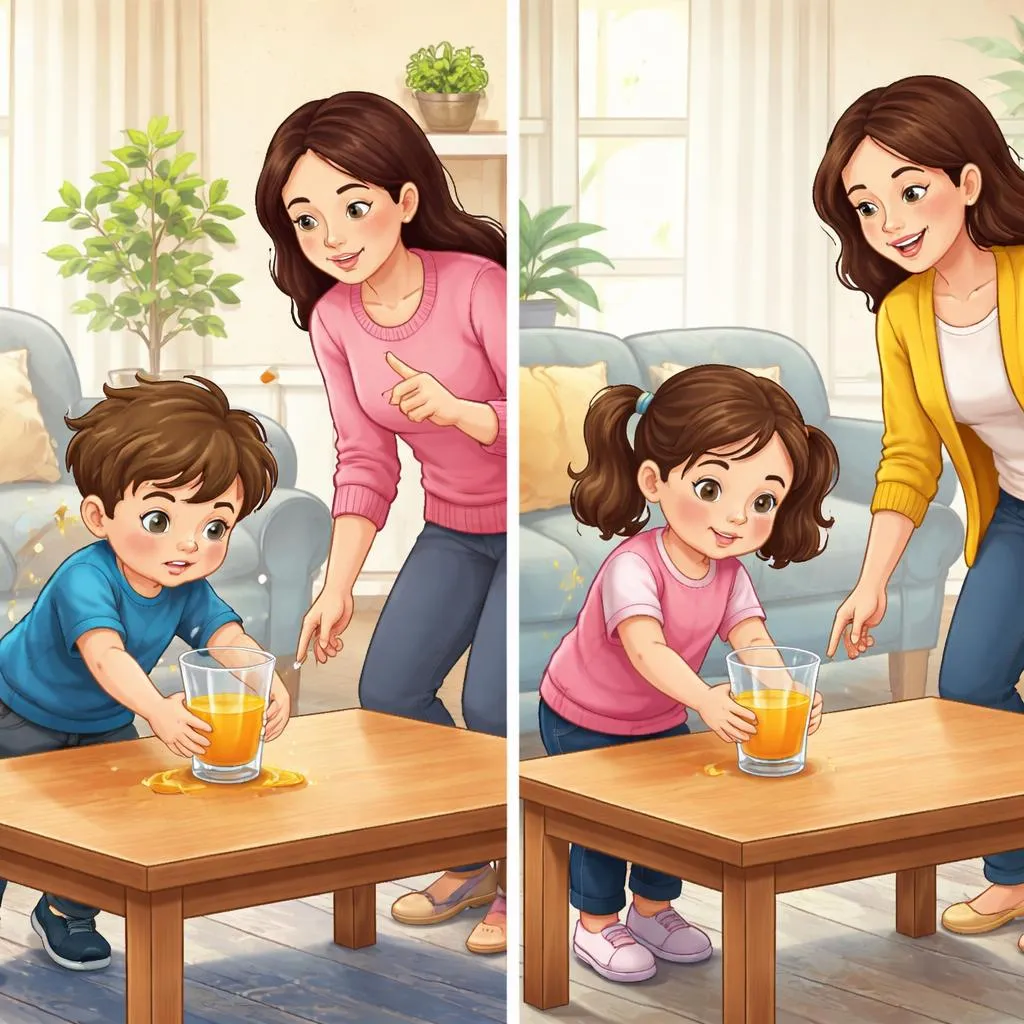
For a child, think of setting a glass of water on a coaster. “Set it down” says “Be gentle. Place it softly.” Both phrases mean to place something. Both say “release the object.” They seem similar because people use both when objects should be placed. Yet one is casual. One is gentle and careful.
What’s the Difference? The main difference is gentleness. “Put it down” is neutral. You can put something down gently or roughly. The phrase does not say. “Set it down” implies gentleness. It means to place carefully, often on a specific spot.
Another difference is formality. “Set it down” sounds a little more formal and careful. “Put it down” is everyday casual.
One more difference is usage with fragile things. For breakable objects, “set it down” is better. It reminds the child to be careful.
Also, “set” often suggests a specific place. “Set it down on the table.” “Put it down” can be anywhere.
Teach children that both mean place something. One is for everyday. One is for careful placement.
When Do We Use Each One? Use “Put it down” for everyday items. “Put your backpack down.” “Put the book down on the desk.” “Put the toy down and come eat dinner.”
Use “Put it down” for quick instructions. “Put that down!” means stop holding it. Usually urgent.
Use “Put it down” as a general phrase. It works for almost anything.
Use “Set it down” for fragile things. “Set the glass down gently.” “Set the vase down on the shelf.” “Set the egg down carefully.”
Use “Set it down” for specific placement. “Set it down right here.” “Set the picture down on the hook.” It suggests exact location.
Use “Set it down” when you want to emphasize care. “Set it down softly. Do not drop it.”
Parents can model both. Say “put it down” for casual placement. Say “set it down” for fragile or careful placement.
Example Sentences for Kids Here are simple sentences children can say.
Put it down:
Put your shoes down by the door.
Please put the book down on the table.
Put the toy down and wash your hands.
I put my backpack down on the floor.
Put that down! It is sharp.
Set it down:
Set the glass down carefully on the coaster.
Please set the cake down on the counter.
Set the baby bird down gently in its nest.
Set the plate down right here.
He set the trophy down with great care.
Read these aloud. Notice how “put it down” is simple and direct. Notice how “set it down” sounds more gentle and careful.
Common Mistakes to Avoid Children make mistakes with these phrases. Here are common errors.
Mistake 1: Using “set it down” for everything. “Set your shoe down” sounds too careful for a shoe. Shoes do not need that much care. Correct: Say “Put your shoe down” for everyday items.
Mistake 2: Using “put it down” for fragile things without care. “Put the egg down” does not remind the child to be gentle. Correct: Say “Set the egg down carefully.”
Mistake 3: Forgetting the word “down.” “Put it” alone means something else. “Put it on the table” is fine, but “put it down” specifically means release from your hand. Correct: Use “down” for placing from a higher position.
Mistake 4: Confusing “set” with “sit.” “Sit it down” is wrong. “Sit” is for people. “Set” is for objects. Correct: “Set the cup down.” People “sit down.”
Mistake 5: Not being specific about where. “Set it down” without a location is fine. But adding a place is clearer. “Set it down on the table.” Correct: Add the surface for clarity.
Easy Memory Tips Here are simple memory tricks.
Memory tip 1: Think of a backpack and an egg. “Put it down” is a backpack. Normal, everyday. “Set it down” is an egg. Gentle, careful.
Memory tip 2: Use your hands. Drop your hand casually for “put it down.” Lower your hand slowly and gently for “set it down.”
Memory tip 3: Ask “is it breakable?” If yes, say “set it down.” If no, “put it down” is fine.
Memory tip 4: Draw two pictures. A child dropping a backpack = “put it down.” A child placing a glass carefully = “set it down.”
Memory tip 5: Use the “care” test. If the object needs care, say “set it down.” If not, “put it down” works.
Practice these tips during daily tasks. Put down toys. Set down glasses.
Quick Practice Time Try these exercises. Parents read aloud. Children answer.
Exercise 1: Choose the best phrase.
A child is holding a plastic cup. It will not break. Do you say: a) Put it down b) Set it down
A child is holding a glass jar. It could break. Do you say: a) Put it down b) Set it down carefully
A child is holding a sharp pencil. You want them to stop holding it. Do you say: a) Put it down b) Set it down
Answers: 1(a), 2(b), 3(a — “put it down” is fine for urgency)
Exercise 2: Fill in the blank.
“Please __________ your backpack on the floor.” (casual)
“__________ the crystal vase on the shelf.” (careful, fragile)
Answers: 1. put it down, 2. Set it down
Bonus: Play the “Careful or Casual” game. Name an object. “Pillow.” “Egg.” “Book.” “Phone.” “Dirty shoe.” The child says “put it down” (casual) or “set it down” (careful). Discuss why fragile things need “set it down.”
Wrap-up Use “put it down” for everyday objects when care is not essential. Use “set it down” for fragile, delicate, or breakable items when you want to emphasize gentleness. Both mean to place something onto a surface. One is casual. One is careful. Teach children that handling things with care shows respect for the object and the space. Setting something down gently takes one extra second. That second can save a broken treasure. Put kindness into every action. Set care into every habit.