
Books open doors. Stories, pictures, facts. Two common phrases invite children into books. “Read a book” and “Look at a book.” Both mean “spend time with a book.” But one means decode words. One means explore pictures. Parents and kids can learn together. Books grow brains and imagination. The right words tell a child what to do. Let us explore these two book expressions.
What Do These Expressions Mean? “Read a book” means “look at the words and understand them.” You sound out letters. You put words together into sentences. You follow a story or learn facts.
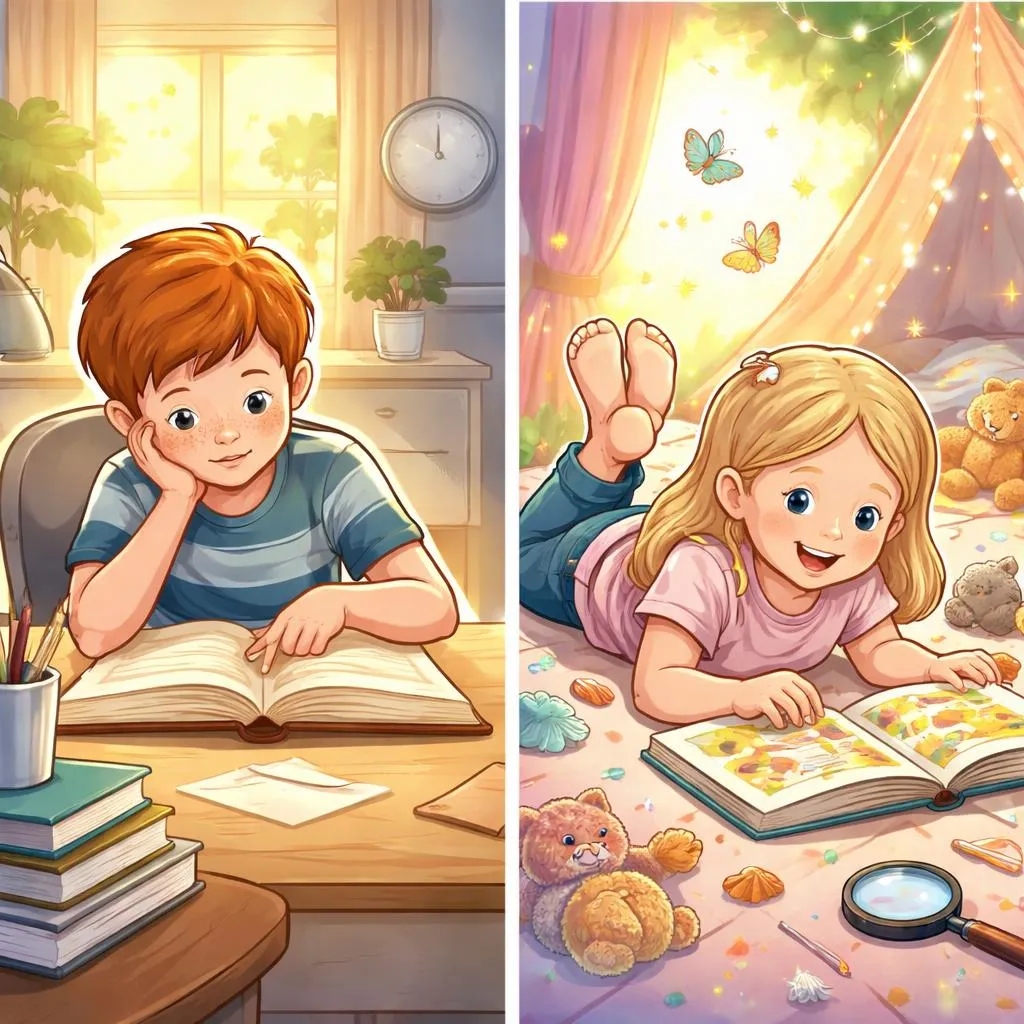
For a child, think of a chapter book. “Read a book” says “Open the book. Read the words from left to right. Understand the story.”
“Look at a book” means “turn the pages and see the pictures.” You do not need to read the words. You can just enjoy the illustrations.
For a child, think of a picture book. “Look at a book” says “See the colorful pictures. Point to the dog. Enjoy the art.” Both phrases are about books. Both say “spend time with a book.” They seem similar because people use both for book time. Yet one is for reading words. One is for enjoying pictures.
What’s the Difference? The main difference is words. “Read a book” involves decoding written language. You need to know letters and sounds. “Look at a book” involves only pictures. You do not need to read.
Another difference is age. Babies and toddlers look at books. Older children read books.
One more difference is skill level. “Read a book” builds literacy. “Look at a book” builds visual skills and print awareness.
Also, “look at a book” can be a first step toward reading. Children learn that books are fun before they can read.
Teach children that both are valuable. One teaches reading. One teaches love of books.
When Do We Use Each One? Use “Read a book” for school or practice. “Please read a book for 20 minutes.” “Read a book before bed.” “I can read a book all by myself.”
Use “Read a book” for stories with words. “Let us read a book about dinosaurs.”
Use “Read a book” for learning. “Read a book to find the answer.”
Use “Look at a book” for babies and toddlers. “Look at the book with the soft pages.” “Look at the pictures of animals.”
Use “Look at a book” for picture books without words. “This book has no words. Just look at the beautiful pictures.”
Use “Look at a book” when you want to encourage exploration without pressure. “You do not have to read. Just look.”
Parents can model both. Say “read a book” for word-reading. Say “look at a book” for picture exploration.
Example Sentences for Kids Here are simple sentences children can say.
Read a book:
I read a book every night before bed.
Please read a book to your little sister.
He read a book about space.
Can you read a book with me?
Reading a book makes me smarter.
Look at a book:
The baby likes to look at a book with colorful shapes.
Let us look at a book about birds.
She cannot read yet, but she can look at a book.
Look at a book and point to the red balloon.
He looked at a book of photographs.
Read these aloud. Notice how “read a book” is for word-reading. Notice how “look at a book” is for picture exploration.
Common Mistakes to Avoid Children make mistakes with these phrases. Here are common errors.
Mistake 1: Saying “look at a book” when you mean read. “Look at a book” for a school assignment sounds like you are not doing the work. Correct: Say “Read the book for your report.”
Mistake 2: Saying “read a book” to a baby. A baby cannot read. They can look at books. Correct: Say “Let’s look at a book together.”
Mistake 3: Forgetting that looking is a first step. Looking at books builds print awareness. It is not a waste of time. Correct: Encourage both looking and reading.
Mistake 4: Thinking looking is not learning. Pictures teach vocabulary, storytelling, and observation. Correct: Looking at books is valuable.
Mistake 5: Not having books at home. Children need books to read or look at. Correct: Visit the library. Get picture books and storybooks.
Easy Memory Tips Here are simple memory tricks.
Memory tip 1: Think of words and pictures. “Read a book” focuses on words. “Look at a book” focuses on pictures.
Memory tip 2: Use your hands. Trace imaginary words with your finger for “read a book.” Point to an imaginary picture for “look at a book.”
Memory tip 3: Ask “can the child read yet?” If yes, say “read a book.” If no (baby/toddler), say “look at a book.”
Memory tip 4: Draw two pictures. A child with an open book reading words = “read a book.” A child pointing at a picture = “look at a book.”
Memory tip 5: Use the “school” test. For school homework, say “read a book.” For playtime with a picture book, say “look at a book.”
Practice these tips during book time. Enjoy every page.
Quick Practice Time Try these exercises. Parents read aloud. Children answer.
Exercise 1: Choose the best phrase.
Your child needs to read a chapter for class. Do you say: a) Read a book b) Look at a book
Your toddler is looking at a board book with a cow on the cover. Do you say: a) Read a book b) Look at a book
You want your child to enjoy a wordless picture book. Do you say: a) Read a book b) Look at a book
Answers: 1(a), 2(b), 3(b)
Exercise 2: Fill in the blank.
“Please __________ for 15 minutes before bed.” (word-reading)
“The baby loves to __________ with the soft pages.” (picture exploration)
Answers: 1. read a book, 2. look at a book
Bonus: Play the “Word or Picture” game. Hold up a children’s book. Ask “Should we read this book (read the words) or look at this book (enjoy the pictures)?” Do both sometimes. First look at pictures. Then read the words. Enjoy the whole book.
Wrap-up Use “read a book” when you want a child to decode words and understand text. Use “look at a book” for picture exploration, especially for babies or toddlers who cannot yet read. Both build a love of books. One teaches literacy. One teaches visual discovery. Teach children that reading is a superpower. Looking is the first step. Every reader started by looking. So look at books. Then read them. Then love them forever. A book in hand is a world of wonder. Now go read or look. Either way, a book is waiting. Open it. Enjoy. Learn. Grow. That is the magic.