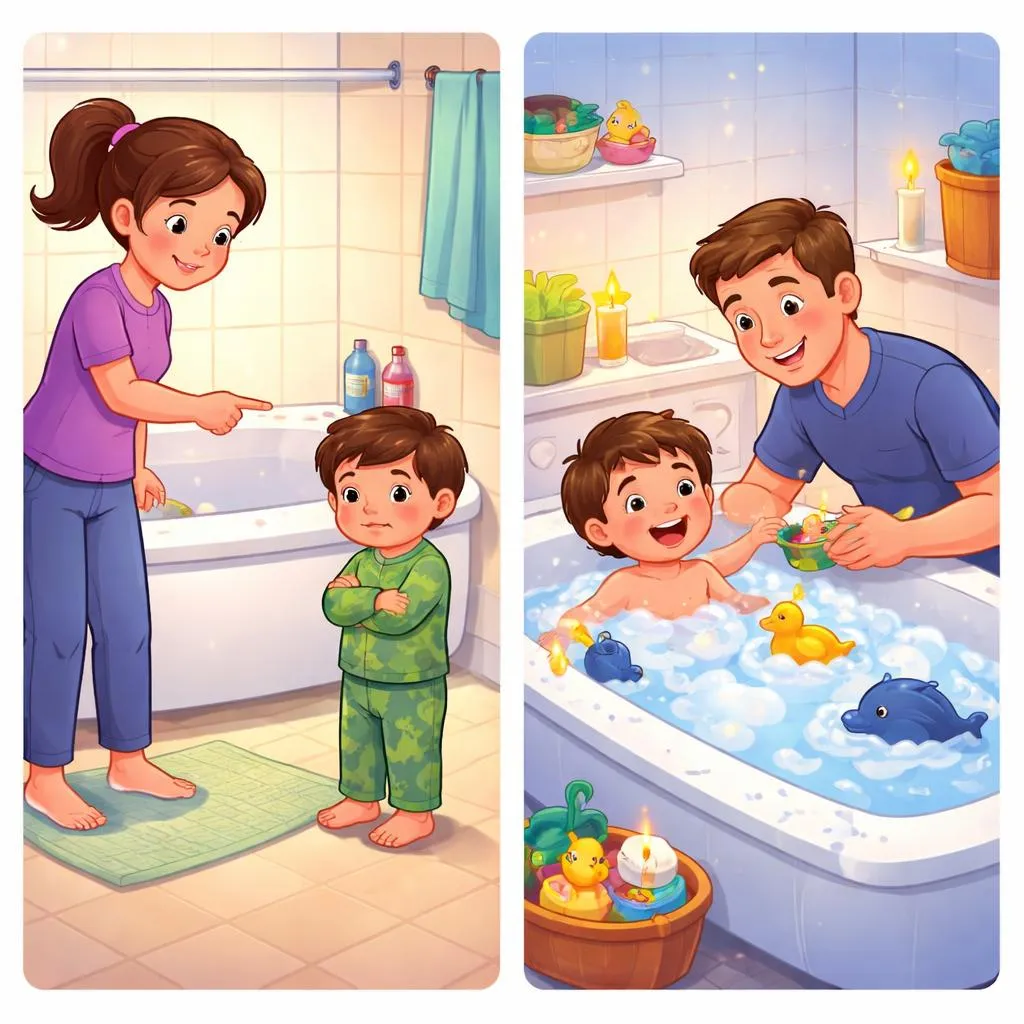

Nighttime means bath time. Warm water. Bubbles. Clean skin. Two common phrases describe this routine. “Take a bath” and “Have a bath.” Both mean “bathe in a tub of water.” But one is more common in American English. One is more common in British English. Parents and kids can learn together. Bathing keeps bodies clean and helps sleep. The right words work in any language. Let us explore these two bathing expressions.
What Do These Expressions Mean? “Take a bath” means “get into a tub of water and wash your body.” It is the standard phrase in American English. “Take” means to do or perform an action.
For a child, think of filling the tub with warm water. “Take a bath” says “Get in the water. Use soap. Wash your whole body.”
“Have a bath” means exactly the same thing: “bathe in a tub of water.” It is the standard phrase in British English. “Have” means to experience or do an activity.
For a child, think of bubble bath toys. “Have a bath” says “Enjoy the water. Get clean. Splash a little.” Both phrases mean to bathe in a tub. Both say “wash your body.” They seem similar because people use both for the same activity. Yet one is American. One is British.
What’s the Difference? The main difference is regional. “Take a bath” is more common in the United States and Canada. “Have a bath” is more common in the United Kingdom, Australia, and New Zealand.
Another difference is the verb. “Take” suggests performing an action. “Have” suggests experiencing an activity. But the meaning is exactly the same.
One more difference is collocations. Americans also “take a shower.” British people “have a shower.” The pattern is consistent.
Also, “take a bath” can mean losing money in finance. “I took a bath on that stock.” “Have a bath” does not have that meaning.
Teach children that both mean to bathe. One is for North America. One is for other English-speaking places.
When Do We Use Each One? Use “Take a bath” in North America. “It is time to take a bath.” “Go take a bath before dinner.” “I take a bath every night.”
Use “Take a bath” in American books and shows.
Use “Take a bath” for the routine. “Take a bath and then put on your pajamas.”
Use “Have a bath” in the UK and other Commonwealth countries. “Let’s have a bath before bed.” “Have a bath and then we will read a story.”
Use “Have a bath” in British books and shows.
Use “Have a bath” for the same routine. “Have a bath and brush your teeth.”
Parents can model both. If you live in the US, say “take a bath.” If you teach British English, say “have a bath.” Both are correct.
Example Sentences for Kids Here are simple sentences children can say.
Take a bath:
I need to take a bath before bed.
Please take a bath. You are dirty from playing.
She takes a bath every night at 7 p.m.
Take a bath and wash your hair.
After soccer, I always take a bath.
Have a bath:
It is time to have a bath. The water is warm.
Have a bath and then we can play.
He has a bath every evening.
Have a bath with your rubber duck.
After a long day, I like to have a bath.
Read these aloud. Notice how both phrases mean the same thing. Only the verb changes.
Common Mistakes to Avoid Children make mistakes with these phrases. Here are common errors.
Mistake 1: Mixing the phrases in the wrong region. In the US, “have a bath” sounds a little odd but is understood. In the UK, “take a bath” is also understood. Not a big mistake. Correct: Use the local version. Both are fine.
Mistake 2: Saying “make a bath.” “Make a bath” is wrong. You do not make a bath. You take or have one. Correct: Say “take a bath” or “have a bath.”
Mistake 3: Forgetting the water temperature. A bath that is too hot or too cold is not safe. Correct: Test the water before getting in.
Mistake 4: Staying in too long. Long baths can dry out skin. Correct: 10-20 minutes is fine.
Mistake 5: Not washing properly. Just sitting in water does not clean. You need soap and scrubbing. Correct: Use soap on a washcloth. Scrub everywhere.
Easy Memory Tips Here are simple memory tricks.
Memory tip 1: Think of the Statue of Liberty and Big Ben. “Take a bath” is American. Like the Statue of Liberty. “Have a bath” is British. Like Big Ben.
Memory tip 2: Use your hands. Pretend to take a bath toy with one hand for “take a bath.” Pretend to have a bubble in your hand for “have a bath.” (Silly, but it works.)
Memory tip 3: Ask “where am I?” In the US = “take a bath.” In the UK = “have a bath.”
Memory tip 4: Draw two pictures. A child with an American flag and a bathtub = “take a bath.” A child with a British flag and a bathtub = “have a bath.”
Memory tip 5: Use the “shower” test. You also “take a shower” (US) or “have a shower” (UK). The pattern is the same.
Practice these tips during bath time. Use your local phrase.
Quick Practice Time Try these exercises. Parents read aloud. Children answer.
Exercise 1: Choose the best phrase based on region.
You live in the United States. It is bath time. Do you say: a) Take a bath b) Have a bath
You live in the United Kingdom. It is bath time. Do you say: a) Take a bath b) Have a bath
You are reading an American children’s book. The character says: a) I take a bath every night. b) I have a bath every night.
Answers: 1(a), 2(b), 3(a)
Exercise 2: Fill in the blank with the correct form for your region.
(For US families) “Please __________ before dinner.” (For UK families) “Please __________ before dinner.”
Answers: (US) take a bath, (UK) have a bath
Bonus: Play the “American or British” game. Say “take a bath” in an American accent. Say “have a bath” in a British accent. Talk about how the same activity has different words in different places. Then take a bath for real. Enjoy the bubbles.
Wrap-up Use “take a bath” in American English. Use “have a bath” in British English. Both mean exactly the same thing: to bathe in a tub of water. One verb is “take.” One verb is “have.” The activity is the same. Teach children that language can vary by place. No matter how you say it, a warm bath cleans your body and calms your mind. So take a bath or have a bath. Just get clean. Nighttime bath, then bedtime. Sweet dreams.