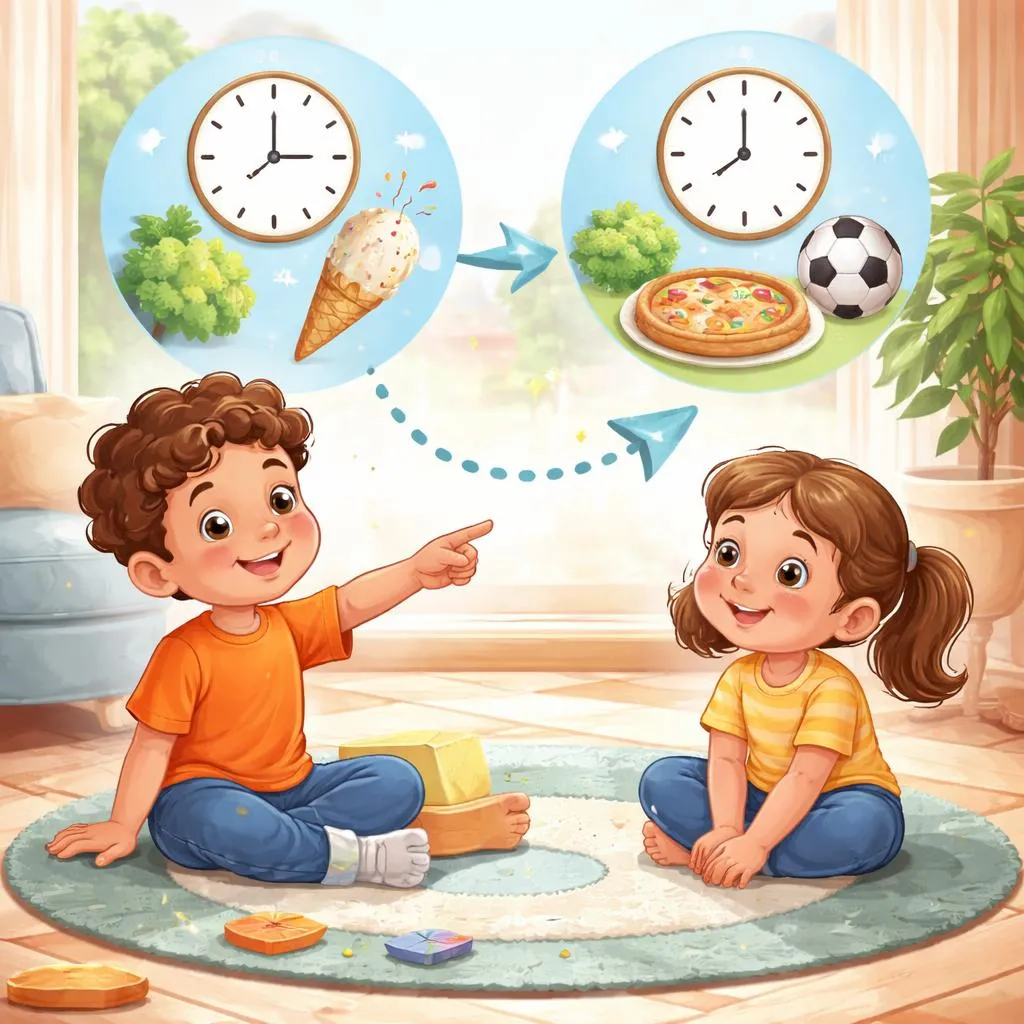

Children talk about the future. After school. After dinner. After the game. Two common phrases describe time that comes next. “Later on” and “Afterwards.” Both mean “at a future time.” Both follow another event. But one is more casual. One is more about sequence. Parents and kids can learn together. Talking about what comes next helps children plan and wait. The right words make timing clear. Let us explore these two future-time expressions.
What Do These Expressions Mean? “Later on” means “at some time in the future, not now.” The word “later” means after this moment. The word “on” adds a sense of continuing time. It is a little softer than “later” alone.
For a child, think of looking down a long road. “Later on” says “Sometime ahead. Not right now. But eventually.”
“Afterwards” means “after an event or time has finished.” It connects directly to something specific. You cannot say “afterwards” without knowing what comes before.
For a child, think of the word “then.” First this, then afterwards that. “Afterwards” says “when this thing is completely done.” Both phrases mean not now. Both point to future time. They seem similar because people use both to postpone or sequence events. Yet one is vague about when. One is tied to a specific event.
What’s the Difference? The main difference is specificity. “Later on” is vague. It means some future time. It could be five minutes or five hours. You do not need an event before it.
“Afterwards” requires a specific event. You must know what comes before. “We will eat dinner. Afterwards, we will play.” The dinner is the marker.
Another difference is formality. “Later on” sounds very casual. Friends say it. Family says it. “Afterwards” sounds a little more organized and thoughtful.
One more difference is placement in a sentence. “Later on” can start a sentence. “Later on, we will go to the park.” “Afterwards” usually comes after the first event is named. “We will eat. Afterwards, we will go.”
Also, “afterwards” can be used with “soon after” or “right afterwards.” “Later on” does not combine as easily with other time words.
Teach children that both mean future. One is a vague “sometime.” One is a clear “after that thing.”
When Do We Use Each One? Use “Later on” for vague future promises. “We will clean your room later on.” “I will help you later on.” It buys time without a specific plan.
Use “Later on” when the exact time does not matter. “Later on today, we will bake cookies.” “Later on in the week, we will see Grandma.”
Use “Later on” to soften a “no.” “Can we go to the park?” “Later on, honey.” It means not now but maybe soon.
Use “Afterwards” when you have a clear sequence. “First we eat lunch. Afterwards, we wash the dishes.” The order is clear.
Use “Afterwards” for routines. “School ends at three. Afterwards, I have piano practice.” The first event is fixed.
Use “Afterwards” in stories. “The dragon flew away. Afterwards, the village was safe.” It shows what happens next.
Parents can model both. Say “later on” for vague future. Use “afterwards” for clear sequences.
Example Sentences for Kids Here are simple sentences children can say.
Later on:
Later on, I will finish my drawing.
We can play outside later on.
Later on today, we have a surprise.
I will tell you a secret later on.
Later on, the sun will go down.
Afterwards:
We will eat cake. Afterwards, we open presents.
The movie ends at eight. Afterwards, we go home.
I will do my homework. Afterwards, I can watch TV.
First we brush our teeth. Afterwards, we read a book.
The rain stopped. Afterwards, we saw a rainbow.
Read these aloud. Notice how “later on” stands alone without a first event. Notice how “afterwards” always follows or refers to a first event.
Common Mistakes to Avoid Children make mistakes with these phrases. Here are common errors.
Mistake 1: Using “afterwards” without a first event. Example: “Afterwards, we will play.” Afterwards after what? The listener is confused. Correct: Say “After dinner, we will play” or “We will eat. Afterwards, we play.”
Mistake 2: Using “later on” when a clear sequence matters. Example: “First we wash the car. Later on, we dry it.” This is fine but “afterwards” is clearer. Correct: For clear sequences, “afterwards” or “then” works better.
Mistake 3: Adding extra words to “afterwards.” “Afterwards” already means “after that.” “Afterwards then” or “afterwards later” is wrong. Correct: Say just “afterwards.”
Mistake 4: Saying “later on” but meaning much later. “Later on” suggests soon. If you mean next week, say “later this week” or “another time.” Correct: Be honest about time. “Later on” means later the same day usually.
Mistake 5: Forgetting that “later on” has two words. Writing “lateron” as one word is a spelling mistake. Correct: Always write two words: “later on.”
Easy Memory Tips Here are simple memory tricks.
Memory tip 1: Think of a cloudy sky and a train track. “Later on” is a cloudy sky. You know the sun is there but not exactly when. “Afterwards” is a train track. First one car, then the next. The order is clear.
Memory tip 2: Use your hands. Wave your hand vaguely forward for “later on.” Use two fingers to show first one event, then the next for “afterwards.”
Memory tip 3: Look for the word “after.” “Afterwards” has “after” in it. After something. “Later on” has no “after.” It stands alone.
Memory tip 4: Draw two time lines. One line with a question mark in the future = “later on.” One line with two boxes: box A then box B = “afterwards.”
Memory tip 5: Use the “what comes before?” test. If you can answer “after what?” then say “afterwards.” If you cannot, say “later on.”
Practice these tips during daily planning. Talk about what comes first and what comes next.
Quick Practice Time Try these exercises. Parents read aloud. Children answer.
Exercise 1: Choose the best phrase.
You promise to help your little sister. You do not know exactly when. Do you say: a) Later on b) Afterwards
You are explaining the order of a race. First you run, then you get a medal. Do you say: a) Later on you get a medal b) Afterwards you get a medal
You finish your homework. Now you want to say what comes next. Do you say: a) Later on I will play b) Afterwards I will play
Answers: 1(a), 2(b — the sequence is clear), 3(b — the homework is the clear first event)
Exercise 2: Fill in the blank.
“I cannot play right now. Maybe __________.” (vague, no specific event)
“We will watch the movie. __________, we will talk about it.” (clear sequence, after the movie)
Answers: 1. later on, 2. Afterwards
Bonus: Play the “First, Afterwards” game. One person names a first event. “We eat breakfast.” The other person says what happens afterwards. “Afterwards, we brush our teeth.” Then switch. Then try the same with “later on” without a first event. Talk about the difference.
Wrap-up Use “later on” for vague future time without a specific event before it. Use “afterwards” to clearly connect one event to the next. Both mean future. One is fuzzy. One is sequential. Choose based on whether you have a clear “after what.” And remember that good communication about time helps everyone wait more patiently.