
Children find places in lines. At the end. Near the wall. After a friend. Two common phrases describe being last or in the rear. “Behind” and “At the back of.” Both mean “facing the same direction with something after.” But one is about relative position. One is about the far end of a space. Parents and kids can learn together. Knowing where you are helps you follow directions. The right words describe your spot in order. Let us explore these two rear expressions.
What Do These Expressions Mean? “Behind” means “facing the same direction with something at your back.” You cannot see the thing because it is after you. The person or thing is in the rear relative to you.
For a child, think of a friend standing after you in line. “Behind” says “My friend is after me. I cannot see them unless I turn around.”
“At the back of” means “the far end of a space or line.” It describes the last position in a group or the rear area of a room. It is a fixed location.
For a child, think of sitting in the last row of a classroom. “At the back of” says “I am near the wall farthest from the teacher.” Both phrases mean rear. Both say not front. They seem similar because people use both for last positions. Yet one is relative to another person. One is about the end of a space.
What’s the Difference? The main difference is what you compare to. “Behind” compares one thing to another. “The book is behind the lamp.” One thing is after another.
“At the back of” describes a location within a space. “At the back of the room.” No comparison needed. The space has a front and a back.
Another difference is movement. “Behind” can describe moving things. “The dog is running behind me.” “At the back of” describes static locations. “The storage is at the back of the store.”
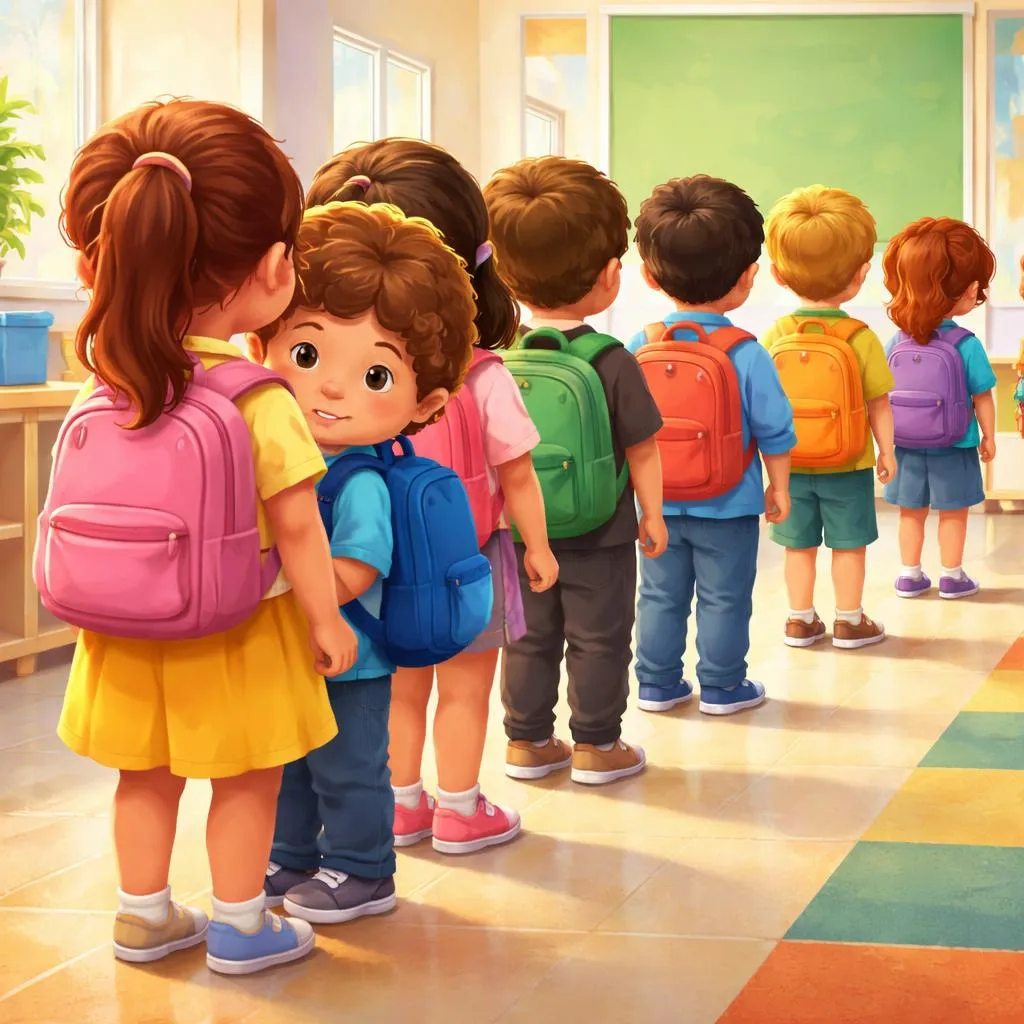
One more difference is lines. In a line, “behind” means the person after you. “At the back of the line” means the very last position.
Also, “behind” can mean late or slow. “I am behind on my homework.” “At the back of” cannot mean that.
Teach children that both mean rear. One is relative. One is absolute within a space.
When Do We Use Each One? Use “Behind” for relative position. “The cat is behind the couch.” “Stand behind your brother.” “My house is behind the school.”
Use “Behind” for movement. “The police car is behind us.” “Run behind me to the tree.”
Use “Behind” for time or progress. “I am behind in my reading.” “The train is behind schedule.”
Use “At the back of” for fixed locations in a space. “The bathroom is at the back of the store.” “We sat at the back of the theater.”
Use “At the back of” for the last position in a line. “Please go to the back of the line.” “The shortest child stands at the back of the group.”
Use “At the back of” for objects with a clear front and back. “Write your name at the back of the paper.” “The label is at the back of the shirt.”
Parents can model both. Say “behind” for relative positions. Say “at the back of” for fixed rear locations.
Example Sentences for Kids Here are simple sentences children can say.
Behind:
The squirrel is hiding behind the tree.
I am standing behind my sister in line.
The garage is behind the house.
Look behind you. I am right here.
He fell behind the other runners.
At the back of:
We sat at the back of the bus.
The eraser is at the back of the drawer.
Please go to the back of the line.
At the back of the book is the answer key.
She hung her coat at the back of the closet.
Read these aloud. Notice how “behind” compares two things. Notice how “at the back of” describes a fixed rear spot.
Common Mistakes to Avoid Children make mistakes with these phrases. Here are common errors.
Mistake 1: Using “at the back of” when “behind” works better. Example: “The toy is at the back of the box.” This is fine but “behind” is better for hiding. Correct: “Behind the box” means on the other side. “At the back of the box” means inside near the rear.
Mistake 2: Using “behind” for the end of a line. “I am behind the line” means after the line, not in it. “At the back of the line” means last in the line. Correct: Use “at the back of the line” for last position.
Mistake 3: Forgetting that “behind” needs a second thing. “Behind alone” is incomplete. “Behind what?” Correct: Always say what it is behind. “Behind the door.”
Mistake 4: Using “at the back of” for moving things. “The car is at the back of the bus” means parked there. Not moving. Correct: For moving, say “behind.”
Mistake 5: Confusing “behind” with “in back of.” “In back of” means the same as “behind.” But it is less common. Correct: Use “behind” for most situations.
Easy Memory Tips Here are simple memory tricks.
Memory tip 1: Think of a shadow and a room. “Behind” is a shadow. It follows something. Relative. “At the back of” is the back wall of a room. Fixed.
Memory tip 2: Use your hands. Put one hand behind the other for “behind.” Point to the far end of a table for “at the back of.”
Memory tip 3: Ask “what is the reference?” If referencing another object, say “behind.” If referencing a space, say “at the back of.”
Memory tip 4: Draw two pictures. A cat behind a chair labeled “behind.” A child at the back of a line labeled “at the back of.”
Memory tip 5: Use the “line test.” In a line, “behind” = the person after you. “At the back of” = the last person.
Practice these tips during daily activities. Lines, rooms, hiding spots.
Quick Practice Time Try these exercises. Parents read aloud. Children answer.
Exercise 1: Choose the best phrase.
Your child is standing after their friend in line. Do you say: a) You are behind your friend b) You are at the back of the line
Your child is the very last person in line. Do you say: a) You are behind b) You are at the back of the line
A toy is on the other side of the couch. Do you say: a) It is behind the couch b) It is at the back of the couch
Answers: 1(a), 2(b), 3(a)
Exercise 2: Fill in the blank.
“Please wait __________ the yellow line on the floor.” (relative position)
“My seat is __________ the classroom, near the pencil sharpener.” (fixed rear location)
Answers: 1. behind, 2. at the back of
Bonus: Play the “Rear Position Game.” Line up toys. Point to the toy behind another. Then point to the toy at the back of the line. Talk about the difference. Then do the same with a room. The chair behind the desk versus the chair at the back of the room.
Wrap-up Use “behind” for relative position where one thing is after another. Use “at the back of” for fixed locations at the far end of a space or line. Both mean rear. One compares two things. One points to the end of a space. Teach children that knowing where you are in space keeps you safe. Behind is fine. The back is fine too. Every spot has its place.