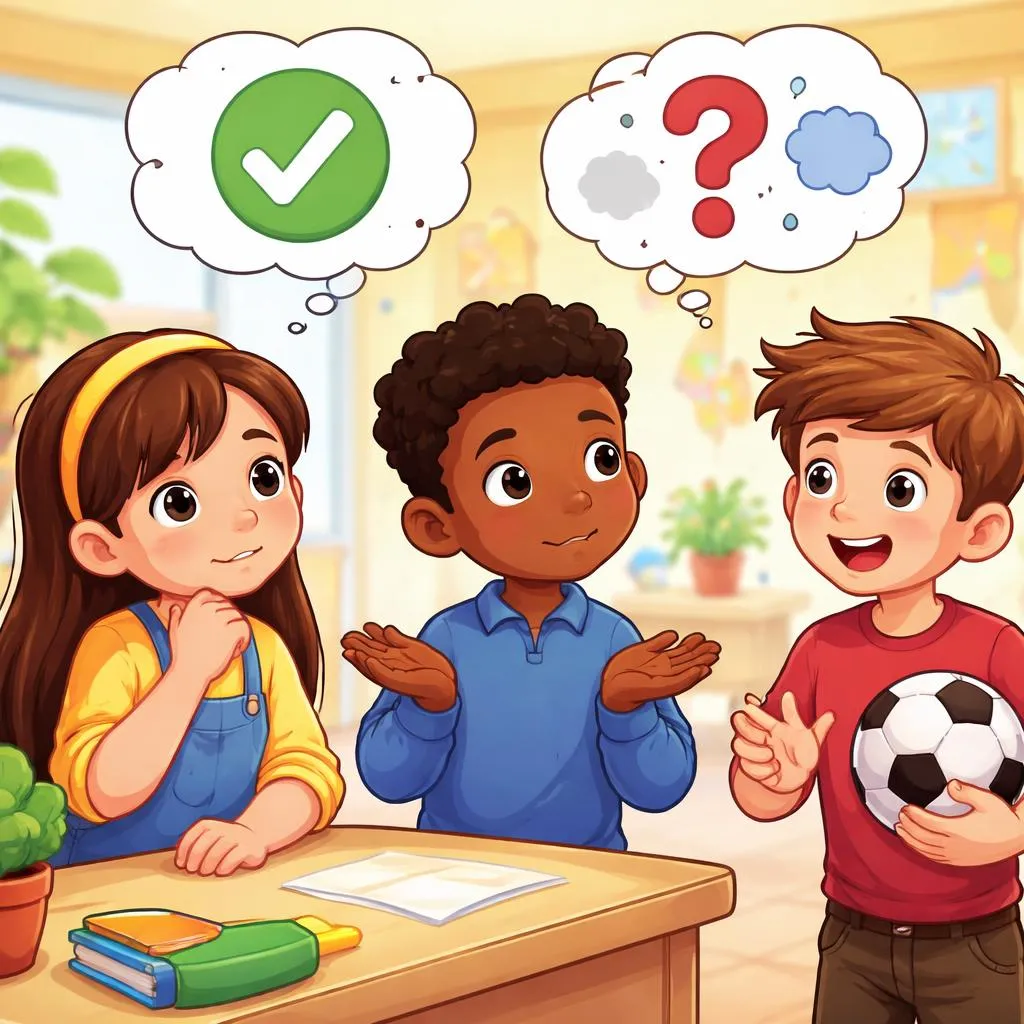

Children hear claims every day. "It will rain later." "You will love this food." "This toy is the best." Sometimes they disagree. Two common phrases express doubt. "I don't think so" and "I doubt it." Both mean "I believe the answer is no." But one sounds softer. One sounds stronger. Parents and kids can learn together. Disagreeing politely takes skill. The right words share your doubt without hurting feelings. Let us explore these two uncertain expressions.
What Do These Expressions Mean? "I don't think so" means "my mind says no." You considered the question. You looked at the facts. Your conclusion leans toward a negative answer.
For a child, think of shaking your head gently. "I don't think so" says "I do not believe that is true. I am pretty sure it is not."
"I doubt it" also means "probably not." But it adds more certainty in your doubt. "Doubt" means you feel strongly that something is not true or will not happen.
For a child, think of a strong head shake with a frown. "I doubt it" says "I am very sure that is not true. Do not expect it to happen." Both phrases express negative certainty. Both say "probably no." They seem similar because people use both when they disagree. Yet one is a soft no. The other is a firm no.
What's the Difference? The main difference is strength. "I don't think so" is softer. You leave a small door open. Maybe you could be wrong. "I doubt it" is stronger. You feel almost sure the answer is no. There is little room for being wrong.
Another difference is politeness. "I don't think so" sounds more polite. You can say it to a teacher. To a grandparent. To a friend. "I doubt it" sounds more direct. It can feel like you are dismissing the other person's idea.
One more difference is emotion. "I don't think so" feels calm and thoughtful. "I doubt it" can feel skeptical or even negative. It carries more emotional weight.
Also, "I doubt it" often refers to future events. "Will it snow tomorrow? I doubt it." "I don't think so" works for past, present, and future.
Teach children that both say no. One is a gentle maybe-not. One is a confident probably-not.
When Do We Use Each One? Use "I don't think so" for polite disagreement. A friend says "This puzzle is impossible." You say "I don't think so. Let me try."
Use "I don't think so" when you are not 100 percent sure. "Did I leave my hat at school? I don't think so. But maybe."
Use "I don't think so" with adults. A teacher asks "Did you finish?" You say "I don't think so. I need more time."
Use "I doubt it" when you feel very sure the answer is no. "Will the baby sleep through the night? I doubt it. She always wakes up."
Use "I doubt it" for unlikely future events. "Do you think we will get a snow day tomorrow?" "I doubt it. The sun is shining."
Use "I doubt it" when you have evidence for your doubt. "Can you eat that whole pizza?" "I doubt it. My stomach is small."
Parents can model both. Say "I don't think so" for soft disagreement. Save "I doubt it" for strong, evidence-based doubt.
Example Sentences for Kids Here are simple sentences children can say.
I don't think so:
I don't think so. The store might still be open.
I don't think so. That doesn't look like a spider.
I don't think so. I probably left my book at home.
I don't think so. This game is not too hard.
I don't think so. We might have time to play.
I doubt it:
I doubt it. It never rains in July here.
I doubt it. My little brother cannot sit still that long.
I doubt it. The dog is too small to jump that high.
I doubt it. We already ate all the cookies.
I doubt it. He said maybe, which usually means no.
Read these aloud. Notice how "I don't think so" sounds open and polite. Notice how "I doubt it" sounds more certain and final.
Common Mistakes to Avoid Children make mistakes with these phrases. Here are common errors.
Mistake 1: Using "I doubt it" for small, polite disagreements. Example: "Do you want more broccoli?" "I doubt it." This sounds too strong for such a small no. Correct: Say "I don't think so" or "No thank you."
Mistake 2: Using "I don't think so" when you are 100 percent sure. Example: "Is the sun green?" "I don't think so." This is too weak. You know the sun is not green. Correct: Say "No" or "Definitely not."
Mistake 3: Saying "I doubt it" with a rude tone. A flat or sarcastic "I doubt it" hurts feelings. It sounds like you do not respect the other person. Correct: Say it in a calm voice. Add "sorry" if needed. "Sorry, I doubt it will work."
Mistake 4: Using these phrases when you actually agree. Sometimes children say "I don't think so" out of habit when they mean yes. Correct: Pause. Think. Say what you really mean.
Mistake 5: Forgetting to give a reason. "I doubt it" alone can feel like a wall. The other person does not know why you doubt. Correct: Add a short reason. "I doubt it because it is too late."
Easy Memory Tips Here are simple memory tricks.
Memory tip 1: Think of a shrug and a head shake. Shrug with palms up = "I don't think so" (maybe not). Firm head shake with eyes sideways = "I doubt it" (probably not).
Memory tip 2: Use your hands. Open hand tilting side to side = "I don't think so." Closed fist shaking once = "I doubt it."
Memory tip 3: Think about proof. If you have a little proof for no, say "I don't think so." If you have strong proof for no, say "I doubt it."
Memory tip 4: Draw two faces. A face with a question mark and a small frown = "I don't think so." A face with a confident frown and crossed arms = "I doubt it."
Memory tip 5: Use the "polite test." If you need to be polite, say "I don't think so." If you are with close friends, "I doubt it" is fine.
Practice these tips during family discussions. Disagree gently with each other.
Quick Practice Time Try these exercises. Parents read aloud. Children answer.
Exercise 1: Choose the best phrase.
A friend says "This math problem is impossible." You think it is hard but possible. Do you say: a) I don't think so b) I doubt it
Your little brother says "I can fly if I jump off the couch." You are very sure he cannot. Do you say: a) I don't think so b) I doubt it
A classmate says "The test is canceled tomorrow." You heard no such thing. You are unsure. Do you say: a) I don't think so b) I doubt it
Answers: 1(a), 2(b — safety issue requires stronger doubt), 3(a)
Exercise 2: Fill in the blank.
"__________ the movie starts at seven. I think it is seven thirty." (soft, polite disagreement)
"__________ we will finish this puzzle tonight. It has one thousand pieces." (strong, evidence-based doubt)
Answers: 1. I don't think so, 2. I doubt it
Bonus: Play the "Doubt Level" game. One person makes a claim. The other person answers with "I don't think so" or "I doubt it." Then explain why. Rate the doubt from 1 to 10. 1-5 = "I don't think so." 6-10 = "I doubt it."
Wrap-up Say "I don't think so" for soft, polite doubt when you are not completely sure. Say "I doubt it" for stronger doubt with evidence, especially about future events. Both say no. One is a gentle maybe-not. One is a confident probably-not. Teach children that doubt is fine. Kindness in disagreement matters even more.