
Doors need closing. For privacy. For quiet. For safety. Two common phrases tell someone to close a door. “Close the door” and “Shut the door.” Both mean “move the door so it covers the opening.” But one is gentle. One can sound firm. Parents and kids can learn together. Closing a door is a simple act. The right words teach how to do it kindly. Let us explore these two closure expressions.
What Do These Expressions Mean? “Close the door” means “move the door until it fits into the frame.” It is neutral. It does not say how hard or soft. Just close it.
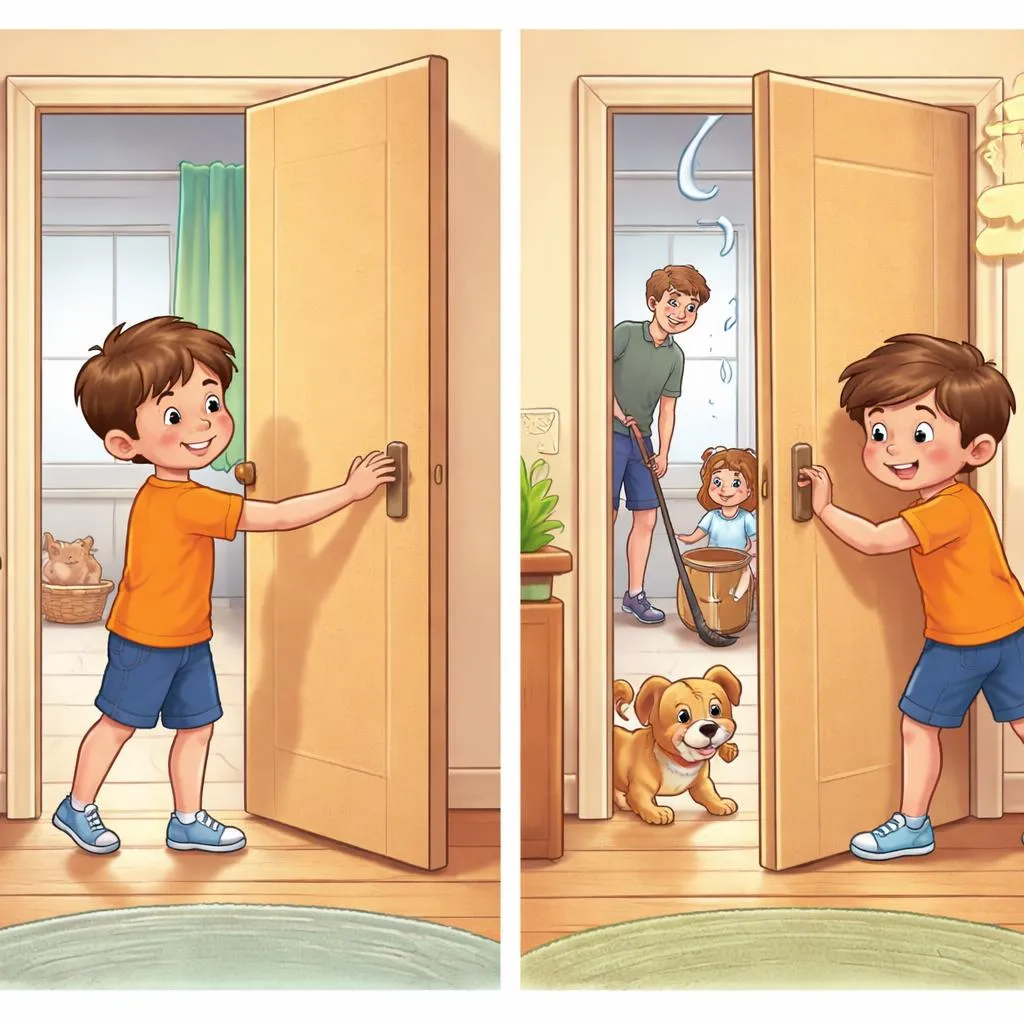
For a child, think of pushing a door until it clicks. “Close the door” says “Make it so the opening is covered.”
“Shut the door” also means “move the door to cover the opening.” But “shut” can sound more forceful. It often means close it all the way, maybe firmly.
For a child, think of shutting a door to keep out cold air. “Shut the door” says “Close it completely. Do not leave it open a crack.” Both phrases mean to cover the opening. Both say “not open.” They seem similar because people use both when a door is open. Yet one is neutral. One implies firmness or completeness.
What’s the Difference? The main difference is force and tone. “Close the door” is softer and more neutral. You can close a door gently. “Shut the door” often sounds more definite or even abrupt. “Shut” can mean to close with a little more force.
Another difference is formality. “Close” is slightly more formal. “Shut” is more casual and direct. “Shut the door” is very common in everyday speech.
One more difference is completeness. “Shut” often implies closing all the way, completely. “Close” can leave room for not fully shut? No, both mean fully closed. But “shut” emphasizes complete closure.
Also, “shut” can be used for eyes and mouths. “Close your eyes” is common. “Shut your eyes” is also fine but more direct.
Teach children that both mean to close. One is gentler. One is firmer.
When Do We Use Each One? Use “Close the door” for gentle requests. “Please close the door quietly. The baby is sleeping.” “Close the door behind you.” It sounds polite.
Use “Close the door” in formal settings. “Please close the door when you leave the office.” It is professional.
Use “Close the door” when you want to emphasize gentleness. “Close the door slowly so it does not slam.”
Use “Shut the door” for firm requests. “Shut the door. It is freezing in here.” “Shut the door all the way. It is open a crack.”
Use “Shut the door” when you are frustrated or in a hurry. “Shut the door! The flies are coming in.” It sounds urgent.
Use “Shut the door” for emphasis. “I told you to shut the door, not just push it.”
Parents can model both. Say “close the door” for polite, gentle requests. Say “shut the door” for firm or urgent situations.
Example Sentences for Kids Here are simple sentences children can say.
Close the door:
Please close the door. The draft is cold.
Close the door quietly so you do not wake the baby.
I will close the door when I leave.
Can you close the door behind you?
Close the door gently. No slamming.
Shut the door:
Shut the door. The bugs are getting in.
Shut the door all the way. It is not closed.
He shut the door loudly because he was angry.
Shut the door to keep the cat inside.
Shut the door. I cannot hear the TV.
Read these aloud. Notice how “close the door” sounds gentler. Notice how “shut the door” sounds more direct and sometimes urgent.
Common Mistakes to Avoid Children make mistakes with these phrases. Here are common errors.
Mistake 1: Using “shut” when gentleness is needed. “Shut the door” during nap time sounds too harsh. Correct: Say “Please close the door quietly.”
Mistake 2: Using “close” when urgency is needed. “Close the door” when a pet is escaping is too slow. “Shut the door” is better. Correct: Say “Shut the door quickly!”
Mistake 3: Forgetting that “shut” can sound rude. “Shut up” is very rude. “Shut the door” is fine but be careful with tone. Correct: Always say “please” with “shut” to soften it.
Mistake 4: Using “close” for slamming. You can close gently or slam. “Close” does not mean slam. “Shut” can be slammed. Correct: Say “Do not slam the door. Close it gently.”
Mistake 5: Not specifying “all the way.” Both “close” and “shut” mean fully closed. But a child might leave it open a crack. Correct: Say “Close the door all the way” or “Shut it completely.”
Easy Memory Tips Here are simple memory tricks.
Memory tip 1: Think of a whisper and a firm voice. “Close the door” is a whisper. Gentle and kind. “Shut the door” is a firm voice. Direct and clear.
Memory tip 2: Use your hands. Push a door slowly for “close the door.” Push it firmly and quickly for “shut the door.”
Memory tip 3: Ask “how do I want to sound?” Polite and gentle = “close.” Firm or urgent = “shut.”
Memory tip 4: Draw two pictures. A child tiptoeing to close a door = “close the door.” A child quickly pushing a door = “shut the door.”
Memory tip 5: Use the “please test.” If you say “please,” both are fine. But “close” sounds nicer.
Practice these tips at home. Practice closing doors gently and firmly.
Quick Practice Time Try these exercises. Parents read aloud. Children answer.
Exercise 1: Choose the best phrase.
The baby is sleeping in the next room. You want the door closed without noise. Do you say: a) Close the door quietly b) Shut the door
A cold wind is blowing in. You want the door closed firmly right now. Do you say: a) Close the door b) Shut the door
Your child left the door open a crack. You want it fully closed. Do you say: a) Close it all the way b) Shut it all the way
Answers: 1(a), 2(b), 3(a or b — both same meaning here)
Exercise 2: Fill in the blank.
“Please __________ gently. Grandma is resting.” (gentle, polite)
“__________ the door! The dog is getting out.” (urgent, firm)
Answers: 1. close the door, 2. Shut
Bonus: Play the “Gentle or Firm” game. One person pretends to be a door. The other says “close the door” (gentle push) or “shut the door” (firmer push). Act out the difference. Discuss which feels kinder.
Wrap-up Use “close the door” for gentle, polite requests. Use “shut the door” for firm, urgent, or direct instructions. Both mean to make the door cover the opening. One is soft. One is strong. Teach children that a closed door can mean privacy, quiet, or safety. Closing a door gently shows respect for others. Shutting a door firmly can keep out cold or noise. Choose your words based on the moment. And always say please. That closes the door on rudeness.