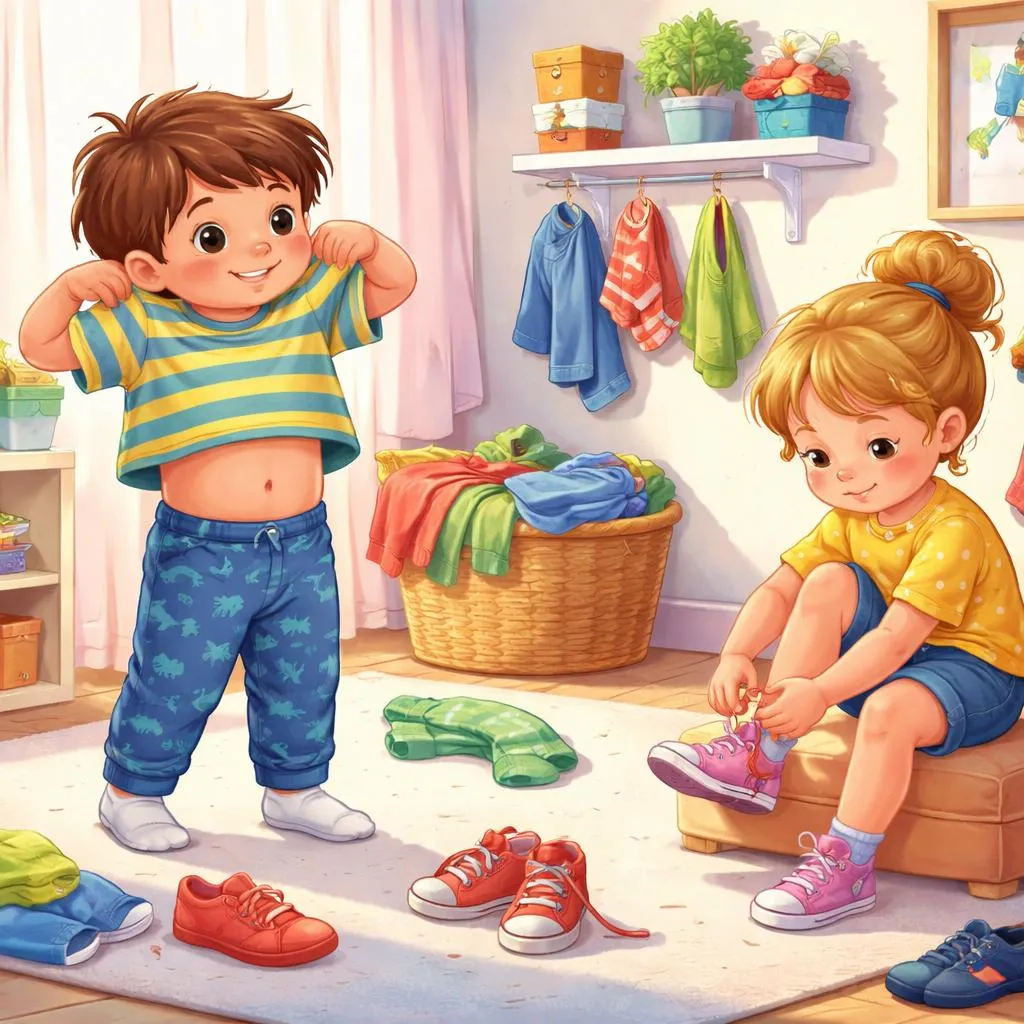

Mornings mean getting dressed. Pajamas off. Shirt on. Pants on. Two common phrases describe this routine. “Get dressed” and “Put on clothes.” Both mean “dress your body.” But one is the whole process. One is the action on each piece. Parents and kids can learn together. Dressing yourself is a big step toward independence. The right words tell a child what to do. Let us explore these two clothing expressions.
What Do These Expressions Mean? “Get dressed” means “put on all your clothing for the day.” It is the whole process. From pajamas to school clothes. It includes shirt, pants, socks, shoes. It is one complete task.
For a child, think of waking up in pajamas. “Get dressed” says “Change from your sleep clothes into your day clothes. All of them.”
“Put on clothes” means “place a specific piece of clothing onto your body.” It focuses on one item at a time. You put on a shirt. You put on socks. It is the action for each piece.
For a child, think of holding a shirt. “Put on clothes” says “Now put this shirt over your head. Good. Now put on your pants.” Both phrases are about dressing. Both say “cover your body.” They seem similar because people use both in the morning. Yet one is the whole task. One is the step-by-step action.
What’s the Difference? The main difference is completeness. “Get dressed” means finish dressing completely. The child is done. “Put on clothes” describes the action. You can be in the middle of putting on clothes.
Another difference is independence. “Get dressed” suggests the child can do it alone. “Put on clothes” can be a step you help with.
One more difference is instruction. “Get dressed” is a single instruction. “Put on your shirt, then put on your pants” is more detailed.
Also, “put on clothes” is more literal. “Get dressed” is idiomatic.
Teach children that both are about dressing. One is the whole goal. One is the action.
When Do We Use Each One? Use “Get dressed” for the complete morning routine. “Time to get dressed for school.” “Can you get dressed by yourself now?” “Get dressed and then come to breakfast.”
Use “Get dressed” when you want the child to dress fully. “Get dressed. We are leaving in ten minutes.”
Use “Get dressed” for the final state. “You are not ready. Go get dressed.”
Use “Put on clothes” for specific steps. “Put on your socks.” “Put on your shirt.” “Put on your shoes.”
Use “Put on clothes” when helping a young child. “Let us put on your clothes one piece at a time.”
Use “Put on clothes” to be very clear about each item.
Parents can model both. Say “get dressed” for the whole task. Say “put on your shirt” for each step.
Example Sentences for Kids Here are simple sentences children can say.
Get dressed:
I need to get dressed for school.
Get dressed quickly. The bus is coming.
She got dressed all by herself today.
After breakfast, get dressed.
He got dressed in his favorite blue shirt.
Put on clothes:
Please put on your clothes. We are late.
Put on your shirt before your pants.
I put on clothes every morning.
Can you help me put on my gloves?
She put on her clothes and ran outside.
Read these aloud. Notice how “get dressed” is the complete task. Notice how “put on clothes” is the action for each piece.
Common Mistakes to Avoid Children make mistakes with these phrases. Here are common errors.
Mistake 1: Saying “put on clothes” when you mean the whole task. “Time to put on clothes” sounds like you are just starting one item, not the whole process. Correct: Say “Get dressed” for the whole task.
Mistake 2: Saying “get dressed” when you mean one item. “Get dressed your socks” is wrong. You cannot get dressed a sock. Correct: Say “Put on your socks.”
Mistake 3: Forgetting that “get dressed” implies finishing. If a child has only put on a shirt, they are not fully dressed. Correct: “You need to put on your pants. Then you will be dressed.”
Mistake 4: Using “put on clothes” for taking off clothes. “Put on clothes” never means remove. Correct: “Take off” for removing.
Mistake 5: Not knowing the order. Children need to learn shirt before pants? Actually, any order works, but some items go under others. Correct: Teach: underwear first, then shirt, pants, socks, shoes.
Easy Memory Tips Here are simple memory tricks.
Memory tip 1: Think of a finish line and a starting line. “Get dressed” is the finish line. All clothes on. “Put on clothes” is the starting line. One piece at a time.
Memory tip 2: Use your hands. Hold up both hands like a finished person for “get dressed.” Point to one finger at a time for “put on clothes” (one piece, then another).
Memory tip 3: Ask “am I giving one instruction or many?” One instruction = “get dressed.” Many instructions = “put on your shirt, then your pants.”
Memory tip 4: Draw two pictures. A child in full school clothes = “get dressed.” A child holding a shirt = “put on clothes.”
Memory tip 5: Use the “ready” test. If the child is ready to go, they are dressed. If they are still putting items on, they are putting on clothes.
Practice these tips every morning. Celebrate when a child gets dressed alone.
Quick Practice Time Try these exercises. Parents read aloud. Children answer.
Exercise 1: Choose the best phrase.
Your child is in pajamas. You want them to dress completely for school. Do you say: a) Get dressed b) Put on clothes
Your child has a shirt on but no pants. Do you say: a) Get dressed b) Put on your pants
You want to tell your child the whole morning routine. Do you say: a) First, get dressed. Then eat breakfast. b) First, put on clothes. Then eat breakfast.
Answers: 1(a), 2(b), 3(a)
Exercise 2: Fill in the blank.
“Please __________. We need to leave in five minutes.” (whole task)
“__________ your shoes before you go outside.” (specific piece)
Answers: 1. get dressed, 2. Put on
Bonus: Play the “Dress Up Game.” Give your child a pile of clothes. Say “Now put on your shirt.” Then “Now put on your pants.” Then “Now you are dressed!” Celebrate. Then mix up the instructions. Practice both phrases.
Wrap-up Use “get dressed” for the complete task of putting on all your day clothes. Use “put on clothes” or “put on [specific item]” for the step-by-step action of dressing each piece. Both are about covering your body for the day. One is the goal. One is the process. Teach children that getting dressed is a proud moment. It means you are growing up. Put on your clothes with care. Be dressed with confidence. Then go out and face the day. You look great. Now go get dressed. The world is waiting.