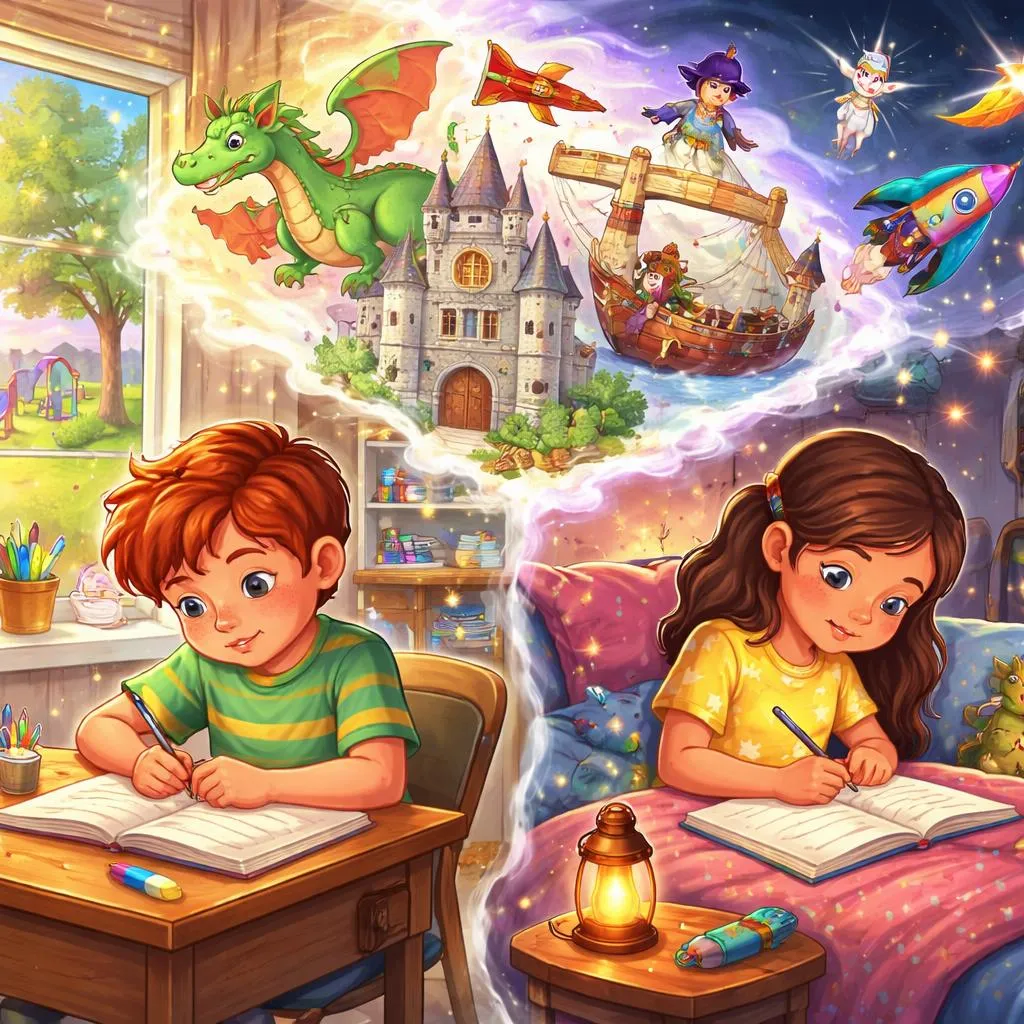

Children love stories. Reading them. Telling them. Writing them. Two common phrases describe making a story. “Write a story” and “Compose a tale.” Both mean “create a narrative with words.” But one is everyday. One is more formal or literary. Parents and kids can learn together. Writing stories builds imagination and skills. The right words describe the creative act. Let us explore these two storytelling expressions.
What Do These Expressions Mean? “Write a story” means “put words on paper to tell a sequence of events.” It is simple and direct. It is what children do in school. Write a story about a dog. Write a story about a dragon.
For a child, think of a blank page and a pencil. “Write a story” says “Think of a beginning, middle, and end. Write sentences. Use your own words.”
“Compose a tale” also means “create a story.” But it sounds more formal and artistic. “Compose” means to create carefully, like composing music. “Tale” is an older word for story.
For a child, think of a storyteller by a fire. “Compose a tale” says “Craft your story with care. Make it beautiful and imaginative.” Both phrases mean to create a story. Both say “tell something in words.” They seem similar because people use both for making stories. Yet one is for everyday schoolwork. One is for artistic creation.
What’s the Difference? The main difference is formality. “Write a story” is everyday language. You use it in school, at home, anywhere. “Compose a tale” sounds more literary or old-fashioned. You might see it in a book about writing or a poetry class.
Another difference is artistry. “Write a story” can be simple. “Compose a tale” suggests more care and beauty. It is for special stories.
One more difference is audience. “Write a story” is for a teacher or parent. “Compose a tale” suggests telling to an audience, perhaps aloud.
Also, “compose” is also used for music. “Compose a symphony.” “Write” is not used for music.
Teach children that both mean to make a story. One is simple. One is fancy.
When Do We Use Each One? Use “Write a story” for school assignments. “Please write a story about your summer.” “I need to write a story for English class.” “Write a story with three paragraphs.”
Use “Write a story” for everyday creativity. “Let us write a story together.” “She wrote a story about a talking cat.”
Use “Write a story” as a simple instruction. “Write a story about anything you like.”
Use “Compose a tale” for formal or artistic writing. “The author composed a tale of adventure and magic.” “He composed a tale for the storytelling contest.”
Use “Compose a tale” for special occasions. “For Grandmother’s birthday, compose a tale about her childhood.”
Use “Compose a tale” when you want to sound poetic. “Let us compose a tale of wonder and delight.”
Parents can model both. Say “write a story” for everyday. Say “compose a tale” for special, artistic moments.
Example Sentences for Kids Here are simple sentences children can say.
Write a story:
I want to write a story about a superhero.
Please write a story for homework tonight.
She wrote a story about her pet rabbit.
Write a story that has a happy ending.
He writes a story every week for fun.
Compose a tale:
The old man composed a tale of knights and dragons.
Let us compose a tale to tell at campfire.
She composed a tale that made everyone cry.
For the festival, compose a tale of friendship.
He loves to compose tales before bed.
Read these aloud. Notice how “write a story” is simple and everyday. Notice how “compose a tale” sounds more artistic and special.
Common Mistakes to Avoid Children make mistakes with these phrases. Here are common errors.
Mistake 1: Using “compose a tale” for a school assignment. “I need to compose a tale for homework” sounds too fancy. The teacher will think it is odd. Correct: Say “I need to write a story for homework.”
Mistake 2: Using “write a story” for an epic poem or song. “Write a story” for a song lyric is fine, but “compose” is better for music. Correct: For music, say “compose a song.”
Mistake 3: Forgetting that “compose” is less common. Children may not know the word “compose.” Teach it gently. Correct: Use “write a story” first. Then introduce “compose a tale” as a fancy option.
Mistake 4: Thinking a story must be long. A story can be one sentence. “The cat sat on the mat.” That is a story. Correct: Short stories count too.
Mistake 5: Not editing. First drafts are messy. Good writers fix mistakes. Correct: Write, then read, then fix.
Easy Memory Tips Here are simple memory tricks.
Memory tip 1: Think of a pencil and a quill. “Write a story” is a pencil. Everyday. “Compose a tale” is a quill. Fancy, old-fashioned.
Memory tip 2: Use your hands. Pretend to write on paper for “write a story.” Pretend to write with a fancy flourish for “compose a tale.”
Memory tip 3: Ask “is this for school or art?” School = “write a story.” Art or special occasion = “compose a tale.”
Memory tip 4: Draw two pictures. A child at a desk with a pencil = “write a story.” A storyteller by a fire in old clothes = “compose a tale.”
Memory tip 5: Use the “music” test. If you are writing music, say “compose.” If writing words, say “write a story.”
Practice these tips during creative time. Write a story together. Then call it a tale.
Quick Practice Time Try these exercises. Parents read aloud. Children answer.
Exercise 1: Choose the best phrase.
Your child has a homework assignment to write a paragraph about a pet. Do you say: a) Write a story b) Compose a tale
You want to encourage your child to create a beautiful, artistic story for a family gathering. Do you say: a) Write a story b) Compose a tale
A famous author writes a new children’s book. The review calls it: a) A written story b) A composed tale
Answers: 1(a), 2(b), 3(b — more literary)
Exercise 2: Fill in the blank.
“Please __________ about your best friend.” (everyday school task)
“The bard __________ of heroes and monsters.” (artistic, old-fashioned)
Answers: 1. write a story, 2. composed a tale
Bonus: Play the “Everyday or Fancy” game. Name a situation. “Homework.” “Campfire storytelling.” “Email to a friend.” “A book for a contest.” The child says “write a story” (everyday) or “compose a tale” (fancy). Discuss why.
Wrap-up Use “write a story” for everyday writing, school assignments, and simple instructions. Use “compose a tale” for artistic, formal, or old-fashioned storytelling, especially for special occasions. Both mean to create a narrative. One is simple and common. One is fancy and literary. Teach children that every story matters. Whether you write a story or compose a tale, you are creating something new. Put words on paper. Share your imagination. The world needs your stories. Now go write. Or compose. Just create. That is the magic.