
Doors are everywhere. Bedroom doors. Car doors. School doors. Two common phrases describe getting through a door. “Open the door” and “Unlock the door.” Both mean “make it possible to enter.” But one is for any door. One is only for locked doors. Parents and kids can learn together. Knowing the difference keeps everyone safe. The right words tell someone exactly what to do. Let us explore these two entry expressions.
What Do These Expressions Mean? “Open the door” means “move the door from closed to not closed.” You can pull it, push it, or turn the handle. The door opens. No key needed.
For a child, think of a door that is shut but not locked. “Open the door” says “Just turn the handle and pull. It will swing open.”
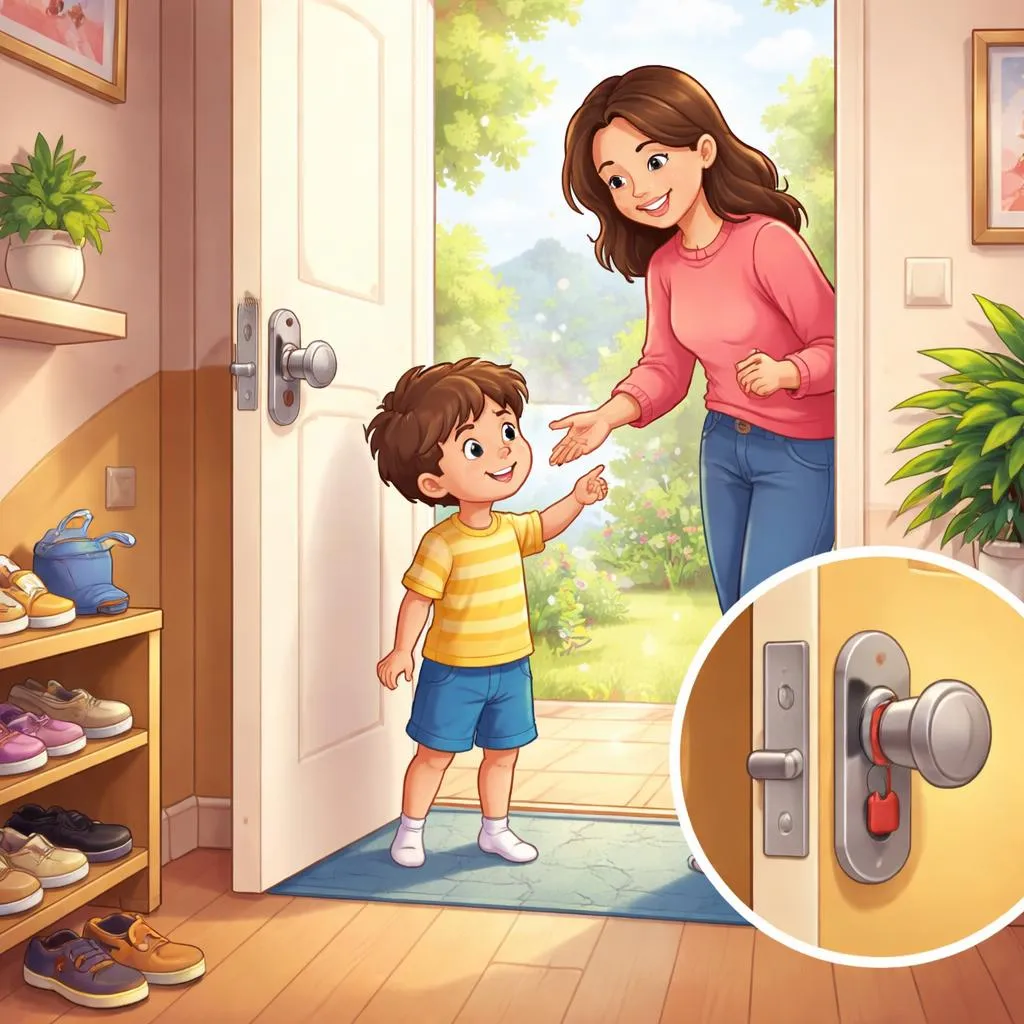
“Unlock the door” means “use a key or turn a lock to make the door able to open.” The door is locked first. You must unlock it before you can open it.
For a child, think of a door with a keyhole. “Unlock the door” says “Put the key in and turn it. Then you can open it.” Both phrases are about doors. Both mean “let me in.” They seem similar because people sometimes unlock a door and then open it. Yet one is for any closed door. One is only for locked doors.
What’s the Difference? The main difference is locked or not. “Open the door” works for any closed door, locked or unlocked. But if it is locked, you must unlock it first. “Unlock the door” only works when the door is locked. It means to remove the lock.
Another difference is steps. “Open the door” is one step. Turn handle. Push or pull. “Unlock the door” is the first step. Then you still need to open it.
One more difference is urgency. “Open the door” is common. “Unlock the door” suggests the door is locked, so you cannot get in.
Also, “unlock” requires a key or code. “Open” requires only a handle.
Teach children that both are about doors. One is for any closed door. One is for locked doors specifically.
When Do We Use Each One? Use “Open the door” for any door that is closed but not locked. “Please open the door. I am coming in.” “Open the door so the cat can come inside.”
Use “Open the door” when you do not know if it is locked. If it is locked, the person will say “I cannot. It is locked.”
Use “Open the door” for car doors. “Open the car door and get in.”
Use “Unlock the door” when you know it is locked. “Unlock the front door. I forgot my keys.” “Unlock the bathroom door. The baby locked it by accident.”
Use “Unlock the door” for safety. “Unlock the door so we can get out quickly.” “Unlock the door for the guests.”
Use “Unlock the door” only when a key or code is needed.
Parents can model both. Say “open the door” for general entry. Say “unlock the door” when the lock is engaged.
Example Sentences for Kids Here are simple sentences children can say.
Open the door:
Please open the door for Grandma.
Open the door. The pizza is here.
Can you open the door? My hands are full.
Open the door slowly so it does not slam.
I opened the door and saw a package.
Unlock the door:
Unlock the door. I lost my key.
Please unlock the front door. The guests are waiting.
He unlocked the door with his key.
Unlock the door so we can leave.
She unlocked the door and then opened it.
Read these aloud. Notice how “open the door” is for any closed door. Notice how “unlock the door” means the door is locked.
Common Mistakes to Avoid Children make mistakes with these phrases. Here are common errors.
Mistake 1: Saying “unlock the door” when the door is not locked. “Unlock the door” when it is already unlocked confuses people. They will look for a key. Correct: Say “Open the door” for unlocked doors.
Mistake 2: Saying “open the door” when it is locked. “Open the door” on a locked door will not work. The person will try and fail. Correct: Say “Unlock the door first, then open it.”
Mistake 3: Forgetting that unlocking does not open. “Unlock the door” does not mean “open.” You must do both steps. Correct: Say “Unlock the door and then open it.”
Mistake 4: Using “unlock” for doors without locks. A tent flap has no lock. You cannot “unlock” it. Correct: Say “Open the tent.”
Mistake 5: Confusing “unlock” with “unlatch.” A latch is not a lock. “Unlatch” means lift the latch. “Unlock” means turn a key. Correct: Use the right word for the right fastener.
Easy Memory Tips Here are simple memory tricks.
Memory tip 1: Think of a knob and a key. “Open the door” uses the knob. Turn and pull. “Unlock the door” uses the key. Insert and turn.
Memory tip 2: Use your hands. Turn an imaginary knob for “open the door.” Pretend to insert and turn a key for “unlock the door.”
Memory tip 3: Ask “is it locked?” If yes, say “unlock the door” first. If no, say “open the door.”
Memory tip 4: Draw two pictures. A hand turning a knob = “open the door.” A hand putting a key in a lock = “unlock the door.”
Memory tip 5: Use the “step” test. Unlocking is step one. Opening is step two. Never skip step one if the door is locked.
Practice these tips at home. Check doors. Are they locked or just closed?
Quick Practice Time Try these exercises. Parents read aloud. Children answer.
Exercise 1: Choose the best phrase.
The front door is closed but not locked. You want your child to let you in. Do you say: a) Open the door b) Unlock the door
The bathroom door is locked from the inside. Your toddler cannot get out. Do you say: a) Open the door b) Unlock the door
A car door is shut. You do not know if it is locked. Do you say: a) Open the door b) Unlock the door
Answers: 1(a), 2(b — then open it), 1(a — try opening first)
Exercise 2: Fill in the blank.
“Please __________. I am carrying groceries.” (door is closed, probably not locked)
“I forgot my keys. Can you __________?” (door is definitely locked)
Answers: 1. open the door, 2. unlock the door
Bonus: Play the “Locked or Not” game. Gather a few doors in your home (or pretend). Some locked, some not. The child says “open the door” or “unlock the door” based on the situation. Practice both steps for locked doors.
Wrap-up Use “open the door” for any closed door that is not locked, or when you do not know. Use “unlock the door” only when the door is locked and needs a key or code. Both are about entry. One is general. One is specific to locks. Teach children that opening a door is simple. Unlocking first takes an extra step. Safety matters. Always check if a door is locked before trying to open it. And never unlock a door for a stranger. That is the rule.