
Hands touch everything. Toys, food, faces. Two common phrases tell children to make hands clean. “Wash your hands” and “Clean your hands.” Both mean “remove dirt and germs from your hands.” But one means water and soap. One means any method. Parents and kids can learn together. Clean hands keep us healthy. The right words tell a child the best way. Let us explore these two hygiene expressions.
What Do These Expressions Mean? “Wash your hands” means “use water and soap to clean your hands.” You rub, rinse, and dry. This is the best way to remove germs.
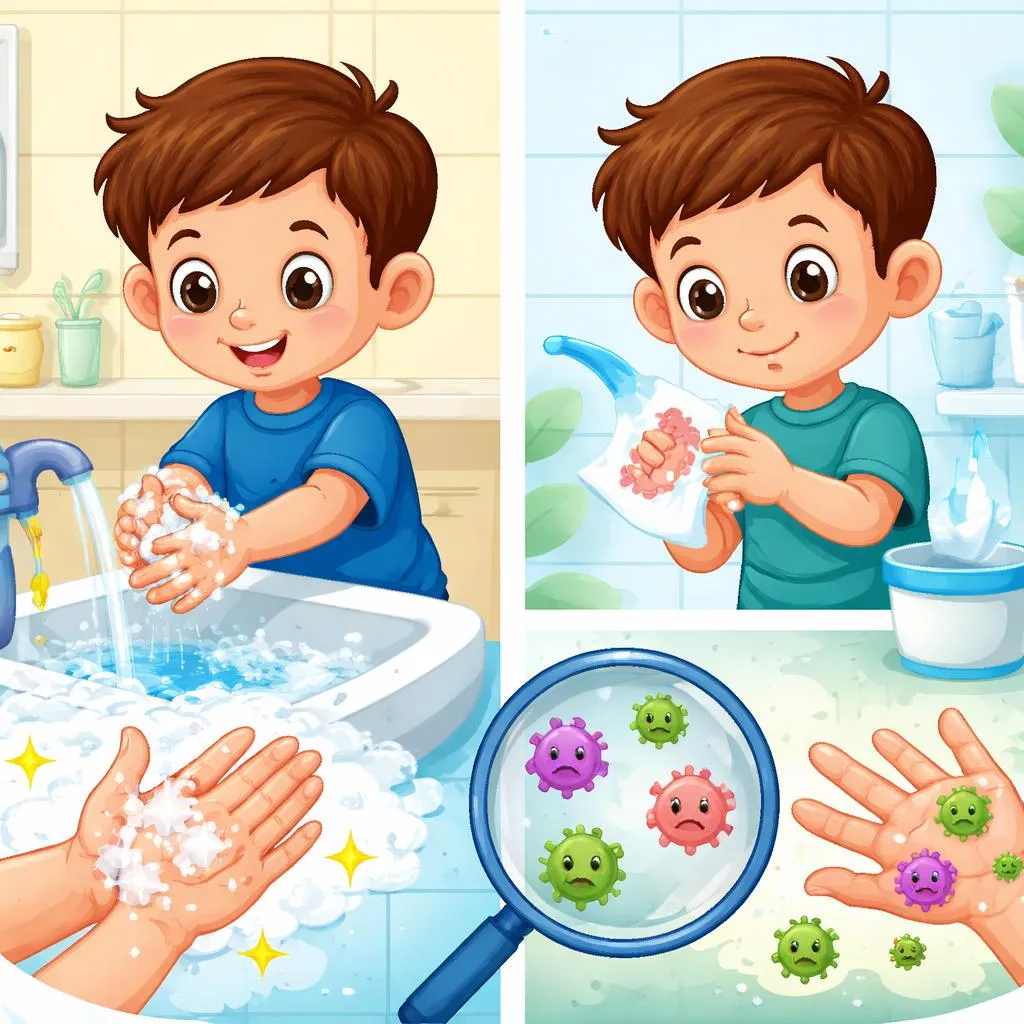
For a child, think of the sink. “Wash your hands” says “Turn on the water. Get soap. Scrub. Rinse. Dry.”
“Clean your hands” means “make your hands free of dirt or germs.” It can be done with soap and water, hand sanitizer, or a wipe. It is a more general phrase.
For a child, think of a wet wipe after a meal. “Clean your hands” says “Use this wipe to get the sticky stuff off.” Both phrases mean to remove dirt. Both say “make hands clean.” They seem similar because people use both when hands are dirty. Yet one means a full wash with soap and water. One means any cleaning method.
What’s the Difference? The main difference is method. “Wash your hands” specifically means soap and water. It is the gold standard for killing germs. “Clean your hands” is general. It could be soap, sanitizer, or wipes.
Another difference is effectiveness. Washing with soap and water is best for germs like flu and stomach bugs. Sanitizer or wipes are not as good.
One more difference is context. A parent says “Wash your hands” before meals or after the bathroom. “Clean your hands” might be said after playing with playdough or eating a sticky snack.
Also, “wash” implies using a sink. “Clean” can be anywhere with a wipe or sanitizer.
Teach children that both make hands clean. One is the best way. One is for quick touch-ups.
When Do We Use Each One? Use “Wash your hands” for health reasons. “Wash your hands before dinner.” “Wash your hands after using the bathroom.” “Wash your hands after coughing.”
Use “Wash your hands” when soap and water are available. “Go to the sink and wash your hands.”
Use “Wash your hands” for the most germy situations. “You touched the trash. Wash your hands.”
Use “Clean your hands” for quick cleaning. “Here is a wipe. Clean your hands.” “Clean your hands with sanitizer before we get in the car.”
Use “Clean your hands” when soap and water are not available. “We are at the park. Use this wipe to clean your hands.”
Use “Clean your hands” for non-germy dirt like paint or mud. “Clean your hands with a paper towel.”
Parents can model both. Say “wash your hands” for serious hygiene moments. Say “clean your hands” for quick touch-ups.
Example Sentences for Kids Here are simple sentences children can say.
Wash your hands:
Please wash your hands before eating.
Wash your hands after you sneeze.
I washed my hands with soap and warm water.
Always wash your hands after playing outside.
She washed her hands for 20 seconds.
Clean your hands:
Here is a wipe. Clean your hands.
Clean your hands with sanitizer before we go in.
I cleaned my hands after painting.
Please clean your hands. They are sticky.
He cleaned his hands with a napkin.
Read these aloud. Notice how “wash your hands” is for serious hygiene. Notice how “clean your hands” can be quick or for dirt.
Common Mistakes to Avoid Children make mistakes with these phrases. Here are common errors.
Mistake 1: Saying “clean your hands” when they need to wash. After the bathroom, “clean your hands” is not enough. They need soap and water. Correct: Say “Wash your hands with soap.”
Mistake 2: Saying “wash your hands” when a wipe is fine. For a little paint, “wash your hands” is fine but a wipe works too. Not a big mistake. Correct: Both work. But “clean” is lighter.
Mistake 3: Forgetting the steps of washing. Wet, soap, scrub 20 seconds, rinse, dry. Correct: Teach the full routine.
Mistake 4: Using sanitizer when hands are visibly dirty. Sanitizer does not remove mud or food. Correct: Wash with soap and water for visible dirt.
Mistake 5: Not drying hands after washing. Wet hands spread germs more easily. Correct: Always dry with a clean towel.
Easy Memory Tips Here are simple memory tricks.
Memory tip 1: Think of a faucet and a wipe. “Wash your hands” is a faucet. Soap and water. “Clean your hands” is a wipe. Quick clean.
Memory tip 2: Use your hands. Pretend to scrub with soap for “wash your hands.” Pretend to wipe with a cloth for “clean your hands.”
Memory tip 3: Ask “Is this for germs or just dirt?” Germs = “wash your hands.” Dirt or stickiness = “clean your hands.”
Memory tip 4: Draw two pictures. A child at a sink with soap bubbles = “wash your hands.” A child using a wipe = “clean your hands.”
Memory tip 5: Use the “before eating” test. Before eating, always say “wash your hands.” After playing with clay, say “clean your hands.”
Practice these tips after bathroom and before meals. Make handwashing a habit.
Quick Practice Time Try these exercises. Parents read aloud. Children answer.
Exercise 1: Choose the best phrase.
Your child just used the bathroom. Do you say: a) Wash your hands b) Clean your hands
Your child has sticky jam on their fingers from a snack. A wipe will work. Do you say: a) Wash your hands b) Clean your hands
Your child touched a dirty trash can. Do you say: a) Wash your hands b) Clean your hands
Answers: 1(a), 2(b), 3(a)
Exercise 2: Fill in the blank.
“Please __________ before you touch your baby brother.” (serious, for germ removal)
“Here is a sanitizer wipe. __________.” (quick clean, no sink around)
Answers: 1. wash your hands, 2. Clean your hands
Bonus: Play the “Germ or Dirt” game. Name a situation. “After the bathroom.” “After playing with mud.” “Before eating apple slices.” “After sneezing into your hand.” The child says “wash your hands” (germs) or “clean your hands” (dirt or less serious). Discuss why.
Wrap-up Use “wash your hands” for serious germ removal with soap and water, especially before meals, after the bathroom, and after coughing or sneezing. Use “clean your hands” for quick touch-ups with wipes or sanitizer, or for removing non-germy dirt like paint or food. Both keep hands clean. One is the gold standard. One is for convenience. Teach children that washing hands saves lives. It is a superpower. Soap and water for 20 seconds. Every time. Clean hands, happy hands. Now go wash up. It is time.