
Not everything needs a lot. Sometimes children want less. Less noise. Less homework. Less sugar. Two common phrases describe a smaller quantity. “Less” and “A smaller amount.” Both mean “not as much.” But one is short and everyday. One is longer and more precise. Parents and kids can learn together. Asking for less shows self-control. The right words make your request clear. Let us explore these two reduction expressions.
What Do These Expressions Mean? “Less” means “a smaller amount or degree.” It is the opposite of “more.” One word. Simple. It works for things you cannot count one by one.
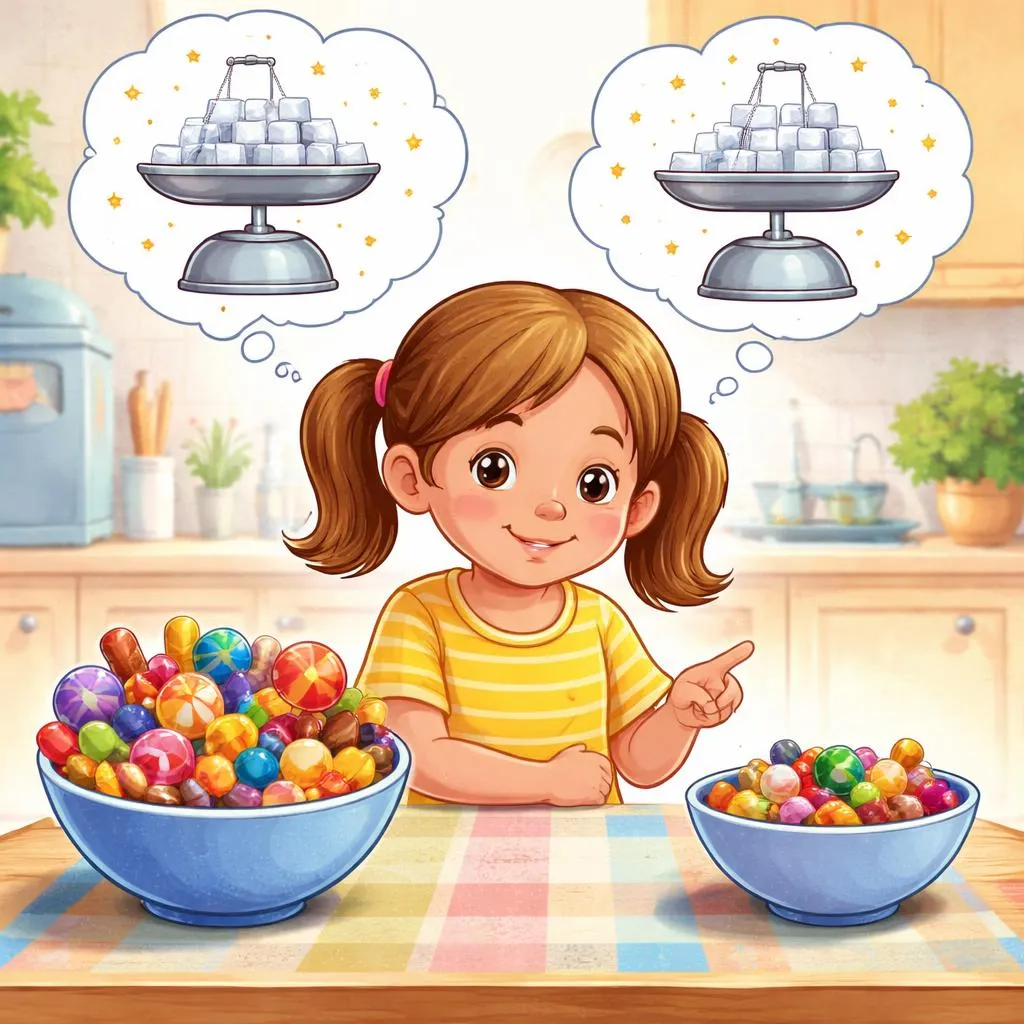
For a child, think of pouring juice. “Less” says “Do not fill it so much. Give me a smaller portion.”
“A smaller amount” also means “not as much.” It is more specific. “Amount” means quantity. The phrase makes the idea of “less” very clear.
For a child, think of a measuring cup. “A smaller amount” says “Use the cup to measure. Put in less than before.” Both phrases mean reduced quantity. Both say “not more.” They seem similar because people use both when they want to decrease something. Yet one is one word. One is three words.
What’s the Difference? The main difference is word count. “Less” is one word. Quick and easy. Children learn it early. “A smaller amount” has three words and more syllables. It takes longer to say.
Another difference is formality. “Less” is casual and everyday. You use it at home, at school, anywhere. “A smaller amount” sounds more careful or formal. You might see it in cooking recipes or science experiments.
One more difference is grammar. “Less” can be an adjective, adverb, or noun. “Less sugar” (adjective). “Eat less” (noun). “Less quickly” (adverb). “A smaller amount” is a noun phrase. It cannot modify a noun directly. You cannot say “a smaller amount sugar.” You need “of.” “A smaller amount of sugar.”
Also, “less” works with uncountable nouns. “Less water.” “A smaller amount” also works with uncountable nouns but is wordier.
Teach children that both mean smaller quantity. One is for quick talk. One is for precise description.
When Do We Use Each One? Use “Less” for everyday requests. “Can I have less ice?” “Please add less salt.” “I want less screen time.” It is natural and kind.
Use “Less” for comparisons. “This box weighs less than that one.” “She eats less than her brother.” “Less” is perfect here.
Use “Less” as a short answer. “Sugar?” “Less, please.” Quick and clear.
Use “A smaller amount” for formal or careful speech. “The recipe calls for a smaller amount of oil.” “Use a smaller amount of glue on this project.”
Use “A smaller amount” in writing. “A smaller amount of pollution is better for the environment.” It sounds more formal than “less.”
Use “A smaller amount” when teaching measurement. “A smaller amount means fewer ounces. Let us measure.”
Parents can model both. Say “less” for daily talk. Say “a smaller amount” for recipes or science.
Example Sentences for Kids Here are simple sentences children can say.
Less:
Please put less syrup on my pancakes.
I have less homework today than yesterday.
Less noise, please. The baby is sleeping.
This backpack weighs less than my old one.
Eat less candy before dinner.
A smaller amount:
The recipe needs a smaller amount of sugar.
Use a smaller amount of paint on your brush.
A smaller amount of water will make the soup thicker.
He asked for a smaller amount of ice in his drink.
A smaller amount of force will not break the toy.
Read these aloud. Notice how “less” is shorter and more common. Notice how “a smaller amount” sounds more precise and careful.
Common Mistakes to Avoid Children make mistakes with these phrases. Here are common errors.
Mistake 1: Using “less” with countable nouns in formal writing. “Less cookies” is common in speech but “fewer cookies” is correct for countable things. Correct: In formal writing, use “fewer” for things you can count. Use “less” for uncountable.
Mistake 2: Saying “a smaller amount of” before a countable noun. “A smaller amount of cookies” is awkward. Use “fewer cookies.” Correct: “A smaller amount of sugar” (uncountable). “Fewer cookies” (countable).
Mistake 3: Forgetting “of” after “amount.” “A smaller amount sugar” is wrong. Correct: Say “a smaller amount OF sugar.”
Mistake 4: Using “a smaller amount” when “less” is simpler. “I want a smaller amount of juice” is fine but long. “I want less juice” is better. Correct: In everyday speech, use “less.”
Mistake 5: Confusing “less” with “lesser.” “Lesser” means not as good or important. “That is a lesser problem.” Correct: “Less” for quantity. “Lesser” for quality.
Easy Memory Tips Here are simple memory tricks.
Memory tip 1: Think of a quick wave and a measuring cup. “Less” is a quick wave of the hand. Less, please. “A smaller amount” is a measuring cup. Exact and careful.
Memory tip 2: Use your hands. Move your hand downward for “less” (reducing). Pinch your fingers together for “a smaller amount” (tiny quantity).
Memory tip 3: Ask “am I in a hurry?” If yes, say “less.” If you have time to be precise, say “a smaller amount.”
Memory tip 4: Draw two pictures. A glass half empty with an arrow down = “less.” A measuring cup with a line lower than before = “a smaller amount.”
Memory tip 5: Use the “countable” test. For uncountable things (water, sugar, time), use “less” or “a smaller amount.” For countable things, use “fewer” or “a smaller number of.”
Practice these tips during meals. Ask for less of something.
Quick Practice Time Try these exercises. Parents read aloud. Children answer.
Exercise 1: Choose the best phrase.
You want a smaller portion of mashed potatoes. Mashed potatoes are uncountable (you say “less potatoes” in speech). Do you say: a) Less potatoes b) A smaller amount of potatoes
You are following a science experiment. The instructions need to be precise. Do you say: a) Use less vinegar b) Use a smaller amount of vinegar
You want fewer cookies. Countable. Do you say: a) Less cookies b) Fewer cookies
Answers: 1(a or b — both fine, “less” is shorter), 2(b — more precise), 3(b)
Exercise 2: Fill in the blank.
“Please add __________ salt to the soup.” (everyday)
“The directions say to add __________ of liquid.” (formal, measurement)
Answers: 1. less, 2. a smaller amount
Bonus: Play the “Countable or Uncountable” game. Name a noun. “Water.” “Cookies.” “Time.” “Toys.” The child says “less” or “a smaller amount” for uncountable, and “fewer” or “a smaller number of” for countable. Learn the difference.
Wrap-up Use “less” for everyday requests and comparisons with uncountable nouns. Use “a smaller amount” for formal or precise descriptions, especially in recipes or science. Both mean a smaller quantity. One is quick and common. One is careful and exact. Teach children that sometimes less is better. Less mess. Less noise. Less worry. And a smaller amount of candy can still be a treat.