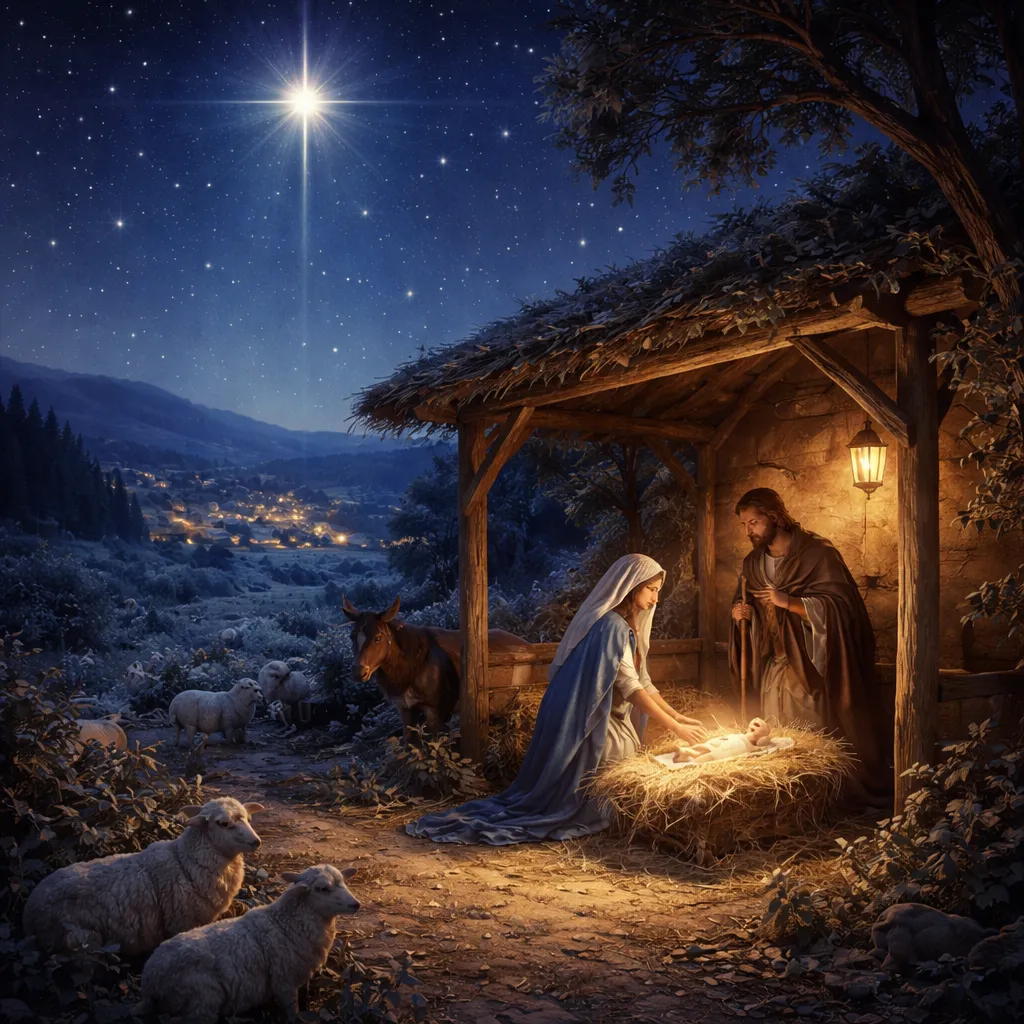

Think of the quietest, calmest night you can remember. Maybe it was a night with fresh snow, where every sound was soft. In a small village a long time ago, someone tried to describe the most peaceful night of all in a song. It’s a song so gentle and beautiful that it is now sung by people in hundreds of languages. Let’s learn about the carol “Silent Night.”
About the Song
Let’s read the beautiful, peaceful words of the first verse and chorus.
Silent night, holy night,
All is calm, all is bright.
Round yon Virgin Mother and Child,
Holy Infant so tender and mild,
Sleep in heavenly peace,
Sleep in heavenly peace.
This song is a world-famous Christmas carol. It is a gentle, lullaby-like poem that paints a picture of the quiet, holy night when Jesus was born. The song is originally from Austria, and its original language is German. The German title is “Stille Nacht, heilige Nacht.” It was written by Joseph Mohr and composed by Franz Gruber in 1818. The English version we sing today is a translation of those original German words. The song tells the story of the Nativity—the birth of Jesus—focusing on the peace, calm, and sacred light of that moment.
What the Song is About
The song paints a picture of deep peace and gentle light. First, it describes the night itself. It is silent. It is holy, or sacred. Nothing is moving or making noise; everything is calm. Yet, it is not a dark night. A soft, bright light glows, making everything visible and beautiful.
The light shines on a specific scene. We see a young mother, Mary, and her newborn baby, Jesus. They are in a simple stable. The song calls the baby a “Holy Infant,” who is “tender and mild”—meaning very gentle, soft, and kind. The mother is looking at her sleeping child. The whole scene is so peaceful that the singer whispers a wish for the baby: “Sleep in heavenly peace.” The song continues to describe shepherds who are amazed by the sight and the sound of angels singing about the newborn king.
Who Made It & Its Story
The creators of “Silent Night” are known. The words were written as a poem by a young Austrian priest named Joseph Mohr. The music was composed by his friend, the schoolteacher and church organist Franz Gruber. The story goes that on Christmas Eve in 1818, in the village of Oberndorf, the church organ was broken. Joseph Mohr gave his poem to Franz Gruber and asked him to write a simple melody that could be played on a guitar. That night, the two men sang “Stille Nacht” for the first time at the Christmas Mass, with Gruber playing guitar. Its simple beauty moved everyone.
This carol became a global symbol of peace for three profound reasons. First, its melody is incredibly simple, slow, and soothing. It feels like a lullaby for the whole world, easy for anyone to sing and remember. Second, its message is universal. It speaks of peace, calm, and holy light—feelings that people of all cultures and languages understand and long for, especially at Christmas. Third, it has a true and touching story of creation from a small village, which adds to its magic. It is even considered an intangible cultural heritage by UNESCO.
When to Sing It
This song is perfect for moments of quiet reflection and family closeness. You can sing it softly by the light of your Christmas tree on Christmas Eve, as a special, calm tradition. You can sing it as a lullaby to a younger sibling or while looking at a Nativity scene. You can also hum it during a quiet winter evening, looking out at a still, starry night, connecting the song’s peace to the peace in your own home.
What Children Can Learn
This gentle carol is a deep well of learning. Let’s explore the quiet beauty of its lessons.
Vocabulary
The song teaches us rich, descriptive words about feelings and scenes. “Silent” means completely quiet, with no noise. “Holy” means connected to God or a god, sacred and special. “Calm” means peaceful and still, not wild or upset. “Bright” means full of light. “Yon” is an old word for “that” or “those over there.” “Virgin” refers to Mary, the mother of Jesus. “Tender” means gentle, soft, and kind. “Mild” means not harsh or strong. “Heavenly” means like heaven, wonderfully beautiful and peaceful.
Let’s use these words! You can say, “The library was silent.” Or, “We visited a holy place.” You might describe a moment: “The pond was calm and bright in the morning sun.” New word: Sacred. This means connected with God or dedicated to a religious purpose, and so deserving great respect. The night was a sacred time.
Language Skills
This song is a masterful lesson in using adjectives to create a strong mood and picture. Adjectives are words that describe nouns (people, places, or things). The song is filled with powerful, paired adjectives that set the scene.
Look at the title: “Silent night, holy night.” Two adjectives describe the same noun (“night”) to build a deep feeling. The line “All is calm, all is bright” uses adjectives to describe the state of everything. Then, it describes the infant with two more adjectives: “tender and mild.” Using adjectives in pairs like this makes the description much richer and more poetic. It teaches us how to build atmosphere with our words.
Sounds & Rhythm Fun
Listen to the slow, flowing, and peaceful melody. The song does not have strong, bold rhymes. Instead, it uses soft, vowel-rich sounds that blend together, like “night”/“bright”/“mild”/“Child.” The words themselves sound calm.
The rhythm is a slow, steady, gentle rocking in 6/8 time. It feels like a peaceful heartbeat or a slow sway. Try swaying very slowly: SI-lent NIGHT, HO-ly NIGHT. The melody uses a very limited range of notes and moves step-by-step, which is why it is so easy to sing even for a beginner. This lullaby rhythm is what makes the song so hypnotically peaceful and easy to memorize. You can write your own peaceful scene song! Use the same gentle, rocking rhythm. Try: “Quiet morn, dewy morn, all is fresh, all is reborn. Round the garden flowers wild, colors tender, sweet and mild, grow in morning sun, grow in morning sun.”
Culture & Big Ideas
“Silent Night” is a key part of Christmas celebrations worldwide, but it holds a special place as a cultural treasure of Austria. It represents the core of the Christmas story from the Christian tradition. The song’s journey from a small Austrian village to the entire world, especially its famous Christmas Eve truce during World War I when soldiers from both sides sang it together, shows its incredible power as a universal symbol of peace and shared humanity.
The song conveys three deep and timeless ideas. First, it’s about profound peace. It’s not just the absence of noise, but a deep, heavenly calm that can exist even in a simple stable. Second, it celebrates sacred, humble beginnings. Great joy and hope can begin in the quietest, most ordinary places. Third, it is about hope and light in darkness. The “bright” light in the silent night symbolizes hope, love, and goodness coming into the world.
Values & Imagination
Let your imagination travel to that stable in Bethlehem. What does the “heavenly peace” feel like? Is the air cool and still? What is the source of the “bright” light? A special star? A heavenly glow? What do the animals in the stable look like? Are they quiet too? Imagine you are a shepherd on a nearby hill, seeing this light. What do you feel? Wonder? Awe? Peace? Draw the scene with soft colors. Show the mother, the child, the gentle animals, and the light that makes the night “bright.”
The song inspires us to find and create moments of peace. A beautiful idea is to create a “Silent Night Moment” with your family. One evening, turn off all the electric lights. Light a single candle or use a small flashlight. Sit together in the quiet, soft light for just two minutes. Then, whisper-sing the first verse of “Silent Night.” This helps you feel the calm the song describes and teaches the value of quiet togetherness.
So, as we finish our time with this quiet carol, think about the stillness it carries. It carries the stillness of an Austrian village in 1818. It carries the stillness of a holy story from 2,000 years ago. It carries the stillness that we can find in our own hearts if we listen. “Silent Night” is more than a Christmas song. It is a language lesson in descriptive, beautiful words. It is a music lesson in the power of a simple, slow melody. It is a history lesson in peace and shared humanity. From the first hushed “Silent night” to the final wish for “heavenly peace,” it wraps its listeners in a feeling so gentle and strong that it has comforted the world for over two hundred years.
Your Core Takeaways
You are now a friend to the carol “Silent Night.” You know it was written in Austria in 1818 by Joseph Mohr and Franz Gruber. You’ve learned rich words like “holy,” “calm,” and “tender,” and you’ve seen how powerful paired adjectives can be. You’ve felt its gentle, lullaby rhythm and created your own peaceful verse. You’ve also discovered the song’s deep messages about sacred peace, humble hope, and its incredible power as a worldwide symbol of comfort and light in the darkness.
Your Practice Missions
First, host a “Stille Nacht” concert. Gather your family. Turn the lights down low. Sing the first verse of “Silent Night” in English. Then, listen to a recording of it sung in its original German (“Stille Nacht, heilige Nacht”). Try to hum along with the German melody. Notice how the same feeling of peace comes through, even in a different language.
Second, draw or build a “Silent, Holy, Calm, Bright” scene. The song describes a scene with four key feelings. On paper or using toys and blocks, create a scene that shows all four. It could be the Nativity, a snowy forest at night, or a cozy room. Label the parts: what is silent? (The sleeping animals). What is holy? (The mother and child). What is calm? (The still air). What is bright? (The star above). Present your scene to your family, explaining your choices.