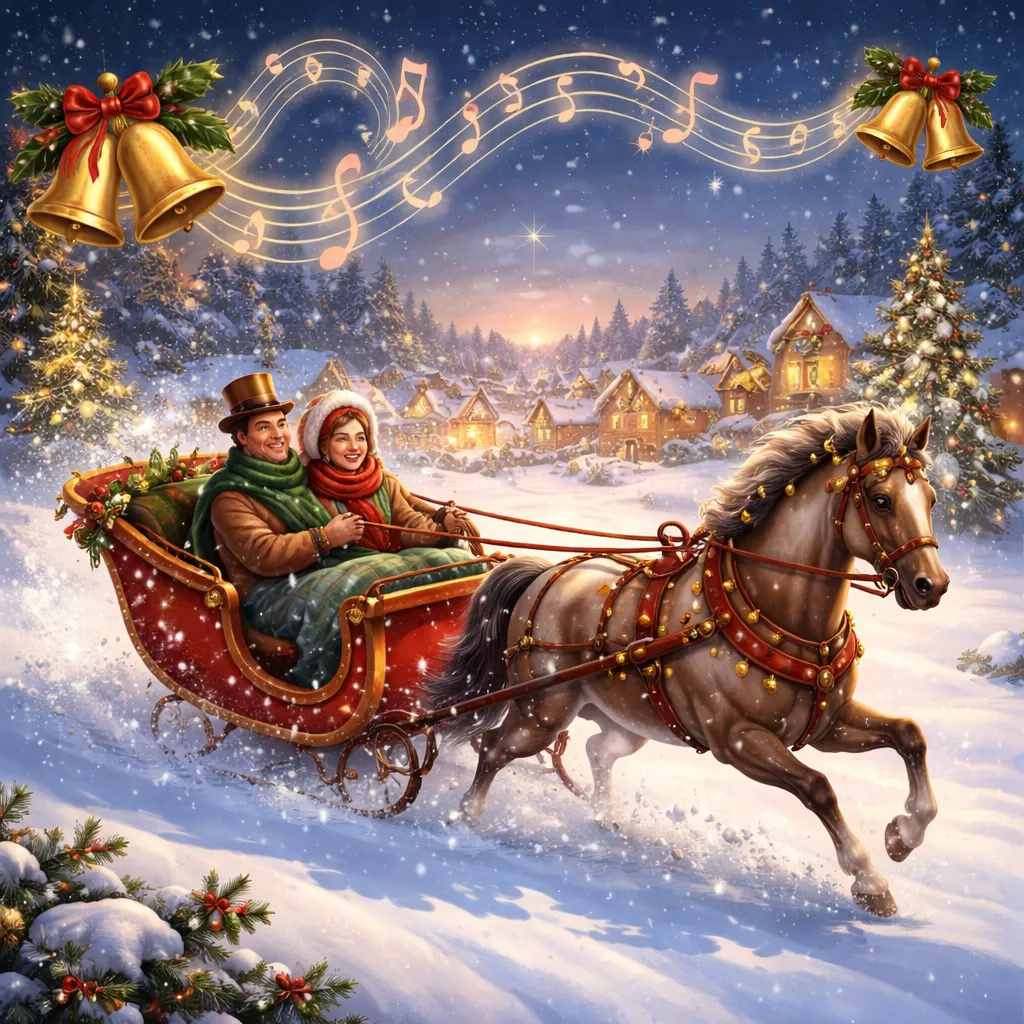

When winter comes and the air gets chilly, do you sometimes hear a ringing, jingling sound? Maybe on a decoration, in a store, or even in a holiday movie! That cheerful jingle is the sound of bells, and it’s the star of one of the most famous songs ever sung. People all over the world know and love the happy tune of “Jingle Bells.” But have you ever wondered where this song about dashing through the snow really came from?
About the Song
Let’s start by singing the most famous part of the song together—the chorus!
Jingle bells, jingle bells,
Jingle all the way!
Oh, what fun it is to ride
In a one-horse open sleigh!
Jingle bells, jingle bells,
Jingle all the way!
Oh, what fun it is to ride
In a one-horse open sleigh!
And here is the first verse that tells the story:
Dashing through the snow
In a one-horse open sleigh,
O’er the fields we go,
Laughing all the way.
Bells on bobtail ring,
Making spirits bright;
What fun it is to ride and sing
A sleighing song tonight!
This song is a classic American winter and holiday song. It is a lively, energetic tune that paints a picture of a fun, fast sleigh ride through a snowy landscape. The song was originally written and composed by an American named James Lord Pierpont in 1857. It was first published under the title “One Horse Open Sleigh” and was meant to be sung for a Thanksgiving church concert in Massachusetts, USA. It wasn’t even a Christmas song at first! But its joyful tune and wintry theme soon made it a favorite for Christmas celebrations too. So, when you sing “Jingle Bells,” you are singing a piece of American history from over 160 years ago!
What the Song is About
The song creates a vivid, exciting scene. Imagine a cold, bright winter’s day. The ground is covered in clean, white snow. A sleek, fast horse is harnessed to a simple wooden sleigh with no roof—an “open sleigh.” The horse has a “bobtail,” which means its tail is cut short to avoid getting tangled.
A group of friends or family bundles up in warm coats and blankets. They climb into the sleigh. The driver gives a shout, and the horse takes off, dashing quickly over the smooth snow. They speed across open fields, the cold wind on their faces. Everyone is laughing and happy. Tied to the horse’s harness are small, shiny bells that jingle and ring with every step the horse takes. This cheerful ringing sound fills the air and makes everyone’s “spirits bright,” meaning it makes them feel joyful and excited. They ride and sing a “sleighing song”—which is the very song we are singing about them!
Who Made It & Its Story
The man who gave us “Jingle Bells” was James Lord Pierpont. He was a musician and songwriter born in New England, USA. In the 1850s, he was the organist at a church in Savannah, Georgia, but he wrote the song for a Thanksgiving program at his father’s church in Boston. The song was an instant hit with the children who performed it. It was published in 1857 and quickly became popular across America.
This song became a global favorite for three main reasons. First, its melody is incredibly catchy, bouncy, and easy to remember and sing, even for very young children. Second, it captures a universal feeling of simple, pure joy—the thrill of speed, the beauty of winter, and the happiness of being with friends. Third, it is not strictly about Christmas; it’s about winter fun, so people in many countries with snowy winters can enjoy it as part of their own winter festivals, making it a truly international song of celebration.
When to Sing It
This song is perfect for any festive, fun moment. You can sing it loudly in the car with your family while on a trip to see holiday lights. You can sing it while building a snowman or having a snowball fight, replacing “dashing through the snow” with your own actions. You can also sing it as you help decorate your home, shaking a string of bells to the “jingle all the way” part.
What Children Can Learn
This joyful winter anthem is packed with exciting things to learn. Let’s hop on our imaginary sleigh and explore them all!
Vocabulary
The song teaches wonderful, descriptive words about winter travel. To “dash” means to move or run very quickly. A “sleigh” (pronounced “slay”) is a vehicle on runners, usually pulled by horses, for traveling over snow. “O’er” is a poetic, short way of saying “over.” A “bobtail” is a horse whose tail is cut short. “Spirits” here means feelings or mood; “making spirits bright” means making people feel happy and cheerful. “Sleighing” is the activity of riding in a sleigh.
Let’s use these words! You can say, “We watched the dog dash across the park.” Or, “The book had a picture of a beautiful horse-drawn sleigh.” You might explain, “The sunny day made our spirits bright.” New word: Harness. This is the set of straps and fittings by which a horse is fastened to a cart, sleigh, or plow. The bells were attached to the horse’s harness.
Language Skills
The song is a great example of using the present continuous tense to describe an action happening right now. This tense is formed with the verb “to be” (am, is, are) and a verb ending in “-ing.” It shows an action in progress.
Look at the first line: “Dashing through the snow.” The full idea is “We are dashing through the snow.” The “-ing” verb paints a live-action picture of the sleigh moving at high speed at that very moment. The song also uses the simple present tense for general truths: “Bells on bobtail ring,” and “What fun it is to ride.” This mix of tenses helps tell a lively story. The song also uses imperative verbs in the chorus: “Jingle all the way!” This is a command, telling the bells (and us!) to keep jingling.
Sounds & Rhythm Fun
Listen to the infectious music of the song. The most famous sound is the onomatopoeia in the word “jingle”—it sounds like the actual noise bells make! The song uses wonderful rhyme: “snow” and “go,” “way” and “sleigh,” “ring” and “sing,” “bright” and “tonight.”
The rhythm is bouncy, quick, and full of energy, like the trotting of a horse. Try clapping in time: DASH-ing THROUGH the SNOW, in a ONE-horse O-pen SLEIGH. The melody jumps up and down, making it fun and easy to sing with gusto. This energetic, trotting rhythm is what makes the song so memorable and why it gets stuck in your head—it feels like you’re on the ride yourself! You can write your own adventure song! Use the same bouncy rhythm. Try: “Running through the park, on a sunny summer day, over the grass we go, laughing all the way! Friends on bikes ring, making spirits high; what fun it is to play beneath the blue sky!”
Culture & Big Ideas
“Jingle Bells” gives us a fun look at American life in the 1800s. Before cars, sleighs were a common way to get around in snowy areas. Sleigh rides were a popular social activity for fun and not just travel. The song also shows how a piece of culture can travel and change. It started as a Thanksgiving song but was adopted by Christmas because it celebrated winter joy. Now it is sung globally, often as the first English Christmas song people learn.
The song shares three wonderful ideas. First, it’s about joy and lighthearted fun. In the middle of cold winter, the song focuses on laughter, speed, and music. Second, it celebrates friendship and togetherness. The singers are enjoying the ride as a group, sharing the experience. Third, it teaches appreciation for simple pleasures. You don’t need fancy toys; the simple thrill of a sleigh ride, the sound of bells, and a song to sing with friends are enough to create perfect happiness.
Values & Imagination
Climb into your own imaginary one-horse open sleigh! What color is your horse? Is it black, white, or brown? What is its name? How do the bells sound—a light tinkle or a loud jangle? What do you see as you dash over the fields? Snow-covered trees? A frozen pond? Are there other sleighs racing with you? Imagine the feeling: the cold air, the warm blankets, the sound of laughter mixing with the bells. Draw a detailed picture of your sleigh, your horse, your friends, and the winter landscape.
The song inspires us to find joy in our own seasons and to share that joy with others. A lovely idea is to create “Jingle Bell Joy” noisemakers. Take a few small jingle bells (or bottle caps, or beans in a closed container) and tie them to a ribbon or a stick. Decorate it. Then, use your noisemaker to accompany the song. You can also take it on a winter walk and shake it, spreading your own cheerful jingling sound, just like the bells on the bobtail.
This song, therefore, is much more than a holiday tune. It is a vocabulary lesson about winter travel. It is a grammar lesson in action and description. It is a music lesson in rhythm and onomatopoeia. From the first “dashing” to the final “hey!” it captures a moment of pure, shared happiness. “Jingle Bells” teaches us that songs can travel through time, that simple activities can be the most memorable, and that the sound of laughter and bells is a language everyone understands. It invites us all to climb aboard, join the ride, and jingle all the way into the winter season with bright spirits and full hearts.
Your Core Takeaways
You are now an expert on the song “Jingle Bells.” You know it was written in 1857 by James Lord Pierpont in America. You’ve learned words like “dash,” “sleigh,” and “bobtail,” and you’ve practiced using “-ing” verbs to describe action. You’ve felt its trotting, energetic rhythm and even created your own version. You’ve also explored how the song celebrates winter joy, friendship, and the simple, fun traditions of the past.
Your Practice Missions
First, be a sleigh ride conductor. Gather your family or a few friends. Sit in a row on a sofa or the floor as if you’re in a sleigh. One person is the driver at the front. Sing “Jingle Bells” at the top of your lungs. As you sing “dashing through the snow,” sway side to side as if moving. When you get to “jingle bells,” shake imaginary reins or a bell. Perform the whole song with actions!
Second, design the ultimate “One-Horse Open Sleigh.” Using a cardboard box, paper, markers, and any craft materials, build a model sleigh. Don’t forget to make a horse (from paper or a toy) and attach some bells (or drawn bells) to it. Once it’s built, place a small toy figure inside and give your sleigh a name. Then, give a tour of your sleigh to someone, using at least five words from the song, like: “This is my one-horse open sleigh. The horse has a bobtail. We will dash over the fields!”