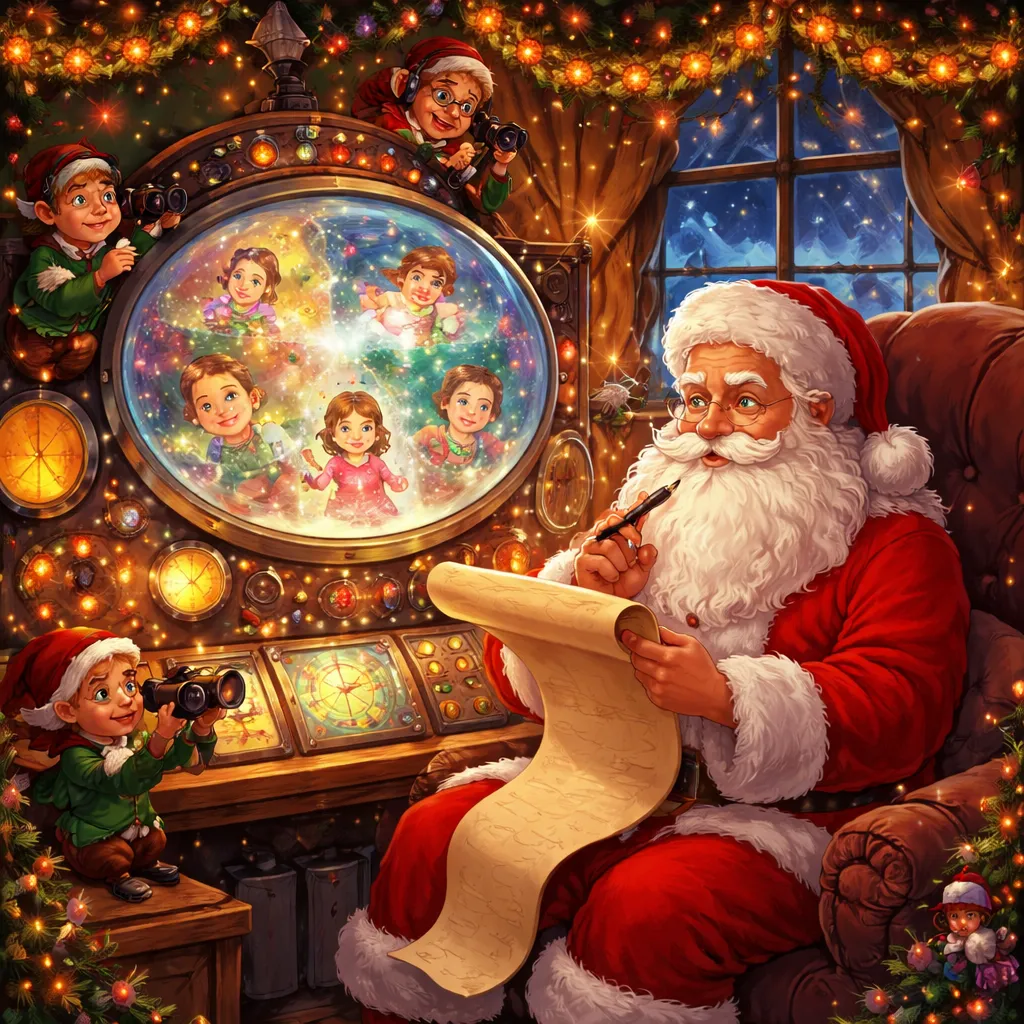

The weeks before Christmas are full of whispers and wonder. Children everywhere feel a special kind of excitement mixed with a tiny bit of worry. Will I get the gift I want? Am I on the "good" list? There is a famous, playful song that speaks directly to that feeling. It’s a cheerful warning and a joyful promise all in one. Let’s learn the song “Santa Claus Is Coming to Town.”
About the Song
Let’s read the fun and famous words to this classic tune.
You better watch out, you better not cry,
You better not pout, I’m telling you why:
Santa Claus is coming to town!
He’s making a list and checking it twice,
Gonna find out who’s naughty and nice.
Santa Claus is coming to town!
He sees you when you’re sleeping,
He knows when you’re awake.
He knows if you’ve been bad or good,
So be good for goodness sake!
Oh! You better watch out, you better not cry,
You better not pout, I’m telling you why:
Santa Claus is coming to town!
This song is a classic American Christmas song. It is a playful, slightly teasing tune that builds excitement for Christmas Eve. The song acts as a friendly reminder from an older sibling or parent, telling children that Santa is preparing for his visit and is watching their behavior. The song was written by John Frederick Coots and Haven Gillespie and was first performed on the radio in 1934. It quickly became a massive hit and is now one of the most famous and recognizable Christmas songs in the world. It perfectly captures the magical, slightly nervous anticipation that is part of the holiday tradition for many children.
What the Song is About
The song creates a vivid picture of Santa Claus as a magical, all-knowing figure who is getting ready for his big trip. First, the singer gives a playful warning. They tell children to “watch out,” and not to cry or pout. The reason? Because Santa Claus is on his way to their town.
Then, the song describes Santa’s preparations. He is in the North Pole, busy with a very important list. He is going over it carefully, not once but twice. The purpose of this list is to figure out which children have been “naughty” (behaving badly) and which have been “nice” (behaving well). The most magical part comes next. The song explains that Santa has a special, mysterious power. Even though he lives far away, he can see when children are sleeping. He knows when they are awake. Most importantly, he knows exactly if they have been “bad or good.” The song ends with a cheerful, repeated warning, mixing the threat of the list with the joyful news that Santa’s visit is near.
Who Made It & Its Story
The songwriters who created this holiday classic are Haven Gillespie (who wrote the words) and J. Fred Coots (who wrote the music). The story goes that Coots wrote the melody in 1934 and tried to sell it, but many publishers thought a song about a “fat man in a red suit” was silly for adults. His friend, lyricist Haven Gillespie, then wrote the famous words. The song was finally performed on Eddie Cantor’s national radio show in November 1934. It was an instant sensation, with orders for 100,000 copies of sheet music and 30,000 records the very next day.
This song became an enduring classic for three key reasons. First, its melody is incredibly catchy, bouncy, and fun to sing. Second, it brilliantly taps into the childhood experience of Christmas anticipation, mixing the excitement of Santa’s visit with a gentle nudge towards good behavior. Third, it creates a delightful and vivid mythology around Santa—the list, the checking, the all-seeing knowledge—that has become a central part of how many children imagine Santa’s Christmas preparations.
When to Sing It
This song is perfect for building holiday excitement. You can sing it with your family while decorating the Christmas tree, using it as a fun reminder to be careful with the ornaments! You can sing it playfully to a younger sibling who is about to have a tantrum, to make them laugh instead. You can also sing it on a car ride in December, looking out the window and wondering which house Santa will visit first.
What Children Can Learn
This anticipatory song is packed with fun and meaningful lessons. Let’s unwrap all the learning inside.
Vocabulary
The song teaches us great words about behavior and action. To “watch out” means to be careful. To “pout” means to push out your lips to show you are upset or annoyed. A “list” is a number of items written one after the other. “Naughty” means badly behaved. “Nice” means kind, polite, and well-behaved. “Gonna” is a casual way of saying “going to.” The phrase “for goodness sake” is an expression used to emphasize a request or a statement.
Let’s use these words! You can remind a friend, “Watch out for that puddle!” Or, “Don’t pout, we can play the game later.” You might say, “I made a list of things I need for school.” New word: Anticipation. This is a feeling of excitement about something that is going to happen. The song is full of Christmas anticipation.
Language Skills
This song is a fantastic lesson in using the future tense with ‘going to’ (gonna) and the present continuous tense to talk about the future. We use “be + going to + verb” to talk about plans or predictions. The song says, “He’s gonna find out who’s naughty and nice.” This is Santa’s plan.
The song also uses the present continuous for future arrangements: “Santa Claus is coming to town!” This tells us his arrival is a fixed, scheduled event. Additionally, the song uses the present simple tense to describe Santa’s general abilities: “He sees you when you’re sleeping. He knows when you’re awake.” This describes his permanent, magical power. Mixing these tenses helps tell a complete story about plans, schedules, and general truths.
Sounds & Rhythm Fun
Listen to the bouncy, marching rhythm of the song. The lyrics have a wonderful, simple rhyme scheme: “cry” and “why,” “pout” and “out,” “twice” and “nice,” “sleeping” and “awake” (a near-rhyme), and “good” and “goodness.” The repetition of the warning “You better watch out” makes it very catchy.
The rhythm is steady, upbeat, and slightly march-like, building excitement. Try clapping in time: You BET-ter WATCH out, you BET-ter not CRY. The melody is simple, repetitive, and easy to learn, with a little jump on “town!” that makes it fun to shout. This clear, strong rhythm and simple melody make the song incredibly easy to remember and sing along to, even for very young children. You can write your own “coming to town” song! Use the same bouncy rhythm. Try: “You better get ready, you better not sigh, the ice cream truck is coming by! It’s checking its route and loading its ice, gonna have every flavor that tastes so nice!”
Culture & Big Ideas
“Santa Claus Is Coming to Town” is a cornerstone of 20th-century American Christmas culture. It helped solidify the modern image of Santa as a kind, omniscient figure who rewards good behavior, a concept that blends folk traditions with modern parenting. The song reflects the cultural practice of using Santa as a gentle incentive for good behavior in the weeks leading up to Christmas, a tradition in many families.
The song explores three interesting ideas. First, it’s about accountability and consequences. The idea of a “list” connects actions (being naughty or nice) with outcomes (gifts), teaching about cause and effect in a simple, magical framework. Second, it deals with surveillance and judgment. The idea that Santa “sees” and “knows” plays on a child’s developing conscience, encouraging self-reflection. Third, it’s about the thrill of anticipation. The entire song is about the build-up to a big event, teaching that the waiting and preparation can be just as fun as the event itself.
Values & Imagination
Imagine you are at the North Pole. What does Santa’s list look like? Is it a long, scrolling piece of paper? A high-tech tablet? How does he “check it twice”? Does he use a magnifying glass? Imagine Santa’s magical ability to see children around the world. How does that work? A giant snow globe? A magical star? Do you think he ever laughs at the silly things he sees? Draw a picture of Santa in his workshop. Show him with his list, a twinkle in his eye, looking at a screen or globe that shows children sleeping and playing all over the world.
The song can inspire us to think about kindness and our actions. A lovely idea is to start a “Nice List Noticer” tradition. With your family, take a small notebook or a piece of paper taped to the fridge. In the weeks before Christmas, whenever you notice a family member doing something especially kind or helpful, write it down. “Today, Mom was nice because she read me an extra story.” “Today, my brother was nice because he shared his cookie.” This focuses on spotting the “nice” behavior the song mentions, turning it into a positive family activity.
This song, therefore, is much more than a holiday warning. It is a vocabulary lesson in behavior and anticipation. It is a grammar lesson in talking about future plans and general abilities. It is a music lesson in catchy, rhythmic fun. From the first playful “you better watch out” to the final shout of “town!”, it perfectly captures the bubbling, nervous, and utterly joyful excitement of waiting for Christmas. “Santa Claus Is Coming to Town” teaches that our actions matter, that waiting can be a game, and that a little bit of magical mystery makes the holiday season sparkle with extra wonder.
Your Core Takeaways
You are now an expert on the song “Santa Claus Is Coming to Town.” You know it was written in 1934 by Haven Gillespie and J. Fred Coots. You’ve learned words like “pout,” “naughty,” and “nice,” and you’ve practiced using “gonna” for future plans and the present continuous for scheduled events. You’ve felt its bouncy, warning rhythm and created your own version. You’ve also discovered how the song plays with ideas of accountability, anticipation, and the fun, magical mythology that makes Christmas so special for children.
Your Practice Missions
First, play the “Good List Detective.” The song says Santa is making a list. You be the detective! For one afternoon, quietly observe your family. Write down (or draw) three “nice” things you see them do. It could be sharing, helping, saying please and thank you, or cleaning up. At dinner, share your “Nice List Report” with them. This turns the song’s idea into a game of positive observation.
Second, compose a “Town Announcement.” The song announces that Santa is coming to town. Imagine a different special visitor is coming to your street or school. Write a short, four-line song to the tune of “Santa Claus is Coming to Town” to announce it. For example: “You better get ready, you better cheer loud, the book fair is coming, it’s drawing a crowd! It’s bringing new stories, adventures so grand, the book fair is coming to our school land!” Sing your announcement to your family.