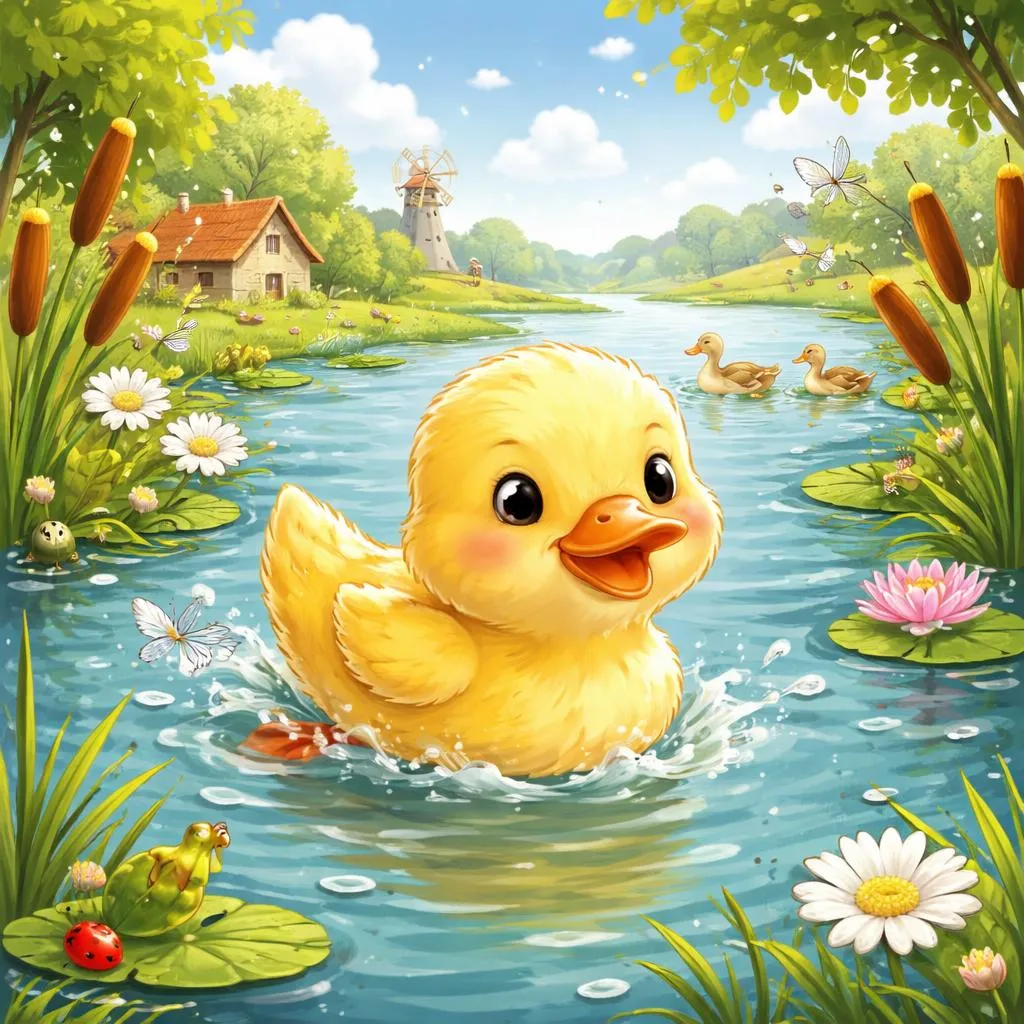

Have you ever waded in a puddle or taken a bath? The feeling of cool water is so much fun. Some animals get to play in the water all the time. In Germany, there is a happy, splashing song all about a little duck enjoying her favorite place. It is a song about water play. Let’s put on our imaginary flippers and learn the wet and wonderful song “The Little Duck (Die kleine Ente).”
About the Song
Here are the happy, bobbing lyrics of a beloved traditional German children’s song:
Die kleine Ente, die kleine Ente,
die schwimmt auf dem See, juchhe!
Die kleine Ente, die kleine Ente,
die taucht in den See, juchhe!
Sie paddelt mit den Füßchen klein,
im Wasser, das ist ihr Sonnenschein.
Die kleine Ente, die kleine Ente,
die ist so froh, so froh und frei.
English Translation:
The little duck, the little duck,
she swims on the lake, hooray!
The little duck, the little duck,
she dives into the lake, hooray!
She paddles with her little feet,
in the water, that is her sunshine.
The little duck, the little duck,
she is so happy, so happy and free.
This is a classic and joyful German-language song for children. The song is a celebration of a duck’s perfect day in the water. “The little duck, the little duck, she swims on the lake, hooray!” it begins, showing her floating happily. But she does not just stay on top. “The little duck, the little duck, she dives into the lake, hooray!” she goes under the water too. The song shows us how she moves. “She paddles with her little feet,” using her webbed feet like tiny oars. For her, the water is the best place. “In the water, that is her sunshine.” The song ends by telling us how she feels. “The little duck, the little duck, she is so happy, so happy and free.” The song is all about the joy of being in your favorite element.
What the Song is About
The song paints a picture of a duck’s perfect water play. Imagine a quiet, blue lake under a sunny sky. A little yellow duck with smooth feathers bobs on the gentle waves. “The little duck, the little duck, she swims on the lake, hooray!” She floats peacefully, carried by the water.
Then, with a flick of her head, she disappears! “The little duck, the little duck, she dives into the lake, hooray!” She plunges under the surface, exploring the cool, deep water below. Under the water, her feet are busy. “She paddles with her little feet,” moving them quickly to swim and dive. The water is her whole world of happiness. “In the water, that is her sunshine.” It is the place where she feels most like herself. When she pops back up, she is filled with joy. “She is so happy, so happy and free.” The song is about finding the place where you feel most alive, joyful, and completely yourself.
Who Made It & Its Story
“Die kleine Ente” is a popular traditional German folk song that celebrates nature, animals, and simple pleasures. Like many folk songs, its specific creator is unknown. It fits into a long tradition of German children’s songs that feature animals in their natural habitats, teaching kids about animal behavior in a fun, musical way. Ducks are common and beloved animals in German parks, ponds, and countryside rivers. The song reflects the German cultural enjoyment of spending time in nature (“Naturerlebnis”) and observing wildlife, as well as the value of feeling “frei” (free) and “froh” (happy).
This light, flowing song is loved for three delightful reasons. First, it is a wonderful way to learn key German action verbs and prepositions related to water and movement, like “schwimmt” (swims), “taucht” (dives), and “auf dem” (on the). Second, it has a bouncy, cheerful melody and the fun, shouting interjection “juchhe!” (hooray!), which makes it incredibly fun to sing with energy. Third, it beautifully expresses a feeling of pure joy, freedom, and being perfectly at home in your environment, a feeling every child can understand and enjoy.
When to Sing It
This song is perfect for any playful, wet, or free-feeling moment. You can sing it loudly while splashing in a bathtub or a swimming pool, pretending to be the duck paddling. You can chant it on a walk by a pond, lake, or river when you see real ducks swimming. You can also hum it while swinging on a swing, feeling the air whoosh past and pretending you are as “free” as the little duck in the water.
What Children Can Learn
This joyful, aquatic song is a wonderful teacher about animal actions, locations, and feelings in German.
Vocabulary
The song teaches us clear words for animals, actions, places, and feelings in German. “The” (Die). “Little” (kleine). “Duck” (Ente). “She” (die / sie). “Swims” (schwimmt). “On the” (auf dem). “Lake” (See). “Hooray” (juchhe!). “Dives” (taucht). “Into the” (in den). “Paddles” (paddelt). “With” (mit). “The” (den). “Little feet” (Füßchen klein). “In the” (im). “Water” (Wasser). “That is” (das ist). “Her” (ihr). “Sunshine” (Sonnenschein). “Is” (ist). “So” (so). “Happy” (froh). “And” (und). “Free” (frei).
Let’s use these words! You can describe an action: “Der Fisch schwimmt.” (The fish swims.) You can talk about a feeling: “Ich bin froh.” (I am happy.) New word: Wasservogel. This is the German word for “waterfowl” or “water bird,” a perfect word for our duck friend who loves the water.
Language Skills
This song is excellent for learning about describing where an action happens, using little words called prepositions like “auf” (on), “in” (in/into), and “mit” (with). The key phrases are “schwimmt auf dem See” (swims on the lake) and “taucht in den See” (dives into the lake).
Concept Definition: Words like “auf” (on), “in” (in/into), and “mit” (with) are prepositions. They are small but powerful words that tell us about location, direction, or connection. They answer questions like “Where?” or “With what?”. In the song, where does the duck swim? She swims on the lake (“auf dem See”). Where does she dive? Into the lake (“in den See”). With what does she paddle? With her little feet (“mit den Füßchen”).
Features and Types: Some prepositions tell us about a static location (where something is): “auf dem See” (on the lake). Some tell us about direction or movement towards a place: “in den See” (into the lake). Some tell us about using something or being together: “mit den Füßchen” (with her feet). Others you know are “unter” (under), “hinter” (behind), “bei” (at/near).
How to Spot Them: Here is a simple “where or with what?” trick. Ask two questions about the action. Question 1: “Wo?” or “Wohin?” (Where? / To where?). The little word that often comes before the answer is a preposition. Question 2: “Womit?” (With what?). The little word that often starts the answer is usually “mit.” The duck swims. Where? On the lake -> “auf dem See”. The duck dives. To where? Into the lake -> “in den See”. She paddles. With what? With her feet -> “mit den Füßchen”.
How to Use Them: A great way to build a detailed sentence is the “Action-Location-Tool Formula”. The pattern is: “[Subject] + [Action] + [Preposition] + [Place/Thing].”
Example from the song: “Die Ente schwimmt auf dem See.” (The duck swims on the lake.) “Die Ente paddelt mit den Füßen.” (The duck paddles with her feet.)
Example you can make: “Das Buch liegt auf dem Tisch.” (The book lies on the table.) “Ich springe in das Bett.” (I jump into the bed.) “Ich male mit dem Stift.” (I draw with the pen.)
Sounds & Rhythm Fun
Listen to the wavy, flowing rhythm of the melody. The song has a light, bobbing tune that sounds like gentle waves. The cheerful shout “juchhe!” is so fun to yell and adds a burst of energy. The repeated line “Die kleine Ente” starts each new idea, like the duck popping up for air.
The rhythm is smooth and flowing, perfect for making swimming motions with your arms. The sounds are soft and watery, with lots of “s” and “sch” sounds in “schwimmt,” “See,” and “Sonnenschein.” The phrase “so froh, so froh und frei” has a beautiful, open, happy feeling. This musical pattern is perfect for creating your own water animal song. You can write your own “Der kleine Fisch” (The Little Fish) song! Try: “Der kleine Fisch, der kleine Fisch, der schwimmt im Bach, juchhe! Der kleine Fisch, der kleine Fisch, der blubbert Luft, juchhe! Er glitzert in der Sonne sein, im Wasser, das ist sein Zuhause fein…” (The little fish… swims in the brook… bubbles air… he glitters in the sun, in the water, that is his fine home…)
Culture & Big Ideas
“Die kleine Ente” connects to the German love for lakes, rivers, and spending leisure time in nature, especially by the water (“am See”). Feeding ducks (“Enten füttern”) is a common and beloved activity for children in city parks. The song reflects the cultural appreciation for simple joys and the feeling of freedom (“Freiheit”) found in nature. The word “Sonnenschein” (sunshine) is also a common German term of endearment, like calling someone “my sunshine.”
The song conveys three wonderful, flowing ideas. First, it teaches empathy by imagining the world from an animal’s perspective, showing that water is a duck’s happy place, just like a playground might be for a child. Second, it celebrates the feeling of being perfectly at home and joyful in your favorite environment, whether that’s water, a treehouse, or a cozy reading nook. Third, it promotes a sense of freedom, happiness, and uncomplicated play, encouraging children to find and enjoy their own “Sonnenschein.”
Values & Imagination
Imagine you are the joyful “kleine Ente.” You glide into the cool, blue lake. “The little duck, the little duck, she swims on the lake, hooray!” you think, as you feel the water hold you up. You see something shiny below. “The little duck, the little duck, she dives into the lake, hooray!” You tuck your head and plunge into the quiet, underwater world.
You kick your feet. “She paddles with her little feet,” you move them back and forth, pushing yourself through the water. Everything feels right here. “In the water, that is her sunshine.” This is where you feel most like you, most alive. You pop back to the surface, shaking water droplets from your head. “She is so happy, so happy and free.” How does the cool water feel on your feathers? What do you see under the surface? Draw the little duck’s happy place. Draw a big, blue lake. Draw a happy duck swimming on top. Draw another version of the same duck diving underwater with bubbles around it. Draw a big, smiling sun in the sky. This shows the song’s feeling of watery joy and freedom.
The song encourages us to think about what makes us feel as happy and free as the duck in the water. It teaches us to appreciate different animals’ favorite habitats. A wonderful activity is the “Mein Sonnenschein” (My Sunshine) game. Think of one place or activity that makes you feel as happy and free as the duck in the water. It could be reading, dancing, or playing with a friend. Say or draw: “Das ist mein Sonnenschein!” (That is my sunshine!). This connects you to the song’s core idea of joyful belonging.
So, from the sunny surface to the deep dive, this song is a splash of happiness. It is a vocabulary lesson in water, movement, and feelings. It is a language lesson in using little words like “auf,” “in,” and “mit” to tell where and how. It is a music lesson in a flowing, bobbing melody with a happy shout. “The Little Duck (Die kleine Ente)” teaches us to see the world through an animal’s eyes, to find our own happy place, and to celebrate feeling free and froh.
Your Core Takeaways
You are now an expert on the song “The Little Duck (Die kleine Ente).” You know it is a joyful German song about a duck who loves to swim on and dive into the lake, paddling with her feet, because the water is her sunshine and makes her feel happy and free. You’ve learned German words like “Ente,” “See,” “schwimmt,” “taucht,” “Wasser,” “froh,” and “frei,” and you’ve practiced using prepositions like “auf” (on), “in” (into), and “mit” (with) to describe where and how actions happen. You’ve felt its flowing, watery rhythm and created your own water animal verse. You’ve also discovered the song’s message about empathy for animals, finding your happy place, and celebrating feelings of joy and freedom.
Your Practice Missions
First, play the “Wo ist es?” (Where is it?) game. Take a toy animal. Make it swim “auf” (on) a blue blanket (the “See”). Then make it dive “in” a box or under a table (“in den See”). As you move it, say the German phrases: “Es schwimmt auf dem See! Juchhe! Es taucht in den See! Juchhe!” This mission helps you act out and use the song’s important location words.
Second, have a “Froh und Frei” (Happy and Free) moment. Think of one thing that makes you feel “froh und frei” like the duck. It could be running, singing, or building with blocks. Do that action for a minute. Then, like the song, describe your feeling: say “Ich bin froh und frei!” with a big smile. This mission helps you connect the song’s wonderful feeling to your own experience.