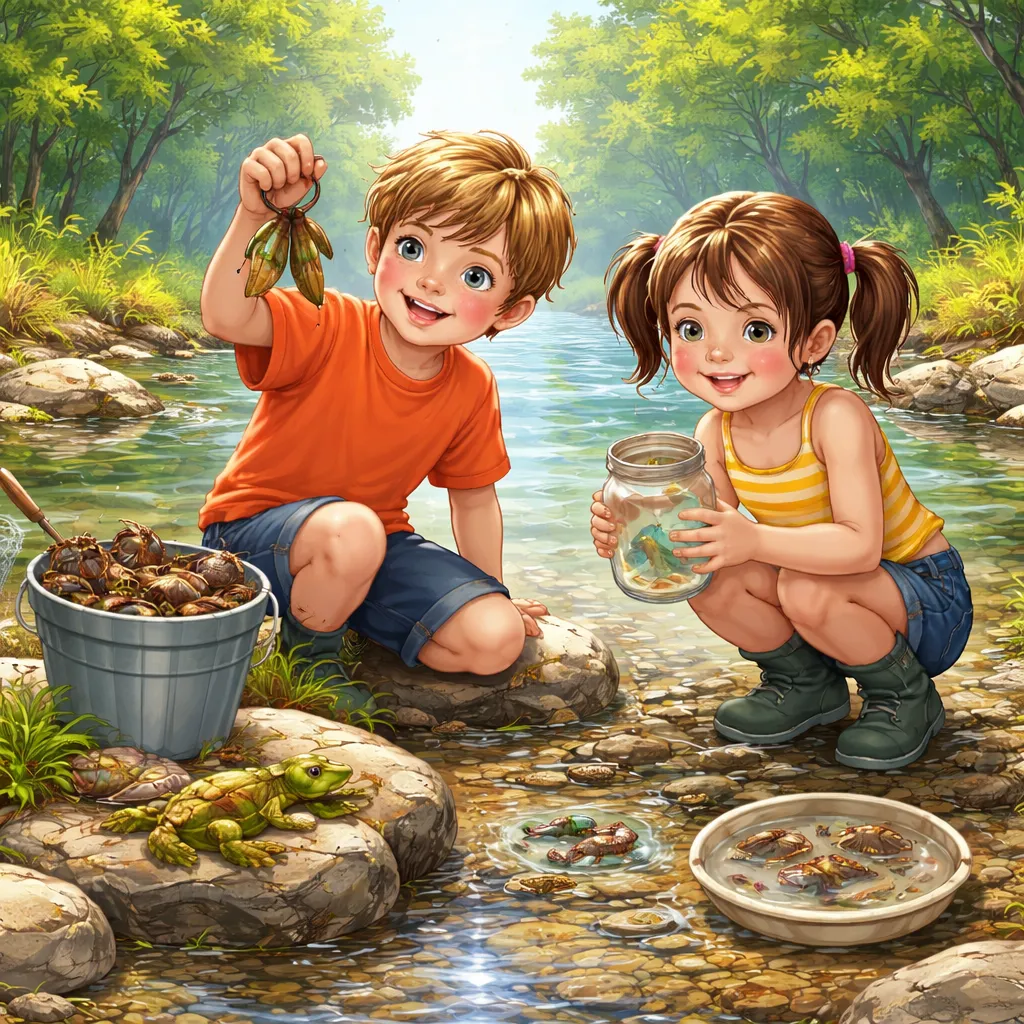

Imagine a hot, lazy day by a muddy creek. You’re poking a stick into the water, hoping to find a creature hiding under a rock. There’s a funny, old song that tells the story of just that kind of adventure. It’s a song about fishing, family, and a funny little creature with big claws. Let’s learn about the folk song “The Crawdad Song.”
About the Song
Let’s read the playful, repeating words of this classic tune.
You get a line and I’ll get a pole, honey,
You get a line and I’ll get a pole, babe.
You get a line and I’ll get a pole,
We’ll go down to the crawdad hole,
Honey, baby mine.
Whatcha gonna do when the creek runs dry, honey?
Whatcha gonna do when the creek runs dry, babe?
Whatcha gonna do when the creek runs dry?
Sit on the bank and watch the crawdads die,
Honey, baby mine.
This song is a traditional American folk song, especially popular in the southern United States. It is a simple, repetitive, and rhythmic song about catching crawdads (also called crayfish or crawfish), which are small, lobster-like creatures that live in creeks and streams. The song is structured as a conversation between two people, often a couple, planning a fishing trip and then worrying about what to do if the water dries up. The melody is easy to remember, and the song is often sung as a work song or a playful, relaxed tune. It captures the feel of a hot, slow day in the country.
What the Song is About
The song paints a picture of two people making plans. One person suggests getting a fishing line, and the other will get a pole. They agree to go together to the “crawdad hole”—a spot in the creek where crawdads live. They call each other sweet names like “honey” and “baby.”
Then, the song asks a worried question. “What are you going to do when the creek runs dry?” This is a real problem because crawdads need water to live. The answer is sad and a bit funny. They say they’ll just sit on the bank and watch the crawdads die. The song doesn’t try to solve the problem; it just describes it in a simple, honest way. The song is about enjoying a simple activity together and also about accepting the way things are in nature, even when it’s sad.
Who Made It & Its Story
“The Crawdad Song” is a traditional folk song, so its original author is unknown. It comes from the rural South of the United States and has roots in African American and Appalachian folk music traditions. The song was passed down orally for generations before being collected by folklorists. The first known recording was by the folk singer Hobart Smith in the 1920s, but the song is much older. It was a popular work song, sung by people while they worked to pass the time and keep a rhythm. The song’s simple, repetitive structure made it easy to remember and adapt, and it became a favorite for children and families.
This song has remained a favorite for three simple reasons. First, its melody is incredibly catchy, easy to sing, and has a bluesy, relaxing feel. Second, it describes a very common, relatable activity—going fishing—in a way that feels both fun and real. Third, it introduces children to a specific part of nature (crawdads) and a specific way of life (fishing in creeks), teaching about the world in a gentle, musical way.
When to Sing It
This song is perfect for relaxed, outdoor moments. You can sing it softly while on a family fishing trip or while exploring near a stream. You can sing it on a hot afternoon, sitting in the shade and imagining the cool water. You can also chant it as a rhythmic clapping game with a friend, taking turns singing the questions and answers.
What Children Can Learn
This simple, rhythmic song is a doorway to many lessons. Let’s wade in and see what we can find.
Vocabulary
The song teaches us words about nature and tools. A “crawdad” (or crayfish) is a small, freshwater animal that looks like a tiny lobster. A “hole” in this context is a deep spot in a creek where crawdads live. A “fishing line” is a long, strong string used to catch fish. A “fishing pole” is the stick that holds the line. A “creek” is a small stream of water. The “bank” is the land at the side of the creek. “Whatcha” is a casual way of saying “what are you.”
Let’s use these words! You can say, “We found a crawdad under a rock in the creek.” Or, “Let’s sit on the bank and have a picnic.” New word: Sustainability. This means using natural resources in a way that doesn’t destroy them. The song makes us think about what happens if the creek dries up.
Language Skills
This song is a wonderful lesson in using the future tense with “gonna” and the imperative mood for suggestions. The future tense is used for plans: “You get a line and I’ll get a pole… We’ll go down…” The contraction “I’ll” means “I will,” and “we’ll” means “we will.”
The song also uses the casual “gonna” for “going to” in the question: “Whatcha gonna do when the creek runs dry?” This is how people often talk in everyday conversation. The first lines are also suggestions, which are like gentle commands: “You get a line and I’ll get a pole.” This is a common way to make a plan together.
Sounds & Rhythm Fun
Listen to the slow, swaying, bluesy rhythm of the melody. The song uses a lot of repetition, which makes it easy to learn. Each line is sung twice, and the phrases “honey” and “babe” are like a sweet refrain. The song has a clear rhyme: “pole” and “hole,” “dry” and “die.”
The rhythm is a relaxed, steady 4/4 time, like the flow of a slow creek. Try a gentle clap: You GET a LINE and I’LL get a POLE, HONEY. The melody is simple, uses a small range of notes, and has a sad-but-strong feeling. This simple, repetitive, and soulful musical pattern makes the song very easy to remember and sing. You can write your own fishing song! Use the same slow rhythm. Try: “You get a net and I’ll get a bucket, buddy. You get a net and I’ll get a bucket, friend. We’ll go down to the tidal pool, and look for seashells, cool. Buddy, my friend.”
Culture & Big Ideas
“The Crawdad Song” is deeply rooted in the rural, southern American culture. It comes from a time and place where people lived close to the land, fishing and foraging for food. The song reflects a way of life that is simple, connected to nature, and sometimes hard. The worry about the creek drying up speaks to the real concerns of people who depend on the natural world. The song is a piece of living history, preserving the language and feelings of everyday people.
The song conveys three important ideas. First, it’s about cooperation and partnership. The song shows two people working together on a plan, each contributing something. Second, it touches on environmental awareness and change. The drying creek is a problem that can’t be easily fixed, making us think about taking care of our water sources. Third, it expresses resignation and acceptance. Sometimes in life, problems are big, and all you can do is watch and feel sad, which is a real emotion the song allows us to feel.
Values & Imagination
Imagine you are by the crawdad hole. What does the water feel like? Cool and muddy? What do the crawdads look like? Are they scurrying backwards? How do you catch one? Do you use a piece of bacon on the line? Now, imagine the creek drying up. What happens to the plants? The fish? The crawdads? How does the hot sun feel? Draw two pictures side by side. One of a lively, wet creek full of crawdads. The other of a dry, cracked creek bed with a lonely crawdad. This shows the change the song describes.
The song encourages us to appreciate nature and to think about how we use resources. A lovely idea is to have a “Water Appreciation” moment. With your family, talk about all the ways you use water (drinking, bathing, cooking). Then, go for a walk to a local stream, pond, or even a puddle. Sit quietly for a minute and listen to the water. Talk about how you can help keep water clean. This connects the song’s worry to positive action.
So, as the last “honey, baby mine” fades, think about the deep feelings in this simple song. It is a vocabulary lesson in nature and tools. It is a grammar lesson in future plans and casual questions. It is a music lesson in a slow, bluesy rhythm. From the first plan to go fishing to the final sad image, it wraps lessons in cooperation, environmental care, and accepting life’s changes in a tune that feels as old and steady as the hills. “The Crawdad Song” teaches us that songs can tell simple truths, that we depend on nature, and that sometimes, the sweetest things are done together, honey, baby mine.
Your Core Takeaways
You are now an expert on “The Crawdad Song.” You know it is a traditional American folk song from the South about fishing for crawdads. You’ve learned words like “crawdad,” “creek,” and “bank,” and you’ve practiced using “gonna” for future plans. You’ve felt its slow, bluesy rhythm and created your own version. You’ve also discovered the song’s connection to rural life, its messages about working together, caring for the environment, and accepting what we cannot change.
Your Practice Missions
First, go on a “Crawdad Hunt” (real or pretend). If you live near a safe creek, go with a grown-up to look for crawdads (just look, don’t touch!). If you can’t, create a crawdad hole at home. Use a blue blanket for water, rocks, and toy crawdads (or drawings). Act out the song with a family member, using a stick for a pole and string for a line. Talk about what you would do if your “creek” (the blanket) dried up.
Second, create a “Creek Health” poster. The song worries about the creek drying up. Make a poster about how to take care of rivers and streams. Draw a healthy creek with clean water, plants, and animals. Write one or two simple promises, like “I promise to not litter” or “I will turn off the faucet.” Hang your poster to remind your family to care for water.