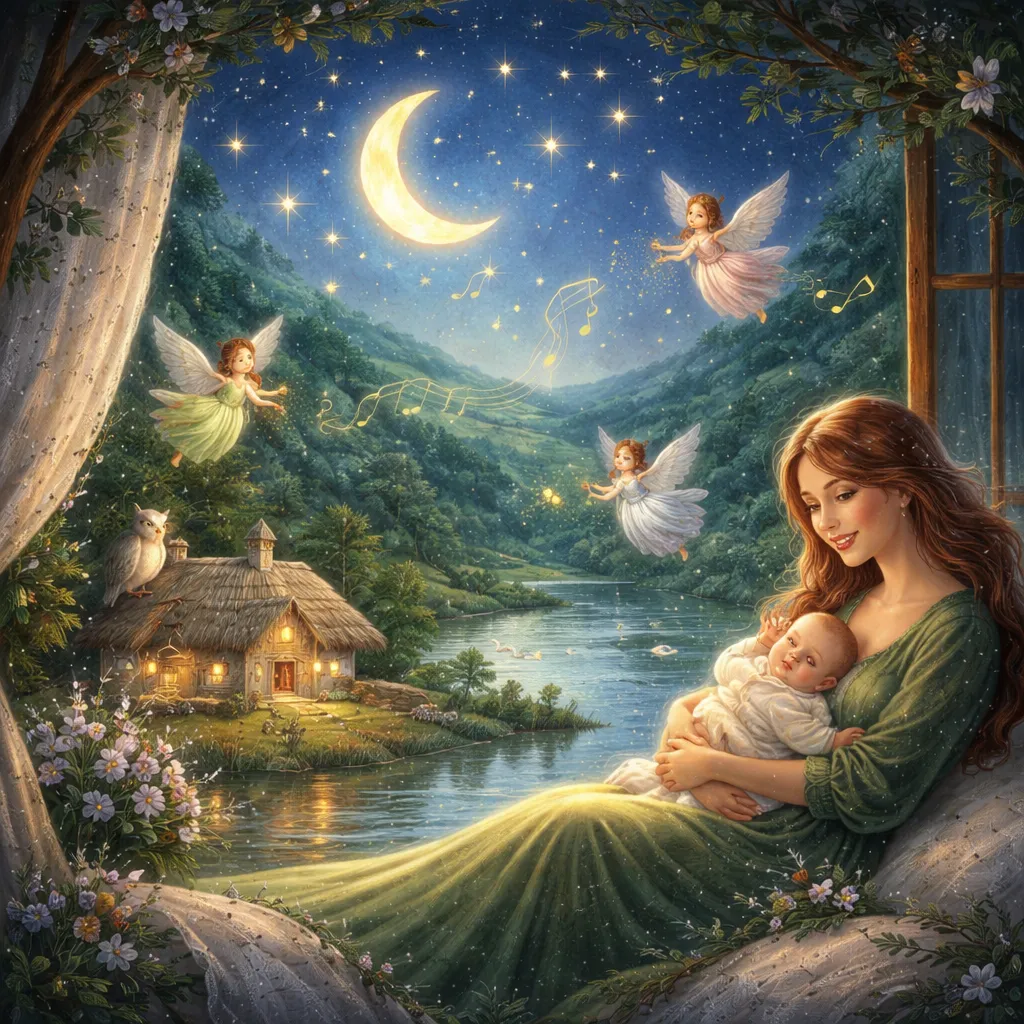

Have you ever heard a song that feels like a warm, cozy blanket made of sound? A song that doesn’t just use normal words, but also magical, comforting sounds that make you feel safe? There is a very famous song from a land of green hills that does exactly that. Let’s learn about the “Irish Lullaby,” also known by its magical chorus: “Too-Ra-Loo-Ra-Loo-Ral.”
About the Song
Let’s read the nostalgic and soothing words of this famous song.
Over in Killarney, many years ago,
My Mother sang a song to me in tones so sweet and low.
Just a simple little ditty, in her good old Irish way,
And I’d give the world if she could sing that song to me this day.
Chorus:
Too-ra-loo-ra-loo-ral, Too-ra-loo-ra-li,
Too-ra-loo-ra-loo-ral, hush now, don’t you cry!
Too-ra-loo-ra-loo-ral, Too-ra-loo-ra-li,
Too-ra-loo-ra-loo-ral, that’s an Irish lullaby.
O, oft in dreams I wander to that cot again beside the sea.
I can hear that song once more, though it’s only memory.
I see Mother’s eyes a-smilin’, as she leans above my bed,
Singin’ “Too-ra-loo-ra-loo-ral,” hush now, sleepy head.
This song is a famous Irish-American ballad and lullaby. It was written in 1913 by the American composer of Irish descent, James Royce Shannon. While it is called an “Irish Lullaby,” it was written in America. The song tells the story of a grown man remembering his Irish mother singing him to sleep when he was a boy in Killarney, Ireland. The magical, nonsense words “Too-ra-loo-ra-loo-ral” are meant to sound like the gentle, soothing sounds a mother makes to calm her baby. The song is a beautiful mix of a sweet story and a comforting, singable chorus that feels like a hug from the past.
What the Song is About
The song paints two pictures: one from the past and one from a dream. First, the singer, now an adult, remembers a time long ago (“many years ago”) in Killarney, a beautiful place in Ireland. He remembers his mother singing a simple little song—a “ditty”—to him in her gentle “Irish way.” He misses that time so much he says, “I’d give the world” to hear her sing it again.
Then comes the magical chorus, the “Too-ra-loo-ra-loo-ral.” This is the heart of the lullaby his mother sang. It’s a sound of pure comfort. In the second verse, the singer tells us he often dreams of this moment. In his dream, he is back in his little cottage (“cot”) by the sea. He can hear the song in his memory and see his mother smiling, leaning over his bed, singing those special sounds to help him fall asleep. The whole song is about the powerful, comforting memory of a parent’s love.
Who Made It & Its Story
The writer of “Too-Ra-Loo-Ra-Loo-Ral (That’s an Irish Lullaby)” is James Royce Shannon. He published the song in 1913 in the United States. Shannon was a popular songwriter, and this became his most famous piece. The song was written for the American stage, not in Ireland. It perfectly captured the feeling of nostalgia that many Irish immigrants in America felt for their homeland and their childhoods. The song became a massive hit, especially after it was sung by Bing Crosby in the 1944 film Going My Way. It turned a made-up, American-style “Irish” song into a beloved classic that people all over the world associate with Irish culture and gentle comfort.
This song has remained a favorite for three beautiful reasons. First, its chorus of “Too-ra-loo-ra-loo-ral” is incredibly catchy, fun to sing, and universally soothing—it sounds like a lullaby from any culture. Second, it tells a deeply emotional story about memory, family, and longing that touches the heart of anyone who has ever missed home or a loved one. Third, it created a timeless, sentimental image of Irish motherhood and home that feels both specific and universal.
When to Sing It
This song is perfect for quiet, loving moments. You can sing it softly as a lullaby to a younger sibling, letting the “Too-ra-loo-ra” sounds rock them to sleep. You can sing it on a family car trip, thinking about your own happy memories. You can also hum it quietly when you are feeling a little bit homesick or missing someone, as the song itself is about finding comfort in memory.
What Children Can Learn
This song, full of memory and music, is a wonderful teacher. Let’s explore its lessons.
Vocabulary
The song teaches us descriptive and nostalgic words. “Killarney” is a beautiful town in Ireland known for its lakes. A “ditty” is a short, simple song. “Oft” is a short, old-fashioned way to say “often.” A “cot” is a small, simple cottage or house. “A-smilin’” means smiling. “Memory” is something you remember from the past. The phrase “I’d give the world” means you want something very, very much.
Let’s use these words! You can say, “My grandma hums a little ditty while she cooks.” Or, “I oft think about my last birthday party.” New word: Nostalgia. This is a warm, sad, happy feeling you get when you remember a happy time in the past. The singer feels nostalgia for his childhood.
Language Skills
This song is a great lesson in using the simple past tense to tell a memory and direct speech to make the story alive. The song uses the past tense to describe the memory: “My Mother sang a song to me… I’d give the world…”
It also uses direct speech in the chorus and at the end: “Singin’ ‘Too-ra-loo-ra-loo-ral, hush now, sleepy head.’” This makes us feel like we are right there, hearing the mother. The song uses the comparison “Just a simple little ditty, in her good old Irish way” to describe how she sang, which teaches us to add descriptive details to our stories.
Sounds & Rhythm Fun
Listen to the slow, swaying, gentle rhythm of the melody. The song is in a classic 3/4 time waltz pattern, perfect for rocking. The most famous part is the chorus of nonsense words: “Too-ra-loo-ra-loo-ral.” These words don’t have a meaning, but their soft ‘l’ and ‘r’ sounds are incredibly soothing and fun to sing. They are an example of vocables—sung sounds that aren’t real words.
The rhythm is a steady, rocking waltz. Try swaying: O-VER in Kill-AR-ney, MAN-y YEARS a-GO. The melody is simple, beautiful, and easy to remember. The combination of a sweet story and a magical, singable nonsense chorus is what makes the song so memorable. You can write your own memory song! Use the same waltzing rhythm. Try: “Back at my old house, not so long ago, my dad would tell a story, in a voice so soft and low. Just a simple little tale, in his own special way, and I wish I could hear that story again today. La-di-da-di-da-dal, la-di-da-di-dee, that’s the special story that means so much to me.”
Culture & Big Ideas
“Too-Ra-Loo-Ra-Loo-Ral” is a classic example of early 20th-century Irish-American sentimental music. It reflects the experience of immigrants who cherished memories of their homeland. The song connects to the deep Irish tradition of sean-nós (old style) unaccompanied singing, where the feeling and melody are more important than the words. While not a traditional folk song, it has become an accepted part of Irish-American culture, symbolizing the warmth of the Irish family and the power of music to carry love across time and distance.
The song conveys three profound ideas. First, it’s about the power of family memory and tradition. The lullaby is a gift passed from a mother to a child, who then carries it forever in his heart. Second, it expresses homesickness and longing. The singer yearns for a time, a place, and a person that live only in memory, a feeling many people understand. Third, it highlights the pure comfort of sound. The “too-ra-loo-ra” isn’t about meaning; it’s about the feeling the sound creates—safety, love, and peace.
Values & Imagination
Imagine you are the little boy in the cottage in Killarney. What do you see from your bed? The fire? Your mother’s face? What does the sea sound like outside? How does the “too-ra-loo-ra” melody make you feel? Now, imagine you are the grown man dreaming. How does it feel to hear the song in your dream? Happy? A little sad? Draw a picture of the memory. Show the inside of the cottage, the mother singing by the bed, and outside the window, draw the hills of Killarney. In a thought bubble from the grown man, draw the same scene, but faded, like a dream.
The song inspires us to value our own family memories and traditions. A lovely idea is to have a “Family Lullaby Interview.” Ask the oldest person in your family if they remember a song or a rhyme that was sung to them when they were little. Ask them to teach it to you. This connects you to your own family’s “too-ra-loo-ra” and keeps those memories alive.
So, as the last “Irish lullaby” fades, think about the journey of this song. It is a vocabulary lesson in memory and description. It is a grammar lesson in telling past stories. It is a music lesson in the comforting power of nonsense sounds. From the first line about Killarney to the final, dreamy repetition, it wraps a lesson in love, memory, and the unbreakable bonds of family in a melody that feels like a gentle, timeless hug. “Too-Ra-Loo-Ra-Loo-Ral” teaches us that the simplest songs hold the deepest feelings, that home is carried in the heart, and that a mother’s love echoes forever in a child’s memory.
Your Core Takeaways
You are now an expert on the “Irish Lullaby (Too-Ra-Loo-Ra-Loo-Ral).” You know it was written by James Royce Shannon in 1913 and is about a man’s memory of his Irish mother. You’ve learned words like “ditty,” “cot,” and “oft,” and you’ve practiced using the past tense for memories. You’ve felt its gentle waltz rhythm and created your own memory verse. You’ve also discovered the song’s place in Irish-American culture and its messages about the power of family memory, the feeling of homesickness, and the pure comfort of loving sound.
Your Practice Missions
First, become a “Tradition Keeper.” Teach the “Too-ra-loo-ra” chorus to a family member. Sing it to them as a gentle, calming song. Explain that it’s a song about remembering love. This makes you a link in the chain of passing songs down, just like in the song’s story.
Second, create a “Memory Map.” The singer dreams of a cottage in Killarney. Draw a map of a place that holds a happy memory for you—your grandparents’ house, your first school, a favorite park. Label the important spots. In the corner, write or draw the “song” or sound of that place. Is it laughter? A specific tune? The wind in the trees? This helps you capture your own memories, just like the singer did.