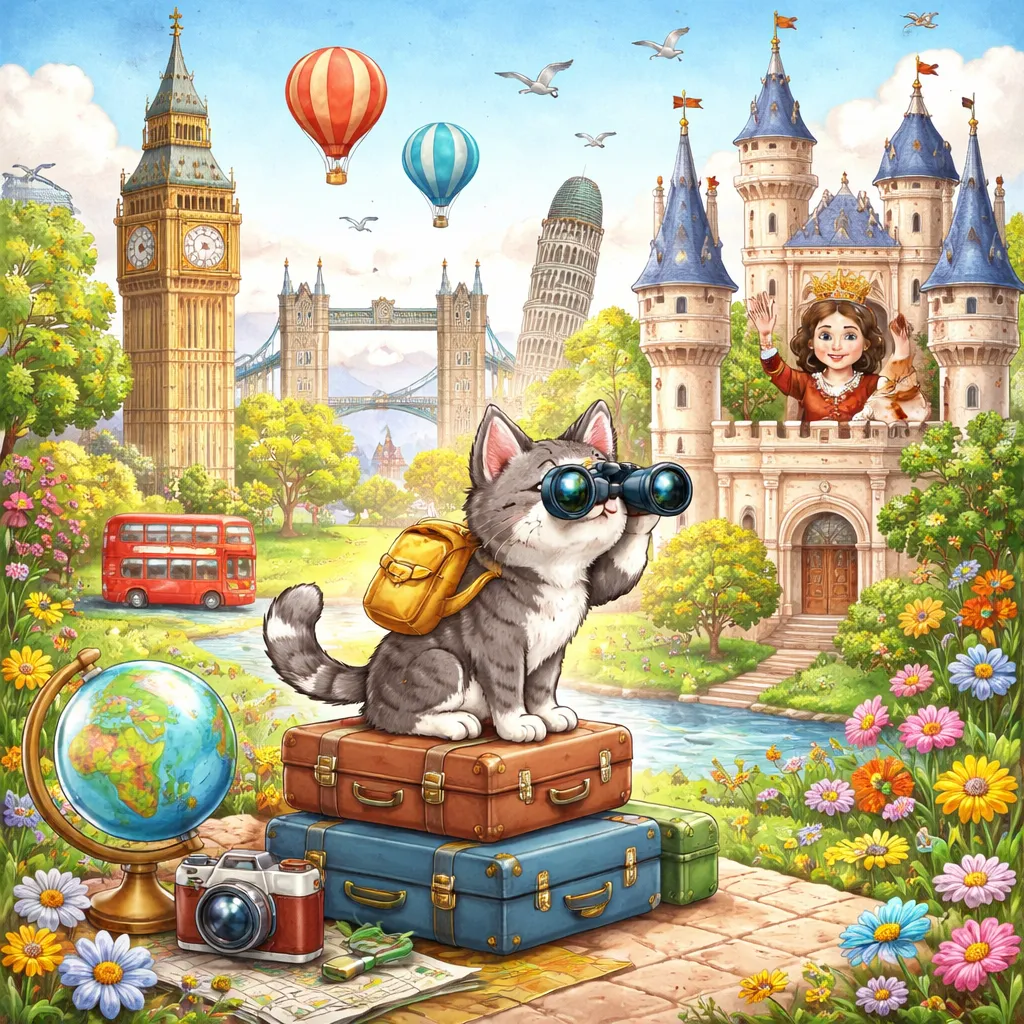

Some songs take us on tiny adventures with furry friends. The English song: Pussy Cat, Pussy Cat does exactly that. This simple nursery rhyme asks a cat where it has been and what it saw at a very special place. For families learning English together, this song offers a wonderful way to explore question words, place names, and the natural curiosity of both cats and children. Let us discover what makes this traditional rhyme so charming for young learners.
What Is the Story Behind This Famous Song?
The English song: Pussy Cat, Pussy Cat is a traditional nursery rhyme that first appeared in print around 1805. It tells of a cat who visits London and sees the Queen. The Queen's chair proves too tempting, and the cat scares a little mouse under it.
The rhyme follows a question and answer pattern. Someone asks the cat where it has been. The cat answers that it went to London to visit the Queen. Then the questioner asks what it did there. The cat says it frightened a little mouse under the Queen's chair.
This simple story captures a child's imagination. A cat traveling to London. A real queen. A hidden mouse. Each element sparks curiosity and wonder.
The rhyme may have roots in real royal cats. English queens have often kept cats as pets. Queen Victoria loved animals. Queen Elizabeth II was famous for her love of dogs, but cats have also lived in palaces.
For children, the rhyme teaches about asking questions and giving answers. It models simple conversations. Where have you been? What did you do there? These are questions children ask and answer every day.
Understanding this背景 helps families appreciate the rhyme's conversational nature. It opens discussions about travel, royalty, and the secret lives of pets.
The Complete Lyrics of the Song
Reading the words helps us understand this simple conversation. Here are the lyrics to the English song: Pussy Cat, Pussy Cat. Let us look at them.
Pussy cat, pussy cat, where have you been?
I've been to London to visit the Queen
Pussy cat, pussy cat, what did you do there?
I frightened a little mouse under her chair
Learning New Words from the Song
The English song: Pussy Cat, Pussy Cat introduces several useful words. Let us explore them together.
First, "pussy cat" is a gentle, child-friendly name for a cat. Pussy sounds soft and kind. Children love saying it.
"Where have you been?" is a question about past location. This teaches the question word "where" and the present perfect tense "have been". Children learn to ask about experiences.
"I've been to London" means I traveled to London and returned. "I've" is a contraction of "I have". London is the capital city of England. This teaches a major place name.
"To visit the Queen" means to go see the royal ruler. Visit means to go see someone for a short time. Queen is the female monarch. Many children know about queens from stories.
"What did you do there?" asks about actions. "What" asks for information about something. "Did do" uses past tense to ask about completed actions.
"I frightened a little mouse" means I scared a small rodent. Frightened is the past of frighten, meaning to make afraid. Mouse is a small animal with a long tail.
"Under her chair" means beneath the Queen's seat. Under is a preposition showing location. Chair is a piece of furniture for sitting. Her shows the chair belongs to the Queen.
The image is charming. A palace, a queen, a cat, and a tiny mouse hiding under the chair. Children can picture this scene clearly.
Exploring Pronunciation and Rhythm
The English song: Pussy Cat, Pussy Cat offers perfect practice with English rhythm. The question and answer pattern creates a natural flow.
Listen to the first question "Pussy cat, pussy cat, where have you been?" The rhythm goes PUSS-y cat, PUSS-y cat, WHERE have you BEEN? The strongest beats fall on "puss", "where", and "been". Clapping along helps children feel this pattern.
The answer "I've been to London to visit the Queen" flows smoothly. I've BEEN to LON-don to VIS-it the QUEEN. Four strong beats on "been", "lon", "vis", and "queen".
The second question "Pussy cat, pussy cat, what did you do there?" continues the pattern. PUSS-y cat, PUSS-y cat, WHAT did you DO THERE? Stress on "puss", "what", "do", and "there".
The final answer "I frightened a little mouse under her chair" ends the story. I FRIGHT-ened a LIT-tle MOUSE UN-der her CHAIR. The key words "fright", "lit", "mouse", "un", and "chair" carry the rhythm.
Finding Grammar Patterns in the Lyrics
The English song: Pussy Cat, Pussy Cat offers useful grammar examples. One pattern appears in the question structure. "Where have you been?" uses the present perfect tense. This tense connects past actions to the present. We use it when the exact time doesn't matter. For example, "Have you ever seen a queen?" or "I have been to London".
The answer uses the same tense. "I've been to London" is present perfect. Children learn this important tense through natural conversation.
Another pattern appears with "to" showing purpose. "To visit the Queen" explains why the cat went to London. We use this infinitive of purpose constantly. "I went to the store to buy milk" or "She called to say hello".
The second question uses simple past. "What did you do there?" asks about a completed action. The answer also uses simple past. "I frightened a little mouse." This teaches the difference between present perfect for experiences and simple past for specific completed actions.
The word "under" is a preposition showing location. Prepositions are small but essential words. Children learn them through repeated examples.
Fun Learning Activities for the Whole Family
Listening to the English song: Pussy Cat, Pussy Cat can inspire many family activities. Here are some ideas to try together.
First, practice question and answer conversations. Take turns asking and answering like the song. "Where have you been?" "I've been to the park." "What did you do there?" "I played on the swings." This builds conversational skills naturally.
Second, learn about London and the Queen. Show pictures of London landmarks. Buckingham Palace is where the Queen lives. Talk about what it might be like to visit. This builds cultural vocabulary.
Third, observe real cats. If you have a cat, watch where it goes and what it does. If not, watch neighbor cats or videos. Imagine what cats might say about their adventures. This builds imagination and descriptive language.
Creating Printable Materials at Home
Families can make simple learning tools based on the English song: Pussy Cat, Pussy Cat. These activities help reinforce new ideas.
Create question word flashcards. Make cards for "who", "what", "where", "when", "why", and "how". On each card, write the word and draw a simple picture. Practice asking questions with each word. This builds question-forming skills.
Make a London landmarks coloring page. Draw simple pictures of Big Ben, Buckingham Palace, and the London Eye. Label each in English. Color and talk about each place. This builds geography vocabulary.
Create a fill-in-the-blank page using song lyrics. Remove key words like "pussy", "where", "London", "Queen", "what", "frightened", "mouse", and "chair". Leave blanks where those words belong. Listen to the song together and fill in the missing words. This builds listening and spelling skills.
Connecting the Song to Daily Life
The English song: Pussy Cat, Pussy Cat connects to daily life through pets and curiosity. Many children have cats or know cats. All children ask questions.
Talk with your children about what pets might do when we're not watching. Where does the cat go? What does it see? Use English to imagine. "Maybe our cat visits the neighbors" or "Perhaps she chases mice in the garden". This builds imagination and narrative skills.
The song also teaches about visiting special places. London is far away, but every place can be special. Talk about special places your family has visited. Use English to share memories. "We went to the beach last summer" or "Remember when we visited Grandma's house". This builds personal connection to language.
Parents can model curiosity. Ask questions about your children's day. "Where did you go today?" "What did you do at school?" This reinforces the question patterns from the song in real life.
Educational Games to Play Together
Games make learning with the English song: Pussy Cat, Pussy Cat exciting. Here are some simple games to try.
Play the question chain game. One person asks a question starting with "where". The next person answers and asks a new question with "what". Continue alternating. "Where have you been?" "I've been to the store. What did you buy?" "I bought apples. Where did you put them?" This builds question skills.
Try the cat and mouse game. One person is the cat, another is the mouse. Others are chairs. The cat chases the mouse around the chairs. When the mouse hides under a chair, the cat says "I frightened a little mouse under the chair!" Switch roles. This builds action vocabulary through play.
Play the royal visit game. Pretend someone is the Queen sitting on a chair. Others take turns visiting and telling what they did. "I bowed to the Queen" or "I gave her a flower". This builds imagination and sentence skills.
Why This Song Helps English Learning
The English song: Pussy Cat, Pussy Cat helps learners in special ways. The question and answer format teaches essential conversation patterns. Children learn how to ask and answer about experiences.
The simple vocabulary matches what beginners need. Words like cat, where, been, London, Queen, what, did, frightened, mouse, under, and chair appear in early lessons. Learning them through song makes them easy to recall.
The repetition of "pussy cat" makes the song easy to remember. Children can join in quickly.
The royal theme captures imagination. Queens and palaces appear in fairy tales. Children love connecting songs to stories they already know.
Making Music Part of Your Routine
Families can make songs a regular part of English time. Choose one song each week to explore together. Listen during pet care time or while looking at picture books.
The English song: Pussy Cat, Pussy Cat works perfectly for cat lovers. Sing it while petting a cat or looking at cat pictures. Let the song celebrate our furry friends.
Remember that language learning thrives in curious moments. When children associate English with questions and answers, they learn naturally. They understand that language is for finding out about the world.
Keep singing, keep asking, and keep exploring the world together through English. In the great palace of language learning, every new word is like a little mouse waiting to be discovered under a chair.