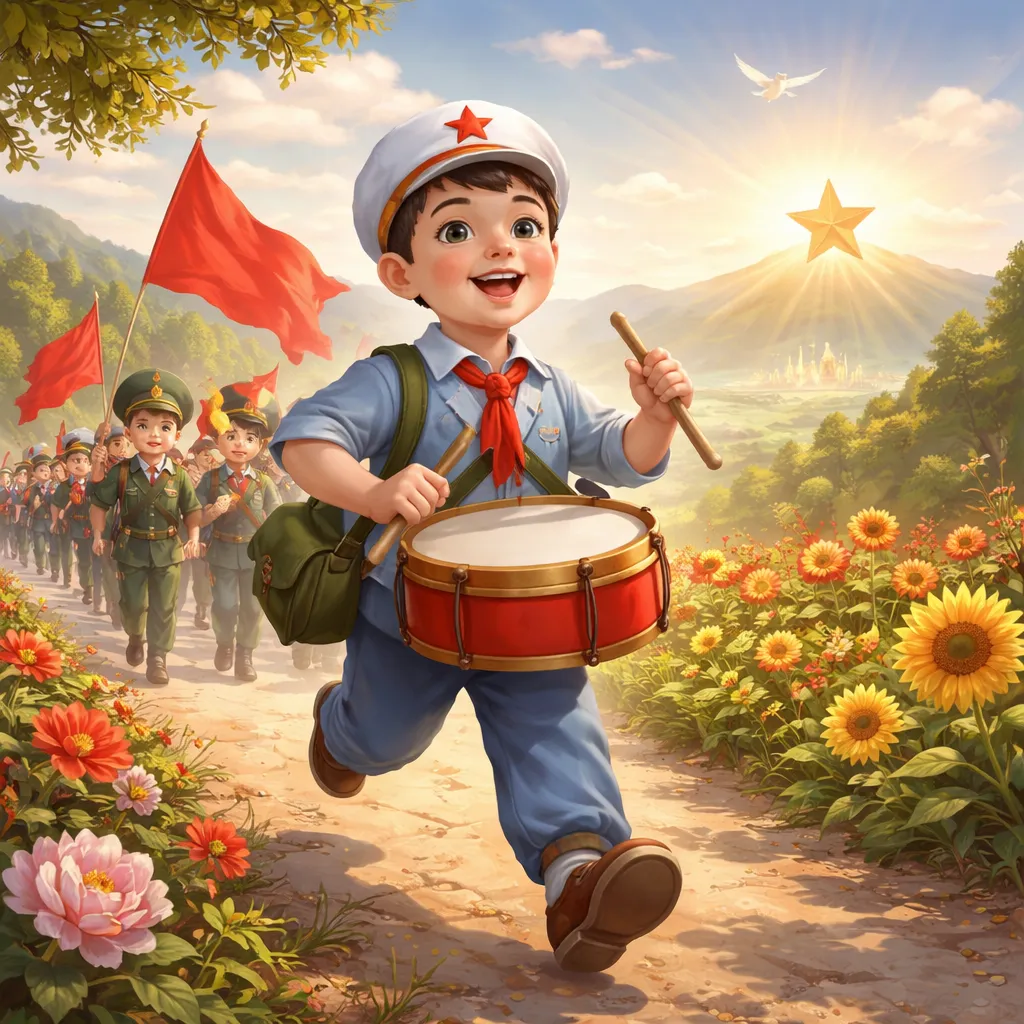

Have you ever practiced something over and over, like kicking a ball or drawing a circle, until you finally got it just right? The feeling of getting better at something through your own effort is wonderful. In China, there is a lively, marching song about a young boy who practices one skill with all his heart. His hard work doesn't just help him—it helps everyone! Let’s march to the beat of “The Little Drummer Boy” (小鼓手, Xiǎo gǔshǒu).
About the Song
Let’s read the rhythmic, proud words of this famous song.
我是一个小鼓手,
小呀小鼓手。
敲起鼓来咚咚咚,
歌声伴着鼓儿走。
我是一个小鼓手,
小呀小鼓手。
练好本领为集体,
胸前红花戴胸口。
English Translation:
I am a little drummer boy,
A little, little drummer boy.
When I beat the drum, boom boom boom,
The song keeps pace with the drum’s sound.
I am a little drummer boy,
A little, little drummer boy.
I practice my skill for the group,
A red flower is worn on my chest.
This song is a classic Chinese children’s song from the mid-20th century. It reflects the collective spirit and educational values of its time. The song is a first-person declaration from a young boy who proudly identifies himself as a drummer. He describes the act of drumming with its onomatopoeic sound “咚咚咚” (dōng dōng dōng), and how his drumming provides the rhythm for a marching song. The lyrics emphasize that he practices his skill not just for himself, but for the benefit of his “集体” (group or collective), for which he is rewarded with a “red flower,” a symbol of honor. The melody is simple, repetitive, and perfectly suited for marching or clapping.
What the Song is About
The song paints a picture of a proud, dedicated young musician. The singer announces, “I am a little drummer boy.” He repeats it, showing he is happy with this role. He then shows us what he does. He beats his drum, making a loud, clear “boom boom boom” sound. His drumbeat is so steady and strong that a whole marching song can be sung along with it. His drum leads the way.
He then tells us why he does this. He says he is “practicing his skill.” He is getting better on purpose. And his purpose is “for the group.” This means he wants to help his team, his class, or his community by providing good music for marches or events. Because of his hard work and team spirit, he is honored. He gets to wear a bright red flower on his chest, a sign that everyone is proud of him. The song is about taking pride in your role, practicing to improve, and finding joy in contributing to something bigger than yourself.
Who Made It & Its Story
“The Little Drummer Boy” is a product of Chinese children’s music from the 1950s and 1960s. While specific composer credits are not as widely documented as some other songs, it is firmly part of the repertoire from that era. The song was created during a time when collective activities, discipline, and contributing to the community were strongly emphasized in education. Songs like this were used in schools and youth groups to encourage participation, discipline, and a sense of collective identity. The “red flower” is a classic socialist symbol of honor for good deeds and achievement. Despite its specific historical context, the song’s core messages about practice, pride in one’s work, and teamwork are universal and have allowed it to remain a recognizable tune.
This song has endured for three positive reasons. First, its melody is extremely simple, repetitive, and march-like, making it instantly engaging and easy for children to sing while walking or clapping. Second, it empowers the child as a capable contributor. The drummer boy isn’t just playing; he’s leading and serving his group, which is a powerful and positive self-image. Third, it celebrates the tangible rewards of practice and teamwork—the joy of the drum’s sound and the honor of the red flower—in a very concrete way that children can understand.
When to Sing It
This song is perfect for energetic, group activities. You can sing it loudly while marching around the room or playground, pretending to beat a drum. You can chant it as a class or family when starting a group project, to feel united. You can also sing it when you’ve practiced something hard and finally mastered a small part, to celebrate your own “drummer boy” moment of achievement.
What Children Can Learn
This proud, rhythmic song is a great teacher about work, music, and community.
Vocabulary
The song teaches us words about music, effort, and recognition. A “drummer” (鼓手, gǔshǒu) is a person who plays a drum. A “drum” (鼓, gǔ) is a musical instrument you hit with sticks or hands. “Boom” (咚咚, dōng dōng) is the onomatopoeic sound a drum makes. A “song” (歌声, gēshēng) is music made with the voice. “Skill” or “ability” (本领, běnlǐng) is something you are good at doing. The “collective” or “group” (集体, jítǐ) is a team of people. A “red flower” (红花, hónghuā) is a reward for good work.
Let’s use these words! You can say, “The drummer kept the beat for the band.” Or, “She received a gold star for her contribution to the team.” New word: Diligence. This means careful and persistent work or effort. The drummer shows diligence in practicing.
Language Skills
This song is a clear lesson in the simple present tense for stating identity and actions and using prepositional phrases for purpose. The song uses the simple present to state a fact: “我是一个小鼓手” (I am a little drummer). It then describes a habitual action: “敲起鼓来…” (When I beat the drum…).
The line “练好本领为集体” (Practice my skill for the group) uses the structure “为…" (wèi…) to express doing something for a purpose or a person. This is a key way to talk about intentions and goals. The song also uses the onomatopoeic word “咚咚咚” to mimic sound directly.
Sounds & Rhythm Fun
Listen to the strong, steady, marching rhythm of the melody. The song is in a bold 4/4 time, like a military march or a parade. The repetition of “小呀小鼓手” (little, little drummer) is catchy and fun. The best part is the onomatopoeic “咚咚咚” in the middle, which lets children be the drum itself! The lyrics have a marching rhyme: “手” (shǒu) and “走” (zǒu), “手” (shǒu) and “口” (kǒu).
The rhythm is unwavering and proud. Try stomping your feet: 我 是 一 个 小 鼓 手 (wǒ shì yī gè xiǎo gǔ shǒu). The melody uses just a few notes, making it very easy to learn and belt out with confidence. This simple, repetitive, and driving musical pattern is what makes the song so effective for group singing and movement. You can write your own “I am a…” song! Use the same proud rhythm. Try: “I am a little helper, yes a little helper. When I clean up my toys, I feel such joy. I am a little helper, for my family, and that’s a job that’s good for me!”
Culture & Big Ideas
“The Little Drummer Boy” is a musical reflection of the collective social values prominent in mid-20th century China. It connects to the idea that individual effort is most meaningful when it serves the common good. The “red flower” is a symbol from that era, often given to children in schools as an award for good behavior, grades, or contribution—similar to a gold star. The song can be connected to national day parades or school sports days, where group performance and discipline are on display. It teaches the Confucian-inspired value of self-cultivation for the benefit of society. While the specific context is historical, the underlying idea—that practicing your skills makes you a valuable part of your team, class, or family—is a timeless and positive lesson.
The song conveys three important ideas. First, it’s about taking pride in your role and identity. Saying “I am a little drummer boy” with confidence is the first step to doing the job well. Second, it expresses that practice has a purpose beyond the self. Getting better at something allows you to contribute to and lead your group. Third, it highlights that effort and contribution are recognized and honored. The red flower is a simple, visual reward that shows hard work for the team is seen and appreciated.
Values & Imagination
Imagine you are the drummer boy. The drum is strapped to your chest. The sticks feel solid in your hands. What does the “boom boom boom” sound like in your ears? Can you feel it in your chest? Now, imagine you are marching at the very front of a big line of people. They are all walking in time to YOUR beat. How does that feel? Powerful? Responsible? Proud? Draw a picture of the drummer boy. Draw him standing very straight, with a big drum. Draw sound waves coming from the drum with the words “咚咚咚”. On his chest, draw a big, bright red flower. Behind him, draw a happy, marching group of other children. This shows his role as a leader and contributor.
The song encourages a strong work ethic, pride in developing skills, and the joy of being a reliable part of a team. A great family activity is to have a “Drummer’s Parade.” Gather pots, pans, or empty containers and wooden spoons as drums. Line up and choose one person to be the lead drummer. Have the lead drummer set a simple beat, and everyone else must follow it while marching around the house singing the song. This turns the song’s theme into a fun, cooperative game.
So, as the final note about the red flower fades, think about the confident message in this marching tune. It is a vocabulary lesson in music and contribution. It is a grammar lesson in stating identity and expressing purpose. It is a music lesson in a steady, marching rhythm. From the first proud declaration to the final symbol of honor, it wraps lessons in identity, purposeful practice, and teamwork in a melody that makes you want to stand tall and keep the beat. “The Little Drummer Boy” teaches us that we can all be drummers for our own teams, that practice makes us useful, and that contributing to the group is its own beautiful reward.
Your Core Takeaways
You are now an expert on the song “The Little Drummer Boy” (小鼓手). You know it is a Chinese children’s song about a boy who takes pride in drumming for his group. You’ve learned words like “drummer,” “collective,” and the onomatopoeia “boom,” and you’ve practiced the simple present tense and the “for…” purpose structure. You’ve felt its strong, marching rhythm and created your own “I am a…” verse. You’ve also learned about the song’s cultural background and its messages about pride in one’s role, practicing for a purpose, and the honor of contributing to a team.
Your Practice Missions
First, host a “Rhythm Leader” game. With your family, sit in a circle. One person is the “drummer boy” and starts a simple, slow clapping rhythm. Everyone must copy it exactly. After a while, the leader changes the rhythm, and everyone must follow. Take turns being the leader. This mission focuses on the song’s themes of leading with rhythm and group coordination.
Second, create a “Red Flower Award.” The drummer boy earns a red flower for his contribution. Think of one way you contributed to your family or class this week (like helping set the table, sharing a toy). Make a “red flower” out of red paper, or draw one. On a petal, write or draw your contribution. Present it to yourself or give it to a family member to award to you. Talk about why the contribution was helpful. This turns the song’s symbol of honor into a personal reflection on your own positive actions.