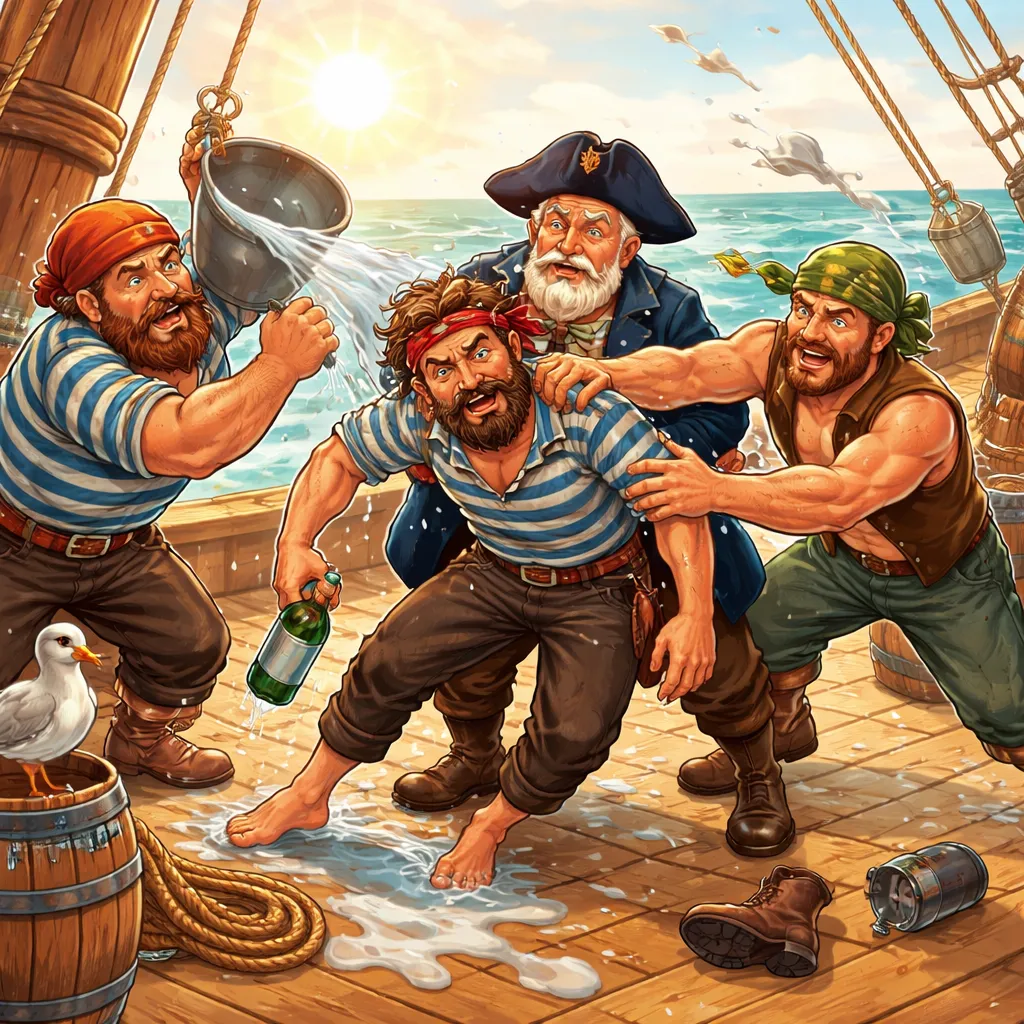

Have you ever woken up very early and seen that something is… wrong? Maybe a pet made a mess, or toys are scattered everywhere. The first thing you do is ask: “What should we do about this?” Long ago, on big sailing ships, sailors had a famous song for exactly that kind of problem. It’s a rhythmic, funny song about a very silly situation. Let’s learn about the sea shanty “Drunken Sailor.”
About the Song
Let’s read the famous, question-and-answer words of this classic work song.
What shall we do with a drunken sailor,
What shall we do with a drunken sailor,
What shall we do with a drunken sailor,
Earlye in the morning?
Hooray and up she rises,
Hooray and up she rises,
Hooray and up she rises,
Earlye in the morning!
Put him in the longboat till he’s sober,
Put him in the longboat till he’s sober,
Put him in the longboat till he’s sober,
Earlye in the morning!
Hooray and up she rises,
Hooray and up she rises,
Hooray and up she rises,
Earlye in the morning!
This song is a traditional sea shanty, a rhythmic work song sung by sailors in the 19th century. It is a “halyard shanty,” used for jobs that need a steady, strong pull, like raising a heavy sail or anchor. The song is structured as a call-and-response. The shantyman (song leader) calls out the problem in a verse: “What shall we do with a drunken sailor?” The whole crew then responds with the energetic chorus, “Hooray and up she rises!” The “she” might refer to the ship or the sail they are raising. Each verse suggests a new, often humorous and impossible, solution to the problem of the drunken sailor, like putting him in a small boat or making him scrub the deck.
What the Song is About
The song paints a funny, chaotic picture on a ship’s deck early in the morning. A sailor has had too much to drink and is not fit for duty. The work crew has a job to do—raise the anchor or a sail—and this sailor is in the way. The shantyman sings out the big question three times: “What shall we do with a drunken sailor?” This focuses everyone on the problem.
After the question, the crew sings the chorus, “Hooray and up she rises!” This is the work part. They all pull together on the ropes in time with the music. Then, the shantyman suggests a solution in a new verse, like “Put him in the longboat till he’s sober.” The crew responds again with the work chorus. The song mixes the silly problem of one sailor with the serious, coordinated effort of the whole team doing their job. It’s about solving problems together with rhythm and a bit of humor.
Who Made It & Its Story
“Drunken Sailor” is a traditional folk song, so its original author is unknown. It comes from the great age of commercial sailing ships in the 1800s. Sailors from Britain, America, and beyond sang it. The song was a practical tool. The strong, simple rhythm helped sailors time their pulls perfectly, making the back-breaking work of raising the heavy anchor or sails more efficient and less exhausting. The humorous verses about punishing a lazy crewmate also helped lighten the mood and build camaraderie. It was collected by folklorists in the late 19th and early 20th centuries and remains the most famous and recognizable sea shanty in the world.
This shanty has stayed incredibly popular for three strong reasons. First, its rhythm is perfect for group effort. The “Hooray and up she rises!” is a natural shout that gets everyone to pull in unison. Second, it is endlessly adaptable and funny. New verses can be invented for new, silly punishments (“Make him polish all the anchors!”), encouraging creativity. Third, it is the ultimate example of call-and-response. It’s impossible to just listen; you want to join in on the response, making it a perfect song for building group spirit and participation.
When to Sing It
This song is perfect for active, cooperative moments. You can sing it while doing a family chore that requires rhythm, like folding a big sheet or pushing a heavy shopping cart, pulling on the “Hooray!” part. You can sing it as a marching song on a walk, stomping your feet on the chorus. You can also use it as a silly game, taking turns being the shantyman who invents a new, funny punishment for the “drunken sailor” (who could be a stuffed animal).
What Children Can Learn
This energetic, problem-solving song is packed with lessons. Let’s hoist the anchor and see what we can discover.
Vocabulary
The song teaches us specific nautical and descriptive words. A “sailor” is a person who works on a ship. “Drunken” means having had too much alcohol to drink. “What shall we do” is a formal way to ask for a plan. “Earlye” is an old spelling of “early.” “Hooray” is a shout of joy or effort. “Rises” means goes up. A “longboat” is a large boat carried on a ship. “Sober” means not drunk anymore.
Let’s use these words! You can say, “We woke up earlye to see the sunrise.” Or, “The crowd shouted ‘Hooray!’ when the team won.” New word: Shanty. This is a work song with a call-and-response structure, sung by sailors.
Language Skills
This song is a fantastic lesson in asking questions about the future and using the imperative mood for solutions. The core of the song is a question about the future: “What shall we do with a drunken sailor?” “Shall” is a formal word for “will,” used here for suggestions.
The verses then give commands, using the imperative mood: “Put him in the longboat…” This is how we give instructions. The song practices the structure of posing a problem and then offering a solution. The repetition of lines makes the grammar pattern easy to remember and use.
Sounds & Rhythm Fun
Listen to the strong, steady, pulling rhythm of the melody. The song is built for call-and-response. The shantyman sings the verse three times, and the crew roars the chorus three times. The verse and chorus have the same melody, making it simple. The lyrics have a clear, driving rhythm.
The song is in a powerful 4/4 time, perfect for synchronized heaving. Try stomping your foot on the “Hoo-RAY!”: What SHALL we DO with a DRUNK-en SAIL-or? The melody is based on just a few notes and is incredibly easy to learn. This strong, repetitive, group-focused musical pattern is what made the song such an effective work tool. You can write your own problem-solving shanty! Use the same structure. Try: “What shall we do with a muddy puppy, what shall we do with a muddy puppy, what shall we do with a muddy puppy, right after his bath? Hooray and in he goes, hooray and in he goes, give him a scrub right on the nose, right after his bath!”
Culture & Big Ideas
“Drunken Sailor” is a cornerstone of maritime folk culture. It comes from a time when human muscle powered global trade, and music was vital for organizing labor and maintaining morale. The song reflects the harsh, disciplined, and sometimes rowdy world of sailors, where teamwork was a matter of life and death, and humor was a relief from hardship. It is a living piece of social history that shows how people use creativity to solve practical problems and build community.
The song expresses three core ideas. First, it’s about creative problem-solving and teamwork. Faced with a problem (the drunken sailor), the group works together to find a solution while also doing their main job. Second, it highlights structure and discipline within community. The song imposes a strict musical structure on chaos, just as shipboard life required order. Third, it embodies using humor to deal with frustration. Instead of just getting angry, the sailors make a joke of the situation, singing about it as they work, which is a healthy way to handle annoyance.
Values & Imagination
Imagine you are a sailor on the deck at dawn. The air is cold. Your hands are on a thick, wet rope. The shantyman’s voice calls out the problem. You wait, then heave and shout “HOORAY!” with the crew. What does the rope feel like? Can you smell the ocean? Now, imagine the drunken sailor. Is he stumbling? Snoring? What does the “longboat” look like? Draw a picture of the scene. Show the crew in a line pulling a rope, the shantyman pointing, and the drunken sailor sitting confused to the side. Show the sun just peeking over the horizon for “earlye in the morning.”
The song inspires creative thinking about solutions and the value of working together cheerfully. A wonderful idea is to have a “What Shall We Do?” game. With your family, pose a silly problem (“What shall we do with a melted ice cream cone?”). Everyone takes turns inventing a creative, funny solution. This practices the song’s core skill in a modern, playful way.
So, as the last “earlye in the morning” fades, think about the power in this old work song. It is a vocabulary lesson in nautical life. It is a grammar lesson in questions and commands. It is a music lesson in powerful, unifying rhythm. From the first question to the final heave, it wraps lessons in teamwork, creative solutions, and cheerful discipline in a tune that makes you want to find a rope and pull with friends. “Drunken Sailor” teaches us that problems can have a beat, that laughter helps with work, and that the best way to solve anything is often together, earlye in the morning.
Your Core Takeaways
You are now an expert on the sea shanty “Drunken Sailor.” You know it is a 19th-century work song used to coordinate labor and solve a silly problem. You’ve learned words like “sailor,” “sober,” and “longboat,” and you’ve practiced asking “What shall we do?” and giving commands. You’ve felt its strong, stomping rhythm and created your own problem-solving verse. You’ve also discovered the song’s role in maritime history and its messages about creative teamwork, maintaining order, and using humor to overcome frustration.
Your Practice Missions
First, stage a “Shanty Pull.” Find a sturdy rope, a long towel, or even a jump rope. With your family, line up and hold it. One person is the shantyman, singing the verses. Everyone else sings the chorus. On the words “Hooray and up she rises,” all pull the rope together in one big, synchronized tug. This lets you feel the physical power of the song’s rhythm.
Second, compose a “Modern Problem” shanty. Think of a funny, modern “problem” (like a tablet with a dead battery, or a sink full of bubbles). Write at least two new verses with solutions, using the same tune. Perform it for your family, encouraging them to be the “crew” and sing the “Hooray” chorus with you. This makes you a true shantyman, leading the crew in song.