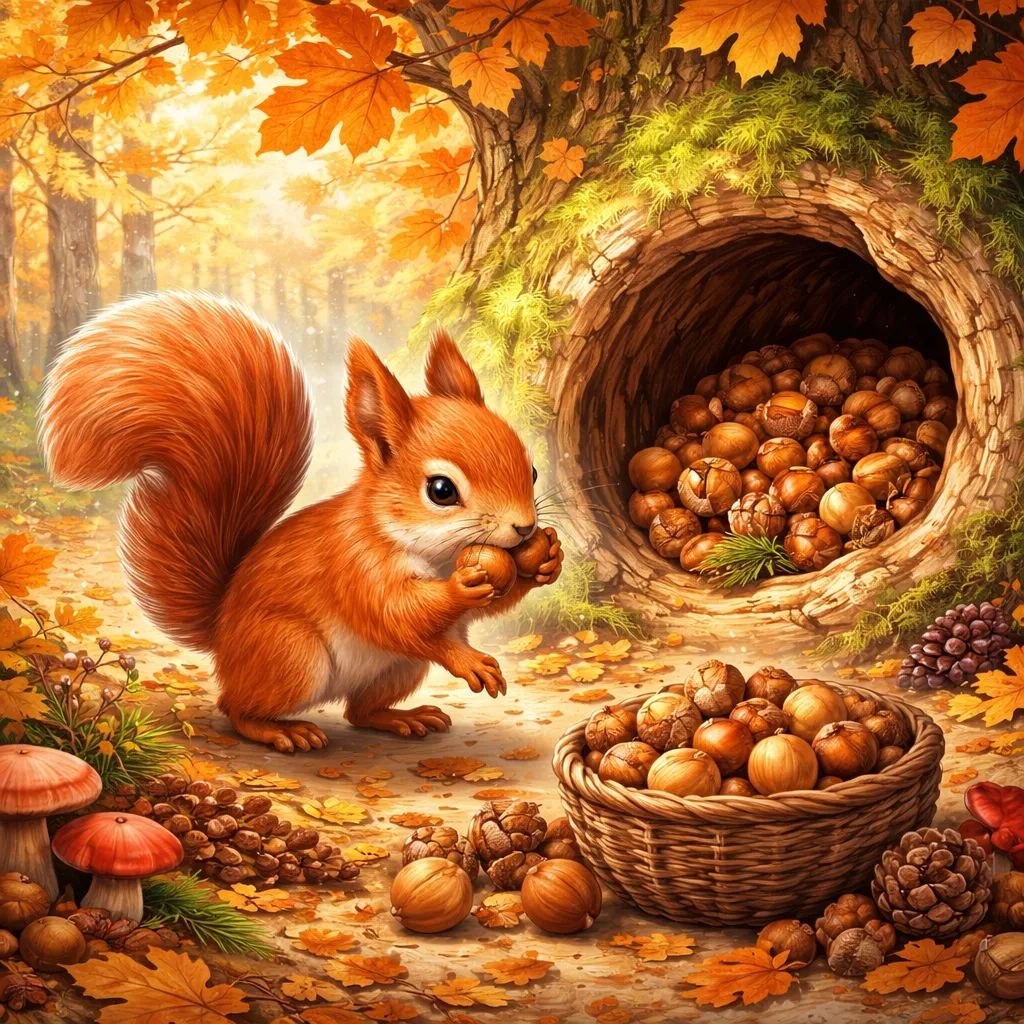

Have you ever seen a squirrel in a park or garden? It moves so fast, darting here and there, sometimes stopping to nibble on something. In Germany, there is a clever, busy song all about a little squirrel getting ready for the cold days. It is a song about hard work and thinking ahead. Let’s scamper along and learn the smart song “The Little Squirrel (Das kleine Eichhörnchen).”
About the Song
Here are the quick, bustling lyrics of a beloved traditional German children’s song:
Das kleine Eichhörnchen, das kleine Eichhörnchen,
das trägt sein Winterkleid, ei, ei!
Das kleine Eichhörnchen, das kleine Eichhörnchen,
das hat jetzt viel Geschäft, ei, ei!
Es trägt die Nüsschen in sein Haus,
versteckt sie in dem Baum hinaus.
Das kleine Eichhörnchen, das kleine Eichhörnchen,
sucht sie dann wieder raus, ei, ei!
English Translation:
The little squirrel, the little squirrel,
he wears his winter coat, oh my!
The little squirrel, the little squirrel,
he has much business now, oh my!
He carries the little nuts into his house,
hides them out in the tree.
The little squirrel, the little squirrel,
searches for them then again, oh my!
This is a classic and charming German-language song for children. The song is all about a squirrel’s important autumn work. “The little squirrel, the little squirrel, he wears his winter coat, oh my!” it begins, telling us the squirrel is ready for the cold. He is not playing; he is very busy. “The little squirrel, the little squirrel, he has much business now, oh my!” it continues. His important job is to gather food. “He carries the little nuts into his house,” carefully taking them to his nest, called a drey. But he does not just leave them in a pile. “Hides them out in the tree,” he tucks them away in secret spots. Later, he will need to find them. “The little squirrel, the little squirrel, searches for them then again, oh my!” The song shows us a smart animal who plans ahead for the winter.
What the Song is About
The song is a picture of a squirrel’s busy, important autumn day. Imagine a crisp fall day in a forest. The leaves are turning orange and brown. A little red squirrel with a fluffy tail looks extra fluffy. “The little squirrel, the little squirrel, he wears his winter coat, oh my!” His fur is thick to keep him warm.
He is not resting. He is very, very busy. “The little squirrel, the little squirrel, he has much business now, oh my!” He scurries up and down trees, his cheeks full. “He carries the little nuts into his house,” running to his cozy nest high in the branches with a nut in his mouth. But he has many nuts, so he needs more storage. “Hides them out in the tree,” he finds little holes in the bark or digs in the soft earth under roots to hide his treasure. When winter comes and food is hard to find, he will remember. “Searches for them then again, oh my!” He will sniff and scratch to find his hidden snacks. The song is about preparation, hard work, and a clever memory.
Who Made It & Its Story
“Das kleine Eichhörnchen” is a traditional German folk song that is part of a wonderful collection of nature-themed songs for children. The songwriter, like many folk songs, is not known. The song reflects the German cultural love for forests (“der Wald”) and the close observation of seasonal changes in nature. Squirrels (“Eichhörnchen”) are beloved and common animals in German parks and woods. The song teaches children about animal behavior, specifically hibernation preparation, in a simple, memorable way. It connects to the value of being prepared (“vorbereitet sein”), a practical and important idea.
This charming, descriptive song is loved for three wonderful reasons. First, it teaches useful German vocabulary about nature, clothing (“Winterkleid”), and activities (“trägt,” “versteckt,” “sucht”). Second, it has a lively, scampering melody and a fun, repeating exclamation “ei, ei!” (oh my!) that adds surprise and fun. Third, it introduces the important concepts of preparation, foresight, and hard work through the relatable and adorable example of a squirrel, making the lesson engaging and easy to understand.
When to Sing It
This song is perfect for any time of planning or busy activity. You can sing it in the autumn while walking in a park, watching real squirrels gather nuts. You can chant it while doing a tidy-up job at home, pretending to be a squirrel “carrying” toys to their storage “house.” You can also hum it in the winter, thinking about the little squirrel finding his hidden food when everything is covered in snow.
What Children Can Learn
This clever, action-packed song is a wonderful teacher about animals, preparation, and the important German preposition “für” (for), which is implied in the squirrel’s purpose.
Vocabulary
The song teaches us clear words for animals, clothing, actions, and things in German. “The” (Das). “Little” (kleine). “Squirrel” (Eichhörnchen). “He/It” (das / es). “Wears” (trägt). “His/Its” (sein). “Winter coat” (Winterkleid). “Oh my” (ei, ei!). “Has” (hat). “Much/Now” (viel / jetzt). “Business” (Geschäft). “Carries” (trägt). “The” (die). “Little nuts” (Nüsschen). “Into” (in). “His/Its” (sein). “House” (Haus). “Hides” (versteckt). “Them” (sie). “In the” (in dem). “Tree” (Baum). “Out” (hinaus). “Searches for” (sucht). “Then/Again” (dann / wieder). “Out” (raus).
Let’s use these words! You can describe an action: “Das Eichhörnchen trägt eine Nuss.” (The squirrel carries a nut.) You can talk about a season: “Im Winter ist es kalt.” (In winter it is cold.) New word: Versteck. This means “hiding place,” which is exactly what the squirrel makes for his nuts.
Language Skills
This song is excellent for learning about talking about a purpose or a goal, using the preposition “für” (for). While “für” is not in the lyrics, the squirrel’s entire mission is for the winter. We can say: “Das Eichhörnchen arbeitet für den Winter.” (The squirrel works for the winter.)
Concept Definition: The little word “für” means “for.” We use it to talk about a purpose, a goal, or who something is meant for. It answers the question “What for?” or “For whom?”. The squirrel works. What for? For the winter. He hides nuts. What for? For later. It shows the reason behind an action.
Features and Types: The word “für” is a preposition that always needs an object after it—the thing or person that is the purpose. It can be for a person (“für Mama” – for mom), a thing (“für die Schule” – for school), or a time (“für morgen” – for tomorrow). Other prepositions you know are “in” (in), “auf” (on), and “mit” (with).
How to Spot Them: Here is a simple “what for?” trick. When you see an action, ask: “Why is this happening? What is the goal?”. If the answer starts with “for…”, then in German you will often use “für”. The squirrel hides nuts. What for? For the winter -> “für den Winter”. I have a gift. For whom? For you -> “für dich”.
How to Use Them: A great way to explain why you do something is the “Action-Purpose Formula”. The pattern is: “[Action/Thing] + für + [Purpose/Person].”
Example you can make: “Das Eichhörnchen sammelt Nüsse für den Winter.” (The squirrel collects nuts for the winter.)
More examples: “Dieses Bild ist für dich.” (This picture is for you.) “Ich lerne für die Schule.” (I am studying for school.) “Wir kaufen Milch für das Frühstück.” (We are buying milk for breakfast.)
Sounds & Rhythm Fun
Listen to the quick, scampering rhythm of the melody. The song has a bouncy, urgent tune that sounds like a squirrel darting about. The repeated line “Das kleine Eichhörnchen” starts each new idea. The fun, surprised exclamation “ei, ei!” is like a little gasp of wonder at the squirrel’s hard work.
The rhythm is not smooth; it has quick, separate notes, like tiny, fast steps. The words “trägt” and “hat” and “sucht” are strong and clear, emphasizing the actions. The phrase “versteckt sie in dem Baum hinaus” has a sneaky, secretive sound. This musical pattern is perfect for creating your own busy animal song. You can write your own “Die kleine Biene” (The Little Bee) song! Try: “Die kleine Biene, die kleine Biene, die fliegt von Blume zu Blume, ei, ei! Die kleine Biene, die kleine Biene, die sammelt süßen Nektar, ei, ei! Sie trägt ihn zu dem Bienenstock, und macht für uns den Honig, klug und froh…” (The little bee… flies from flower to flower… collects sweet nectar… carries it to the beehive, and makes honey for us, clever and happy…)
Culture & Big Ideas
“Das kleine Eichhörnchen” connects to the German deep appreciation for forests, nature, and observing the changing seasons (“Jahreszeiten”). The song is a gentle lesson in biology, showing how animals prepare for winter. It reflects the value of being prepared, responsible, and hardworking—qualities often celebrated. The image of the squirrel with its “Winterkleid” (winter coat) also ties into the cultural practice of getting one’s own “Winterkleidung” ready for the cold months.
The song conveys three important, thoughtful ideas. First, it teaches basic natural science and animal adaptation, showing how squirrels change their behavior and “wardrobe” for the season. Second, it promotes the values of planning ahead, hard work, and responsibility, showing that preparation (like the squirrel’s) leads to security later. Third, it encourages careful observation of the natural world and an understanding of cause and effect (collecting in fall means eating in winter).
Values & Imagination
Imagine you are the busy “kleine Eichhörnchen.” The air is getting chilly, and your fur feels extra thick. “The little squirrel, the little squirrel, he wears his winter coat, oh my!” you think. You know you have a big job to do. “The little squirrel, the little squirrel, he has much business now, oh my!” You see a perfect nut under an oak tree.
You pick it up in your mouth. “He carries the little nuts into his house,” you scamper up the tall tree to your cozy nest in the fork of a branch. But you need to save more. “Hides them out in the tree,” you find a perfect little hole in the bark and push the nut inside. You will hide many, many nuts. When the snow comes, you will need them. “Searches for them then again, oh my!” You will use your amazing nose and memory to find your secret stores. How does the smooth nut feel in your mouth? How do you remember all your hiding spots? Draw the little squirrel’s busy day. Draw a squirrel with a big, fluffy tail. Draw an arrow from an oak tree to the squirrel’s mouth. Draw another arrow from its mouth to a hole in a tree. Finally, draw a snowflake near the tree. This shows the song’s story of preparation for winter.
The song encourages us to think ahead, to work hard for a future goal, and to appreciate the cleverness of animals. A wonderful activity is the “Eichhörnchen-Spiel” (Squirrel Game). Find ten small, safe objects like pebbles or crumpled paper balls. These are your “nuts.” Find ten different hiding spots around a room. Hide each “nut,” then wait a few minutes. Can you, like the squirrel, find all your hidden treasures again? This connects you to the song’s themes of hiding and searching with a purpose.
So, from the winter coat to the hidden nuts, this song is a lesson in smart preparation. It is a vocabulary lesson in nature, clothing, and actions. It is a language lesson in understanding the purpose “für” (for) something. It is a music lesson in a quick, scampering rhythm with surprised exclamations. “The Little Squirrel (Das kleine Eichhörnchen)” teaches us about animal instincts, the importance of planning and hard work, and the wonder of nature’s clever systems.
Your Core Takeaways
You are now an expert on the song “The Little Squirrel (Das kleine Eichhörnchen).” You know it is a clever German song about a squirrel who wears his winter coat, is very busy carrying little nuts into his house, hides them in the tree, and will search for them again in winter. You’ve learned German words like “Eichhörnchen,” “Winterkleid,” “Nüsschen,” “trägt,” “versteckt,” “sucht,” and the exclamation “ei, ei!”, and you’ve practiced talking about a purpose using the idea of “für” (for). You’ve felt its quick, scampering rhythm and created your own busy animal verse. You’ve also discovered the song’s message about animal adaptation, planning ahead, and the value of hard work.
Your Practice Missions
First, play the “Wofür?” (What for?) game. Look at an action you or someone else is doing. Ask “Wofür?” (What for?) and answer with “für” (for). For example, if you are putting on a coat, say “Ich ziehe die Jacke an für den kalten Tag.” (I am putting on the jacket for the cold day.) If you are setting the table, say “Das ist für das Abendessen.” (This is for dinner.) This mission helps you think and speak about purposes, just like the squirrel’s work.
Second, have an “Eichhörnchen-Tag” (Squirrel Day). Choose a small, tidy-up task, like putting your books on the shelf. As you carry each book, say “Ich trage das Buch in mein Haus.” (I am carrying the book into my house.) When you place it neatly, say “Ich verstecke es gut.” (I am hiding it well.) This mission lets you act out the song’s core actions of carrying and storing with a purpose.