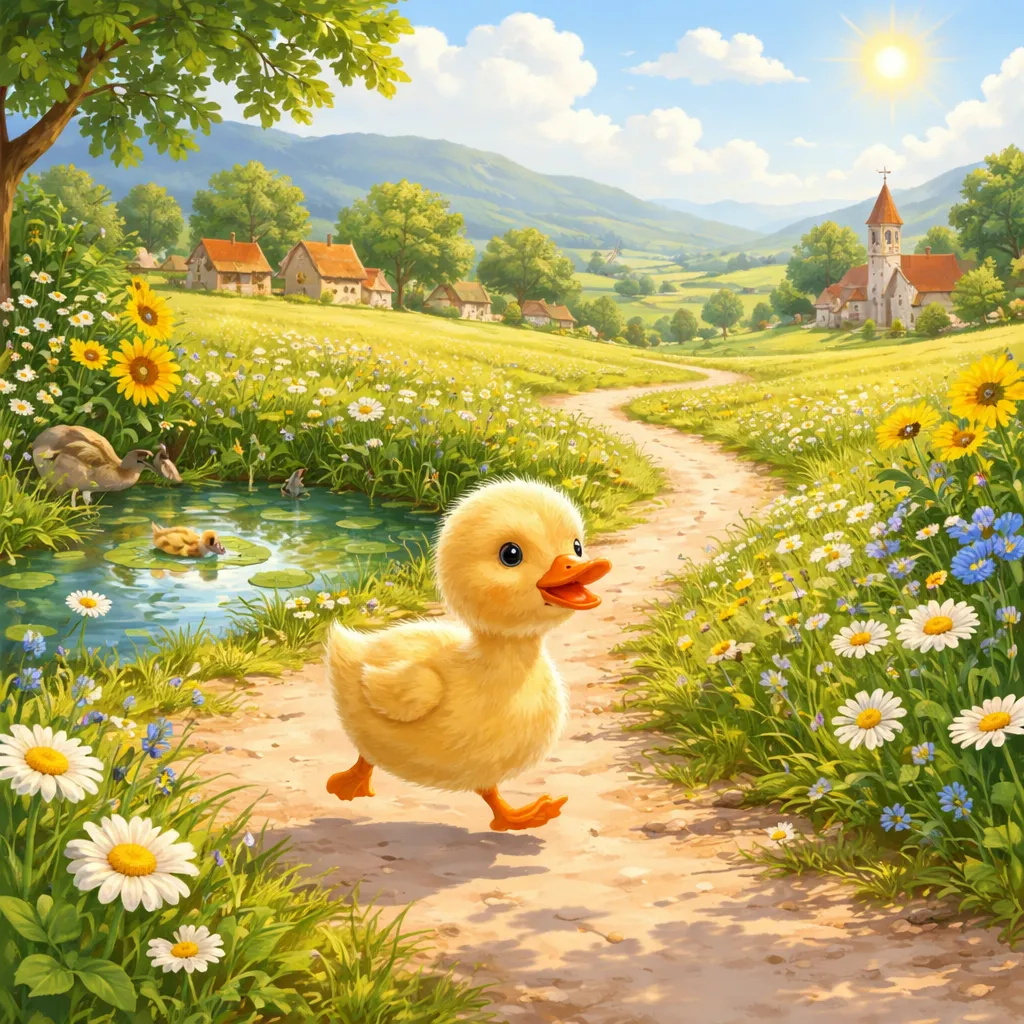

Have you ever seen a duck or a goose walk? They have a very special, funny way of moving from side to side. In Germany, there is a cheerful song all about a little goose and her wonderful, wobbly walk. It is a song about happy movement and friendship. Let’s try the funny walk and learn the joyful song “The Little Goose (Die kleine Gans).”
About the Song
Here are the bouncy, playful lyrics of a beloved traditional German children’s song:
Die kleine Gans, die kleine Gans,
die watschelt über'n Hof, juchhei!
Die kleine Gans, die kleine Gans,
die watschelt hin und her, juchhei!
Sie wackelt mit dem Schwänzelein,
ihr Schnabel schnattert froh und fein.
Die kleine Gans, die kleine Gans,
die watschelt immerzu, juchhei!
English Translation:
The little goose, the little goose,
she waddles across the yard, hooray!
The little goose, the little goose,
she waddles here and there, hooray!
She wiggles with her little tail,
her beak chatters happily and nicely.
The little goose, the little goose,
she waddles on and on, hooray!
This is a classic and lively German-language song for children that celebrates a goose’s special way of moving. The song is all about the funny, happy walk of a goose. “The little goose, the little goose, she waddles across the yard, hooray!” it begins, showing her moving over the farmyard. Her walk is not straight; it is a wobble. “The little goose, the little goose, she waddles here and there, hooray!” she goes from side to side. The song shows us the funny details. “She wiggles with her little tail,” and “her beak chatters happily and nicely.” She is not just walking; she is talking too! The song ends with her never stopping. “The little goose, the little goose, she waddles on and on, hooray!” The song is a celebration of a unique, joyful way of moving through the world.
What the Song is About
The song is a funny picture of a goose’s busy, happy walk. Imagine a sunny farmyard with a barn and a pond. A plump, white goose with a long neck comes out. “The little goose, the little goose, she waddles across the yard, hooray!” She doesn’t walk straight. She swings her body from left to right with each step in a funny waddle.
She doesn’t go in one direction. “The little goose, the little goose, she waddles here and there, hooray!” She goes towards the pond, then back, then over to the other geese. As she walks, her short tail moves too. “She wiggles with her little tail,” it goes side to side with her body. And she is not quiet! “Her beak chatters happily and nicely.” She makes friendly “schnatter” noises as she goes. She is full of energy and does not stop. “She waddles on and on, hooray!” The song is about movement, sound, and the simple, cheerful busyness of farm life.
Who Made It & Its Story
“Die kleine Gans” is a traditional German folk song that fits perfectly with other animal songs for young children. Its creator, like many folk songs, is not known. The song captures the amusing and familiar sight of geese waddling (“watscheln”) in a farmyard, a common scene in the German countryside. The verb “watscheln” is a perfect, funny-sounding word in German that describes this specific walk, and the song makes it fun to say and act out. It connects to the cultural enjoyment of observing and playfully imitating animals.
This bouncy, descriptive song is loved for three wonderful reasons. First, it teaches the fantastic, onomatopoeic German verb “watscheln” (to waddle) and other fun action words like “wackelt” (wiggles) and “schnattert” (chatters). Second, it has a catchy, rolling melody that perfectly mimics the side-to-side motion of a waddle, and the cheerful shout “juchhei!” makes it incredibly fun to sing and move to. Third, it celebrates individuality, joyful movement, and the lively sounds of animals, encouraging children to observe details and join in the fun.
When to Sing It
This song is perfect for any time you feel like moving in a funny, happy way. You can sing it while walking around the room with a big, wobbly, waddling walk, swinging your arms like wings. You can chant it during a visit to a park with a pond, watching real geese and ducks walk. You can also hum it while playing with toy animals, making your toy goose “watscheln” over the floor and “schnattern” with its beak.
What Children Can Learn
This playful, movement-filled song is a wonderful teacher about animal actions, body parts, and describing how things are done in German.
Vocabulary
The song teaches us clear words for animals, funny actions, body parts, and sounds in German. “The” (Die). “Little” (kleine). “Goose” (Gans). “She” (die / sie). “Waddles” (watschelt). “Across the” (über’n – short for “über den”). “Yard” (Hof). “Hooray” (juchhei!). “Here and there” (hin und her). “Wiggles” (wackelt). “With” (mit). “The” (dem). “Little tail” (Schwänzelein). “Her” (ihr). “Beak” (Schnabel). “Chatters” (schnattert). “Happily” (froh). “And” (und). “Nicely” (fein). “On and on” (immerzu).
Let’s use these words! You can describe an action: “Die Ente watschelt.” (The duck waddles.) You can talk about a sound: “Der Vogel schnattert.” (The bird chatters.) New word: Lustig. This means “funny” or “amusing,” a perfect word to describe the little goose’s walk.
Language Skills
This song is excellent for learning about describing how an action is done, using words called adverbs like “froh” (happily) and “fein” (nicely). The key phrase is “schnattert froh und fein” (chatters happily and nicely).
Concept Definition: Words like “froh” (happily) and “fein” (nicely) are adverbs. They are describing words for verbs (action words). They tell us more about the action. They answer the question “How?”. In the song, how does the goose’s beak chatter? It chatters happily and nicely. They add color and detail to what is happening.
Features and Types: Many adverbs in German are made by adding “-lich” or “-ig” to an adjective, but some, like “froh,” can look like the adjective. They often come after the verb they describe. Other examples you might know are “schnell” (quickly), “laut” (loudly), “leise” (quietly), and “gut” (well).
How to Spot Them: Here is a simple “How?” trick. Find the action word (the verb) in the sentence, like “schnattert” (chatters) or “watschelt” (waddles). Then ask: “How does it do that?” The word that answers that question is often an adverb. The goose’s beak chatters. How? Happily and nicely -> “froh und fein”.
How to Use Them: A great way to make your sentences more interesting is the “Action-Description Formula”. The pattern is: “[Subject] + [Action Verb] + [Adverb(s)].”
Example from the song: “Ihr Schnabel schnattert froh und fein.” (Her beak chatters happily and nicely.)
Example you can make: “Das Kind läuft schnell.” (The child runs quickly.) “Der Hund bellt laut.” (The dog barks loudly.) “Die Gans watschelt lustig.” (The goose waddles funnily.)
Sounds & Rhythm Fun
Listen to the bouncy, waddling rhythm of the melody. The song has a rolling, side-to-side tune that perfectly matches the action of waddling. The repeated line “Die kleine Gans” starts each wobbly step. The word “watschelt” itself sounds funny and wobbly when you say it, and it repeats, making it easy to remember.
The rhythm is not smooth; it has a little hop or sway in it, just like a goose’s walk. The fun animal sound “schnattert” is also great to say. The cheerful shouts “juchhei!” add bursts of energy. This musical pattern is perfect for creating your own funny walk song. You can write your own “Der kleine Pinguin” (The Little Penguin) song! Try: “Der kleine Pinguin, der kleine Pinguin, der watschelt auf dem Eis, juchhei! Der kleine Pinguin, der kleine Pinguin, der wackelt hin und her, juchhei! Er rutscht auf seinem Bauch so froh, im Schnee, da ist das gar nicht so…” (The little penguin… waddles on the ice… wiggles here and there… he slides on his belly so happily, in the snow, that is not so bad…)
Culture & Big Ideas
“Die kleine Gans” connects to the German enjoyment of farm life, animal observation, and the tradition of “Kinderlieder” (children’s songs) that turn everyday sights into music. The farmyard (“Hof”) is a common setting. The song also reflects a playful approach to language, using fun, descriptive words like “watscheln” that sound like what they mean. Geese are also associated with Martinmas (“Martinstag”) in some German regions, where processions with lanterns sometimes feature a goose.
The song conveys three playful, important ideas. First, it encourages close observation of nature and animal behavior, noticing not just what an animal is, but how it moves and sounds. Second, it celebrates unique ways of moving and being, showing that a “funny” walk like a waddle is something to enjoy and cheer for with a “juchhei!”. Third, it fosters a sense of joyful activity and persistence (“immerzu” – on and on), suggesting that keeping going in your own special way is a happy thing.
Values & Imagination
Imagine you are the cheerful “kleine Gans.” You step out of the barn into the big farmyard. “The little goose, the little goose, she waddles across the yard, hooray!” you think, as you start your funny, swinging walk from side to side. You are in no hurry to go straight. “The little goose, the little goose, she waddles here and there, hooray!” You visit a puddle, then some tasty grass, then your friends.
As you move, your whole body joins in. “She wiggles with her little tail,” your tail feathers swing with each step. And you are not quiet! “Her beak chatters happily and nicely.” You make friendly “schnatter schnatter” noises to the other geese. Why would you stop? It is too much fun! “She waddles on and on, hooray!” How does the ground feel under your webbed feet? What do you “schnatter” about to your friends? Draw the little goose’s waddle. Draw a big farmyard. Draw a path with left and right footprints to show a wobbly walk. Draw the goose with lines showing her tail wiggling and sound lines (“schnatter!”) coming from her beak. This shows the song’s focus on funny movement and sound.
The song encourages us to appreciate the funny and wonderful ways animals move, to find joy in our own unique ways of doing things, and to be cheerful and persistent. A wonderful activity is the “Watschel-Wettbewerb” (Waddle Contest). Have a race with a friend or family member, but you must waddle like the goose! As you waddle, say “Ich watschele!” (I am waddling!) and “Juchhei!”. See who can waddle the funniest or longest. This connects you to the song’s spirit of joyful, unique movement.
So, from the farmyard waddle to the chattering beak, this song is a celebration of movement. It is a vocabulary lesson in animals, funny actions, and descriptions. It is a language lesson in using adverbs like “froh” (happily) to describe how something is done. It is a music lesson in a bouncy, wobbly rhythm with cheerful shouts. “The Little Goose (Die kleine Gans)” teaches us to observe animals closely, to celebrate funny and unique ways of moving, and to keep going with a happy “juchhei!”
Your Core Takeaways
You are now an expert on the song “The Little Goose (Die kleine Gans).” You know it is a cheerful German song about a goose who waddles across the yard and here and there, wiggles her tail, chatters happily, and just keeps on waddling. You’ve learned German words like “Gans,” “watschelt,” “Hof,” “Schwänzelein,” “Schnabel,” “schnattert,” and “froh,” and you’ve practiced using adverbs like “froh” (happily) to describe how an action is done. You’ve felt its bouncy, waddling rhythm and created your own funny walk verse. You’ve also discovered the song’s message about observing animals, enjoying unique ways of moving, and being cheerfully persistent.
Your Practice Missions
First, play the “Wie macht es das?” (How does it do it?) game. Watch an animal, a person, or a vehicle move. Describe the action and how it is done using an adverb. For example, “Das Auto fährt schnell.” (The car drives quickly.) Or, waddle like the goose and say “Ich watschele lustig!” (I waddle funnily!). This mission makes you use the song’s key language skill of describing actions.
Second, have a “Schnatter”-Gespräch (Chatter Conversation). Like the little goose who chatters “froh und fein,” have a friendly, happy, made-up conversation with a friend, a toy, or even yourself in “schnatter” language. Just make cheerful, nonsense sounds back and forth, like the goose. Finish by saying “Das war ein frohes Gespräch!” (That was a happy conversation!). This mission connects you to the song’s playful, communicative joy.