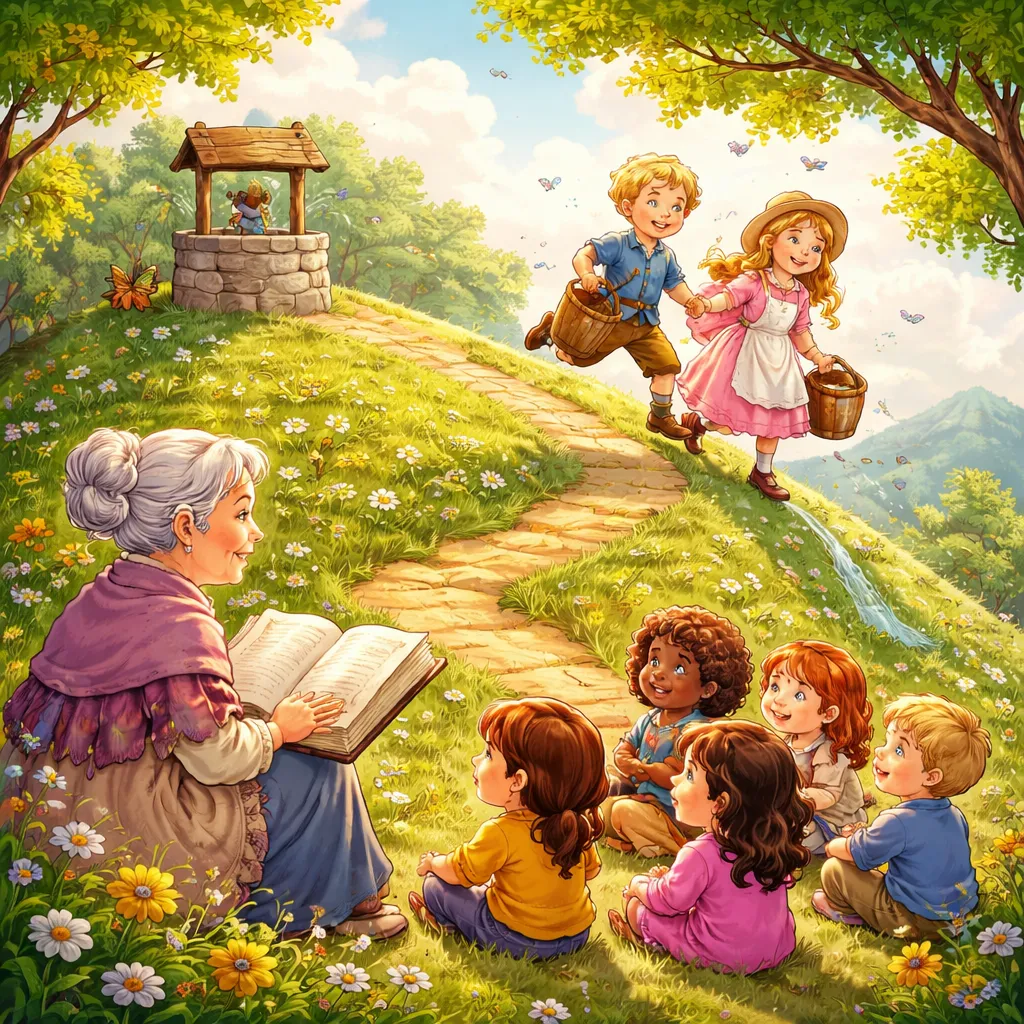

What is the Rhyme "Jack and Jill"?
"Jack and Jill" is one of the oldest and most famous English nursery rhymes in the world. It tells the simple story of two children who go up a hill to fetch a pail of water. Jack falls down and breaks his crown. Jill comes tumbling after. The English song: Jack and Jill has been sung to children for hundreds of years. The short story has a clear beginning, middle, and end. Children learn about cause and effect. Jack went up the hill. He fell down. Then Jill fell too. The simple plot helps young children understand story structure. The rhyming words make it easy to remember. This classic rhyme introduces children to the joy of storytelling through song.
The Complete Lyrics of the Nursery Rhyme
Let us look at the words together. The basic rhyme is short and sweet. Some versions have additional verses.
Jack and Jill went up the hill
To fetch a pail of water.
Jack fell down and broke his crown,
And Jill came tumbling after.
Then up Jack got and home did trot,
As fast as he could caper.
He went to bed to mend his head
With vinegar and brown paper.
Vocabulary Learning from the Song
This English song: Jack and Jill introduces children to important words about actions, body parts, and old-fashioned items. Each word builds their understanding of language and story.
First, we meet the characters "Jack" and "Jill." These are common names for boys and girls. You can talk about names in your family. Every person has a name, just like Jack and Jill.
The song teaches action words. "Went up" means climbing or walking upward. "Fetch" means to go get something and bring it back. "Fell down" means dropping to the ground. "Came tumbling" means rolling or falling quickly. These verbs help children describe movement.
"A pail" is an old word for a bucket. People used to carry water in pails from wells or streams. You can show your child a bucket and explain that people long ago had to carry water from outside.
"Broke his crown" is a funny phrase. Here, "crown" means the top of his head, not a royal crown. He bumped his head. You can talk about being careful not to fall and hurt your head.
Phonics Points to Practice
Let us listen for special sounds in the song. Phonics helps children connect letters to the sounds they hear. This English song: Jack and Jill gives us many sounds to explore.
Listen to the "j" sound at the beginning of "Jack" and "Jill." It is a sound made with the tongue pressed to the roof of the mouth. Say "Jack and Jill" slowly. Feel how your tongue moves. Practice other "j" words like "jump," "juice," and "joy."
The "h" sound appears in "hill" and "home." It is a gentle breath sound. Put your hand in front of your mouth and say "hill." Feel the air? Practice other "h" words like "happy," "house," and "hello."
Listen to the "f" sound in "fell" and "fetch." It is made by putting your top teeth on your bottom lip and blowing air. Practice other "f" words like "fish," "fun," and "flower."
The "t" sound in "tumbling" and "trot" is a quick sound made with the tongue behind the teeth. Practice other "t" words like "toy," "table," and "tickle."
Grammar Patterns We Can Learn
This classic story song teaches important grammar in a very natural way. The English song: Jack and Jill introduces past tense verbs, conjunctions, and prepositions.
The song uses past tense throughout. Jack and Jill "went" up the hill. Jack "fell" down and "broke" his crown. Jill "came" tumbling after. These are all past tense verbs. You can talk about your own day using past tense. "We went to the park." "You fell down." "Daddy came home." This helps children understand how we talk about things that already happened.
The word "and" connects ideas. "Jack and Jill" shows two people together. "Fell down and broke" shows two things happening. You can practice using "and" in daily life. "We had apples and bananas." "I like to run and jump."
Prepositions show location. "Up the hill" shows direction. "Down" shows falling. "After" shows sequence. You can practice using these words. "Let's go up the stairs." "The ball rolled down." "You go first, and I will come after."
Learning Activities to Do at Home
Bringing this English song: Jack and Jill into your daily life is simple and joyful. Here are some activities you can try with materials you already have.
A wonderful activity is the "Hill Climbing" game. Use pillows or cushions to make a small hill. Let your child be Jack or Jill and climb up with a small bucket or cup. When they reach the top, they can pretend to fall gently onto soft pillows. This brings the story to life through physical play.
Another activity is the "Water Fetching" game. Give your child a small bucket or pail. Fill it with water at a "well" (the sink or a basin). Have them carry it carefully to another spot. Talk about how hard it would be to carry water up a hill. This builds understanding of the story's challenge.
You can also have a "Head Helper" conversation. After Jack bumps his head, he goes to bed with vinegar and brown paper. Talk about what we do today when someone gets hurt. A hug, a bandage, a kiss to make it better. This builds empathy and connects old and new ways.
Printable Materials for Learning
Creating simple printables can make this English song: Jack and Jill more visual and engaging. You can make these materials together with your child.
Story sequencing cards are perfect for this rhyme. Draw simple pictures on separate cards. Jack and Jill going up the hill with a pail. Jack falling down. Jill tumbling after. Jack going home. Jack in bed with his head wrapped. Your child can arrange the cards in order and retell the story. This builds sequencing and narrative skills.
A Jack and Jill coloring page is always popular. Draw the two children on a hill with a pail between them. Add a well at the top. Let your child color the scene. Write "Jack and Jill" at the top. Display their artwork proudly.
You can also create simple word cards. Write words from the rhyme on cards. "Jack," "Jill," "hill," "pail," "water," "fell," "crown," "tumbling." Show each card as you sing that word. This builds early reading skills in a gentle, supportive way.
A path game helps with story understanding. Draw a winding path up a hill on paper. Place a small toy at the bottom. As you retell the story, move the toy up the hill, then down again. This makes the story's movement visual and clear.
Educational Games for Deeper Learning
Games make learning active and exciting. They encourage children to use the language from the English song: Jack and Jill in new and creative ways.
The "What Happens Next?" game builds prediction skills. Pause the song at different points and ask, "What happens next?" After Jack falls, ask, "What will Jill do?" After they both fall, ask, "What will Jack do now?" This builds comprehension and narrative understanding.
The "New Characters" game encourages creativity. Ask your child, "What if Tom and Tina went up the hill?" Create new verses. "Tom and Tina went up the hill to fetch a pail of water. Tom fell down and broke his crown, and Tina came tumbling after." Try other pairs of names. This shows children how the story pattern works with different characters.
The "New Endings" game explores possibilities. Ask your child, "What if Jack and Jill were very careful?" Create a new ending. "Jack and Jill went up the hill to fetch a pail of water. They walked slowly, held on tight, and never had a fall." This builds problem-solving and creative thinking.
The "Opposite Day" game is great fun. Sing the song backward. "Jill and Jack came down the hill, they put a pail of water back. Jack got up and fixed his crown, then Jill came tumbling up, not down!" This silly game shows children how language can be playful.
The "Safety First" conversation connects the song to real life. Talk about why Jack and Jill fell. The hill was steep. They might have been running. What could they have done to be safe? Walk slowly. Hold hands. Wear good shoes. This builds safety awareness while enjoying the story.
The "Vinegar and Brown Paper" exploration is a sensory activity. If your child is interested, let them smell a tiny bit of vinegar (diluted). Feel brown paper (a paper bag). Talk about how people long ago used these things for healing. This connects the song to history and sensory learning.
The "Pail Balance" game builds gross motor skills. Give your child a small bucket or pail. Have them try to walk while carrying it. Make it harder by adding a small amount of water or rice. Can they walk without spilling? This connects to Jack and Jill's task and builds coordination.
The "Hill Building" game uses blocks or cushions. Build a hill together. How high can you make it before it becomes unstable? This connects to engineering thinking while relating to the story's setting.