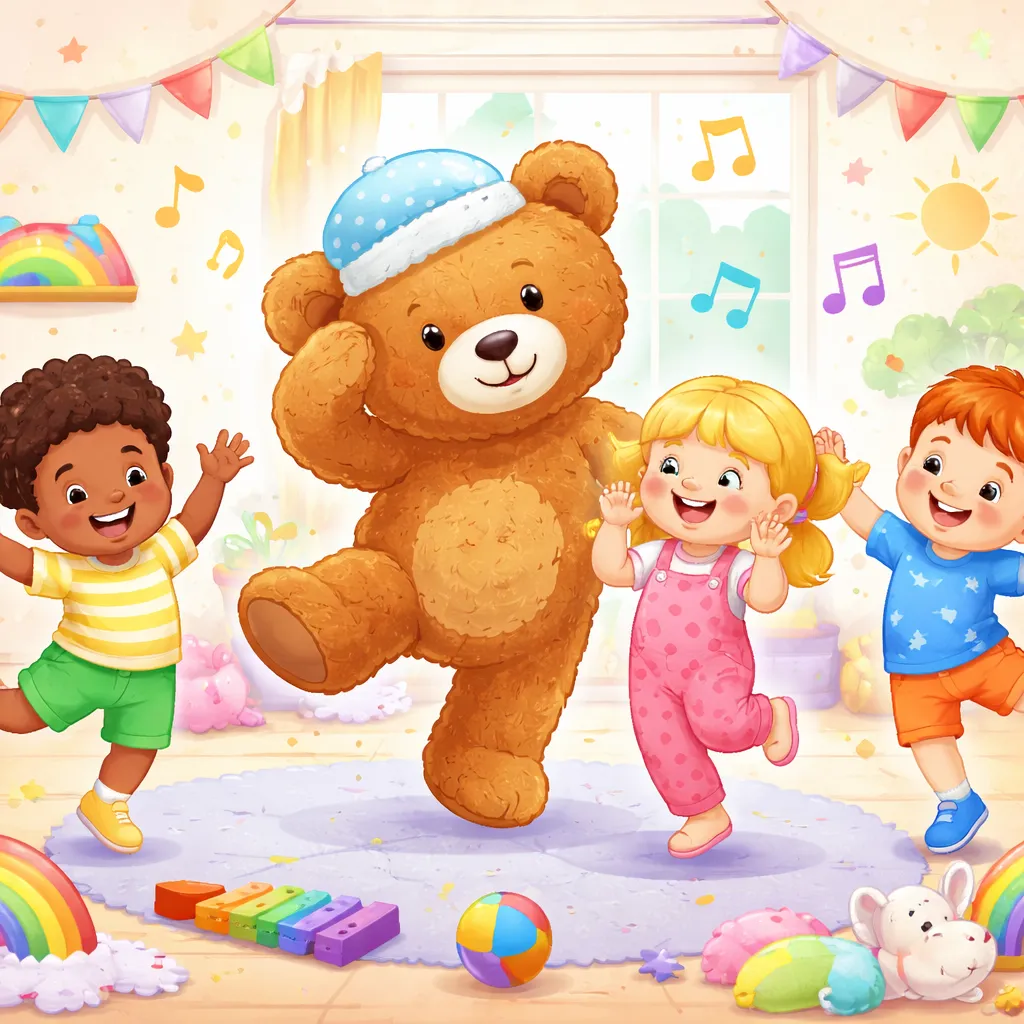

What is the Song "Teddy Bear, Teddy Bear"?
"Teddy Bear, Teddy Bear" is a delightful English nursery rhyme and action song that children absolutely adore. The song gives instructions to a teddy bear to perform different actions. Turn around, touch the ground, show your shoe, and say your prayers. The English song: Teddy Bear, Teddy Bear has been loved by generations of children playing with their favorite stuffed animals. The simple commands make it easy for young children to follow along. Children love to act out the motions with their own teddy bears or with their own bodies. The song builds coordination, following directions, and body awareness. The gentle ending about saying prayers and turning out the light makes it perfect for bedtime routines.
The Complete Lyrics of the Nursery Rhyme
Let us look at the words together. The song has several verses with different actions.
Teddy bear, teddy bear, turn around,
Teddy bear, teddy bear, touch the ground.
Teddy bear, teddy bear, show your shoe,
Teddy bear, teddy bear, that will do!
Teddy bear, teddy bear, go upstairs,
Teddy bear, teddy bear, say your prayers.
Teddy bear, teddy bear, turn out the light,
Teddy bear, teddy bear, say good night!
Vocabulary Learning from the Song
This English song: Teddy Bear, Teddy Bear introduces children to action words, body parts, and bedtime routines. Each word builds their understanding of language and daily life.
First, the song teaches about a "teddy bear." A teddy bear is a soft, stuffed toy bear. Many children have a favorite teddy bear that they love. You can talk about your child's own teddy bear. What is its name? How does it feel?
The song teaches action words. "Turn around" means to spin in a circle. "Touch the ground" means to reach down and touch the floor. "Show your shoe" means to lift your foot so your shoe can be seen. "Go upstairs" means to climb steps. "Say your prayers" means to speak to God before bed. "Turn out the light" means to switch off the lamp. "Say good night" means to wish someone a good sleep.
The phrase "that will do" means that is enough, that is good. This is a gentle way to say the actions are complete.
Phonics Points to Practice
Let us listen for special sounds in the song. Phonics helps children connect letters to the sounds they hear. This English song: Teddy Bear, Teddy Bear gives us many sounds to explore.
Listen to the "t" sound at the beginning of "teddy." It is a quick sound made with the tongue behind the teeth. Say "teddy bear" slowly. Feel your tongue move. Practice other "t" words like "toy," "table," and "tickle."
The "b" sound appears in "bear." It is a strong sound made by pressing lips together. Practice other "b" words like "ball," "book," and "baby."
Listen to the "r" sound in "round" and "prayers." It is a rolling sound made with the tongue. Practice other "r" words like "rabbit," "red," and "run."
The "sh" sound in "shoe" and "show" is important. Put your finger to your lips and say "shhh." Practice other "sh" words like "ship," "fish," and "shop."
The "l" sound in "light" is a light sound made with the tongue touching the roof of the mouth. Practice other "l" words like "lamb," "leaf," and "lullaby."
Grammar Patterns We Can Learn
This action song teaches important grammar in a very natural way. The English song: Teddy Bear, Teddy Bear introduces imperatives, repetition, and the phrase "that will do."
The song uses imperatives throughout. "Turn around." "Touch the ground." "Show your shoe." "Say your prayers." "Turn out the light." "Say good night." These are commands telling the teddy bear what to do. Children hear imperatives every day. "Come here." "Sit down." "Eat your lunch." The song adds playful imperatives to the mix.
The repetition of "teddy bear, teddy bear" at the beginning of each line makes the song easy to learn and remember. It also shows how we can address someone directly before giving a command.
The phrase "that will do" is a gentle way to say something is finished or acceptable. You can use this phrase in daily life. "You've brushed your teeth, that will do." "You've put away your toys, that will do."
Learning Activities to Do at Home
Bringing this English song: Teddy Bear, Teddy Bear into your daily life is simple and joyful. Here are some activities you can try with materials you already have.
A wonderful activity is the "Teddy Bear Dance." Get your child's favorite teddy bear. Hold the bear and make it do the actions while you sing. Turn the bear around. Touch the bear's feet to the ground. Show the bear's shoe. This brings the song to life and makes the teddy bear a participant.
Another activity is the "Follow the Leader" game. You be the leader and call out actions. Your child follows along, pretending to be a teddy bear. Then switch roles. Your child calls out actions and you follow. This builds listening skills and following directions.
You can also have a "Bedtime Routine" connection. Use the song as part of your bedtime routine. After singing, say good night to your child's teddy bear. Turn out the light. This creates a loving bedtime ritual.
Printable Materials for Learning
Creating simple printables can make this English song: Teddy Bear, Teddy Bear more visual and engaging. You can make these materials together with your child.
Action cards are perfect for this song. Draw simple pictures of each action on separate cards. Teddy bear turning around, touching ground, showing shoe, going upstairs, saying prayers, turning out light, saying good night. Hold up each card as you sing that verse. This builds vocabulary and following directions.
A coloring page is always popular. Draw a cute teddy bear doing one of the actions, like turning around or touching the ground. Let your child color the scene. Write "Teddy Bear, Teddy Bear" at the top. Display their artwork proudly.
You can also create simple word cards. Write words from the song on cards. "Teddy," "bear," "turn," "around," "touch," "ground," "show," "shoe," "upstairs," "prayers," "light," "good," "night." Show each card as you sing that word. This builds early reading skills.
A bedtime routine chart helps with evening organization. Draw pictures of each step in order. Brush teeth, put on pajamas, read story, sing teddy bear song, say prayers, turn out light. Check them off as you complete them.
Educational Games for Deeper Learning
Games make learning active and exciting. They encourage children to use the language from the English song: Teddy Bear, Teddy Bear in new and creative ways.
The "New Actions" game encourages creativity. Ask your child, "What other things could the teddy bear do?" Jump up high? Spin real fast? Touch your nose? Create new verses. "Teddy bear, teddy bear, jump up high. Teddy bear, teddy bear, touch the sky." This shows children how to extend the pattern.
The "Teddy Bear Picnic" pretend play is creative fun. Set up a picnic for teddy bears. Have them sit in a circle. Sing songs to them. Feed them pretend food. This builds imagination and social skills.
The "Opposite Actions" game adds challenge. Call out actions and their opposites. Turn around/stand still. Touch the ground/reach the sky. Show your shoe/hide your shoe. This builds vocabulary and listening skills.
The "Prayer Time" discussion explores the concept of prayers. Some families say prayers before bed. Talk about what prayers mean in your family. This builds understanding of family traditions.
The "Upstairs/Downstairs" game uses the concept of going upstairs. If you have stairs, practice going up and down safely. Count the steps. This builds gross motor skills and number sense.
The "Light Switch" practice is a simple life skill. Let your child practice turning the light on and off (with supervision). Talk about why we turn out the light at bedtime. This builds independence.
The "Good Night" ritual can be extended. Say good night to everyone and everything. "Good night, teddy bear. Good night, moon. Good night, mommy. Good night, me." This builds language and creates a calming routine.
The "Teddy Bear Names" game practices names. What is your teddy bear's name? Why did you choose that name? If your teddy bear doesn't have a name, choose one together. This builds decision-making and personal connection.