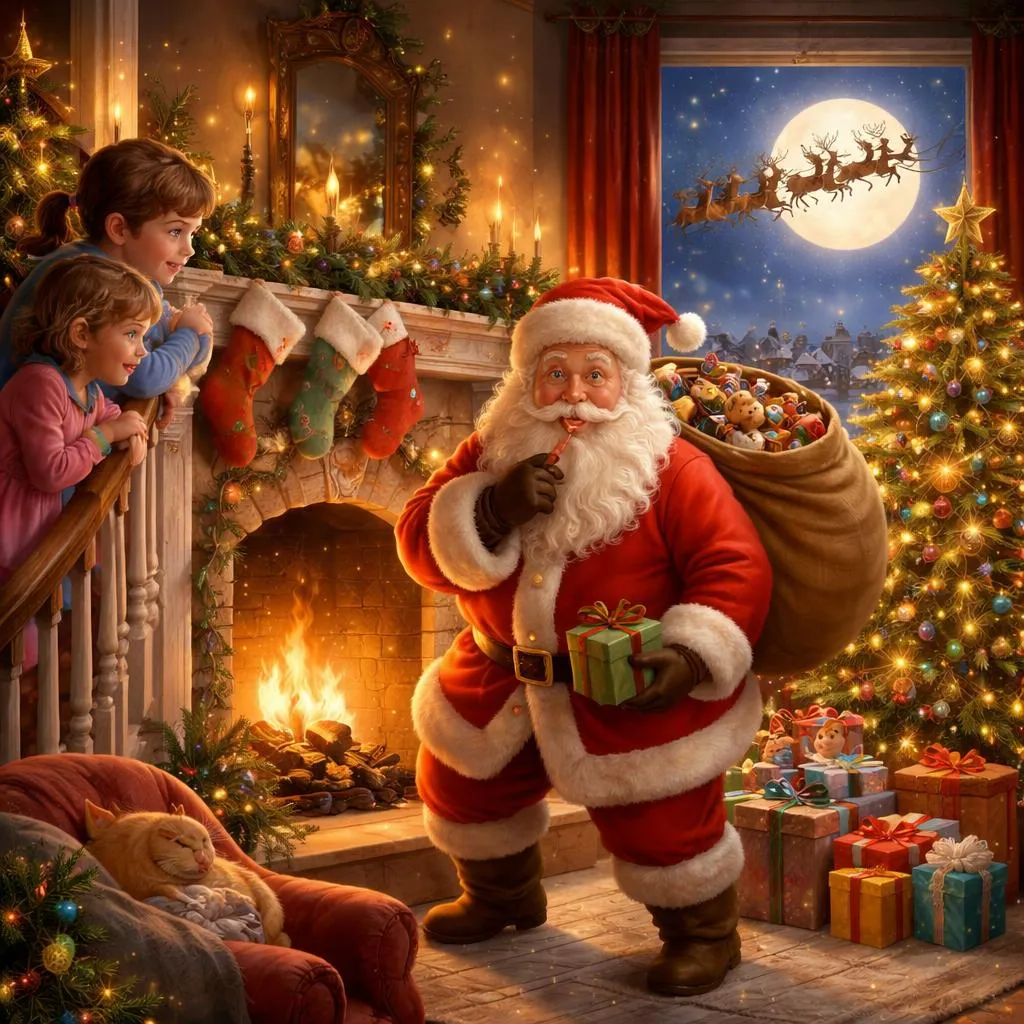

‘Twas the night before Christmas, when all through the house
Not a creature was stirring, not even a mouse;
The stockings were hung by the chimney with care,
In hopes that St. Nicholas soon would be there;
The children were nestled all snug in their beds,
While visions of sugar-plums danced in their heads;
And mamma in her ‘kerchief, and I in my cap,
Had just settled down for a long winter’s nap,
When out on the lawn there arose such a clatter,
I sprang from the bed to see what was the matter.
Away to the window I flew like a flash,
Tore open the shutters and threw up the sash.
The moon on the breast of the new-fallen snow
Gave the lustre of mid-day to objects below,
When, what to my wondering eyes should appear,
But a miniature sleigh, and eight tiny reindeer,
With a little old driver, so lively and quick,
I knew in a moment it must be St. Nick.
More rapid than eagles his coursers they came,
And he whistled, and shouted, and called them by name;
“Now, Dasher! now, Dancer! now, Prancer and Vixen!
On, Comet! on Cupid! on, Donder and Blitzen!
To the top of the porch! to the top of the wall!
Now dash away! dash away! dash away all!”
As dry leaves that before the wild hurricane fly,
When they meet with an obstacle, mount to the sky,
So up to the house-top the coursers they flew,
With the sleigh full of toys, and St. Nicholas too.
And then, in a twinkling, I heard on the roof
The prancing and pawing of each little hoof.
As I drew in my hand, and was turning around,
Down the chimney St. Nicholas came with a bound.
He was dressed all in fur, from his head to his foot,
And his clothes were all tarnished with ashes and soot;
A bundle of toys he had flung on his back,
And he looked like a peddler just opening his pack.
His eyes—how they twinkled! his dimples how merry!
His cheeks were like roses, his nose like a cherry!
His droll little mouth was drawn up like a bow,
And the beard of his chin was as white as the snow;
The stump of a pipe he held tight in his teeth,
And the smoke it encircled his head like a wreath;
He had a broad face and a little round belly,
That shook, when he laughed like a bowlful of jelly.
He was chubby and plump, a right jolly old elf,
And I laughed when I saw him, in spite of myself;
A wink of his eye and a twist of his head,
Soon gave me to know I had nothing to dread;
He spoke not a word, but went straight to his work,
And filled all the stockings; then turned with a jerk,
And laying his finger aside of his nose,
And giving a nod, up the chimney he rose;
He sprang to his sleigh, to his team gave a whistle,
And away they all flew like the down of a thistle.
But I heard him exclaim, ere he drove out of sight,
“Happy Christmas to all, and to all a good-night.”
Background and Author Introduction
This beloved poem, originally titled A Visit from St. Nicholas, is commonly known as ’Twas the Night Before Christmas. It was first published anonymously in 1823 and later attributed to Clement Clarke Moore, an American professor and writer. Moore wrote this poem to entertain his children, and it quickly became a cherished Christmas tradition in the United States and around the world. The poem played a significant role in shaping the modern image of Santa Claus, including his sleigh, reindeer, and jolly personality.
Detailed Interpretation and Meaning
The poem captures the magical anticipation and joy of Christmas Eve through the eyes of a narrator who witnesses the arrival of St. Nicholas (Santa Claus). Its rhythmic and vivid descriptions create a warm, cozy atmosphere that appeals to children and adults alike. It portrays themes of generosity, wonder, and the spirit of giving, emphasizing the excitement of the holiday season and the innocence of childhood dreams.
Santa Claus is depicted as a cheerful, kind, and hardworking figure who brings happiness to children by delivering gifts. The poem’s imagery—such as the glistening snow, the prancing reindeer, and the twinkling eyes of Santa—evokes a sense of enchantment and festive cheer. It also highlights the importance of family, tradition, and hope during the winter holidays.
Lessons and Insights for Children and Students
- Imagination and Creativity: The poem encourages children to use their imagination to visualize magical scenes and characters, fostering creativity and storytelling skills.
- Appreciation of Traditions: Understanding this poem helps students appreciate cultural traditions and the ways stories shape holiday celebrations.
- Generosity and Kindness: Santa’s role as a giver teaches the value of generosity and caring for others, inspiring children to think about how they can share and help in their own lives.
- Patience and Anticipation: The poem captures the excitement of waiting for something special, teaching patience and the joy of anticipation.
How to Apply These Lessons in Daily Life
- In Learning: Students can practice descriptive writing by creating their own holiday stories or poems inspired by this classic. They can also explore the history of holiday traditions worldwide to broaden their cultural understanding.
- In Social Settings: The spirit of kindness and giving can be practiced by helping classmates, sharing with friends, or participating in community service during the holiday season.
- In Family Life: Families can read this poem together to create bonding moments and reinforce the importance of traditions and togetherness.
Cultivating Positive Values from the Story
- Joy and Positivity: Emulate Santa’s cheerful and jolly nature by approaching challenges with a positive attitude.
- Hard Work and Dedication: Notice how Santa works quietly and efficiently to deliver gifts, reminding students that dedication and effort are important in achieving goals.
- Respect and Gratitude: The poem encourages respect for the magic of childhood and gratitude for the kindness of others, which are essential social values.
Conclusion
’Twas the Night Before Christmas is more than just a festive poem; it is a timeless piece that teaches valuable lessons about imagination, generosity, and the joy of giving. By exploring its themes and imagery, students can deepen their appreciation for literature and learn how to embody the positive qualities it celebrates in their everyday lives.
