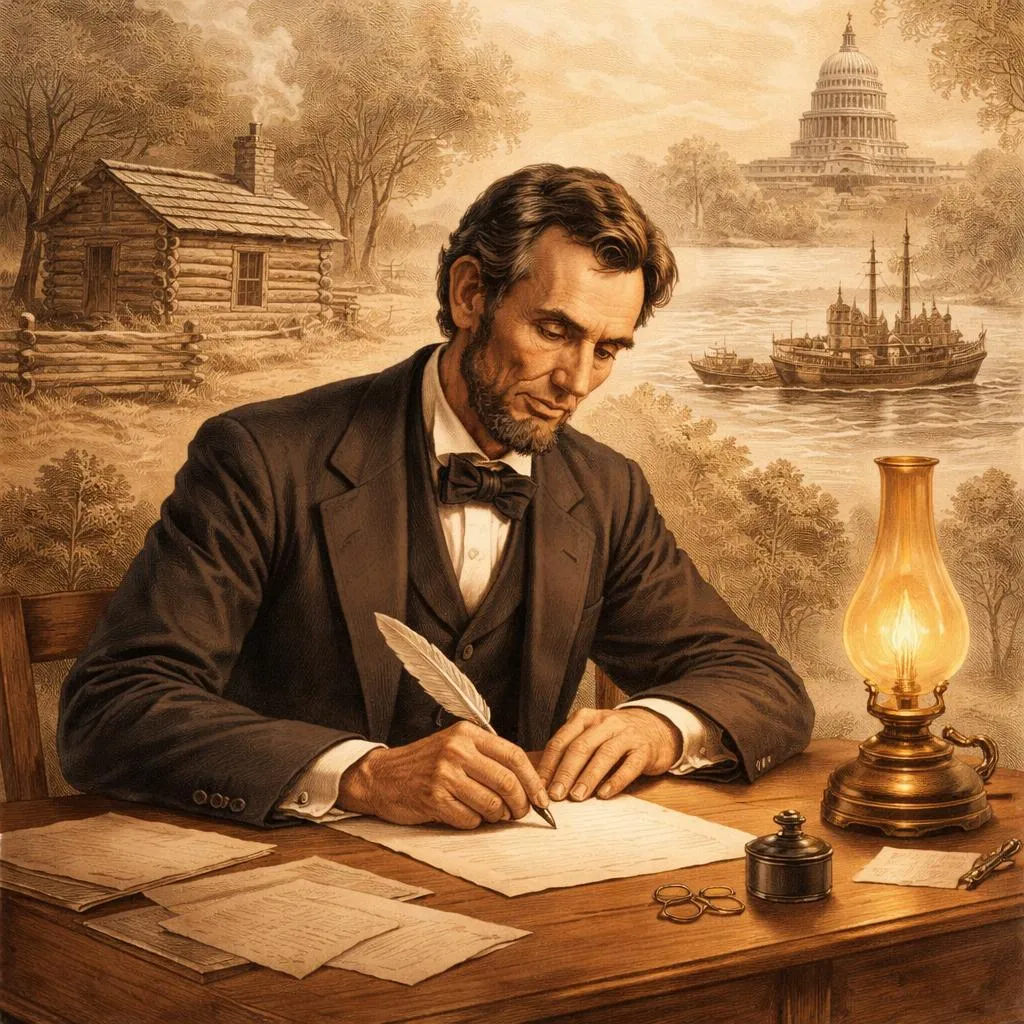

I was born February 12, 1809, in Hardin County, Kentucky. My parents were both born in Virginia, of undistinguished families—second families, perhaps I should say. My mother, who died in my tenth year, was of a family of the name of Hanks, some of whom now reside in Adams, and others in Macon County, Illinois. My paternal grandfather, Abraham Lincoln, emigrated from Rockingham County, Virginia, to Kentucky about 1781 or 1782, where a year or two later he was killed by the Indians, not in battle, but by stealth, when he was laboring to open a farm in the forest. His ancestors, who were Quakers, went to Virginia from Berks County, Pennsylvania. An effort to identify them with the New England family of the same name ended in nothing more definite than a similarity of Christian names in both families, such as Enoch, Levi, Mordecai, Solomon, Abraham, and the like.
My father, at the death of his father, was but six years of age, and he grew up literally without education. He removed from Kentucky to what is now Spencer County, Indiana in my eighth year. We reached our new home about the time the state came into the Union. It was a wild region, with many bears and other wild animals still in the woods. There I grew up. There were some schools, so called, but no qualification was ever required of a teacher beyond “readin’, writin’, and cipherin’” to the rule of three. If a straggler supposed to understand Latin happened to sojourn in the neighborhood, he was looked upon as a wizard. There was absolutely nothing to excite ambition for education. Of course, when I came of age I did not know much. Still, somehow I could read, write, and cipher to the rule of three, but that was all. I have not been to school since. The little advance I now have upon this store of education I have picked up from time to time under the pressure of necessity.
I was raised to farm work, which I continued till I was twenty-two. At twenty-one I came to Illinois, Macon County. Then I got to New Salem, at that time in Sangamon, now in Menard, County, where I remained a year as a sort of clerk in a store.
Then came the Black Hawk war, and I was elected a captain of volunteers, a success which gave me more pleasure than any I have had since. I went the campaign, was elated, ran for the legislature the same year (1832), and was beaten—the only time I have ever been beaten by the people. The next and three succeeding biennial elections I was elected to the legislature. I was not a candidate afterward. During this legislative period I had studied law, and removed to Springfield to practice it. In 1846 I was once elected to the lower house of Congress. I was not a candidate for reelection. From 1849 to 1854, both inclusive practiced law more assiduously than ever before. Always a Whig in politics; and generally on the Whig electoral tickets, making active canvasses. I was losing interest in politics when the repeal of the Missouri Compromise aroused me again. What I have done since then is pretty well known.
If any personal description of me is thought desirable, it may be said I am, in height, six feet four inches, nearly; lean in flesh, weighing on an average one hundred and eighty pounds; dark complexion, with coarse black hair and gray eyes. No other marks or brands recollected.
Background and Author Introduction
This passage is an excerpt from the early life of Abraham Lincoln, the 16th President of the United States. Born in a humble frontier family in 1809, Lincoln's story is one of perseverance, self-education, and dedication to public service. His upbringing in a rugged and undeveloped region, with limited access to formal schooling, shaped his character and values. Despite these challenges, Lincoln taught himself law and rose to become a key figure in American history, leading the nation through its greatest crisis, the Civil War.
Detailed Interpretation and Significance
Lincoln’s narrative reveals the harsh realities of frontier life in early 19th-century America. The lack of formal education and the rough environment did not deter him from seeking knowledge and self-improvement. His early experiences with farming and manual labor grounded him in the realities of everyday people, which influenced his empathy and leadership style later in life.
The passage also highlights the importance of resilience. Lincoln faced defeat in his first political campaign but did not give up. Instead, he continued to pursue his goals, eventually achieving significant political success. His story emphasizes that setbacks are part of growth and that determination can lead to great accomplishments.
Lessons and Insights for Students
-
Value of Self-Education: Lincoln’s life teaches students that formal education is valuable, but learning can and should continue beyond the classroom. Curiosity, reading, and practical experience are powerful tools for personal growth.
-
Perseverance Through Challenges: Students learn that failure is not the end but a stepping stone. Lincoln’s initial political defeat did not discourage him; instead, it motivated him to work harder.
-
Humility and Hard Work: Coming from modest beginnings, Lincoln’s story shows that success is not about where you start but how you work and grow.
-
Leadership and Service: Lincoln’s dedication to serving his community and country encourages students to think about how they can contribute positively to society.
Applying These Lessons in Daily Life
-
In Learning: Students can adopt Lincoln’s habit of self-study by exploring topics beyond their school curriculum, developing critical thinking and problem-solving skills.
-
In Social Settings: Lincoln’s empathy and understanding remind students to respect others’ backgrounds and experiences, fostering kindness and cooperation.
-
In Facing Difficulties: When encountering setbacks in school or personal life, students can remember Lincoln’s resilience and keep striving toward their goals.
Cultivating Positive Traits from Lincoln’s Story
- Curiosity: Encourage asking questions and seeking knowledge actively.
- Determination: Set goals and persist even when progress seems slow.
- Integrity: Uphold honesty and fairness in all actions.
- Leadership: Practice responsibility and help others in group activities or community projects.
By reflecting on Abraham Lincoln’s early life and values, students can find inspiration to develop their character and skills, preparing them for future challenges and opportunities.
