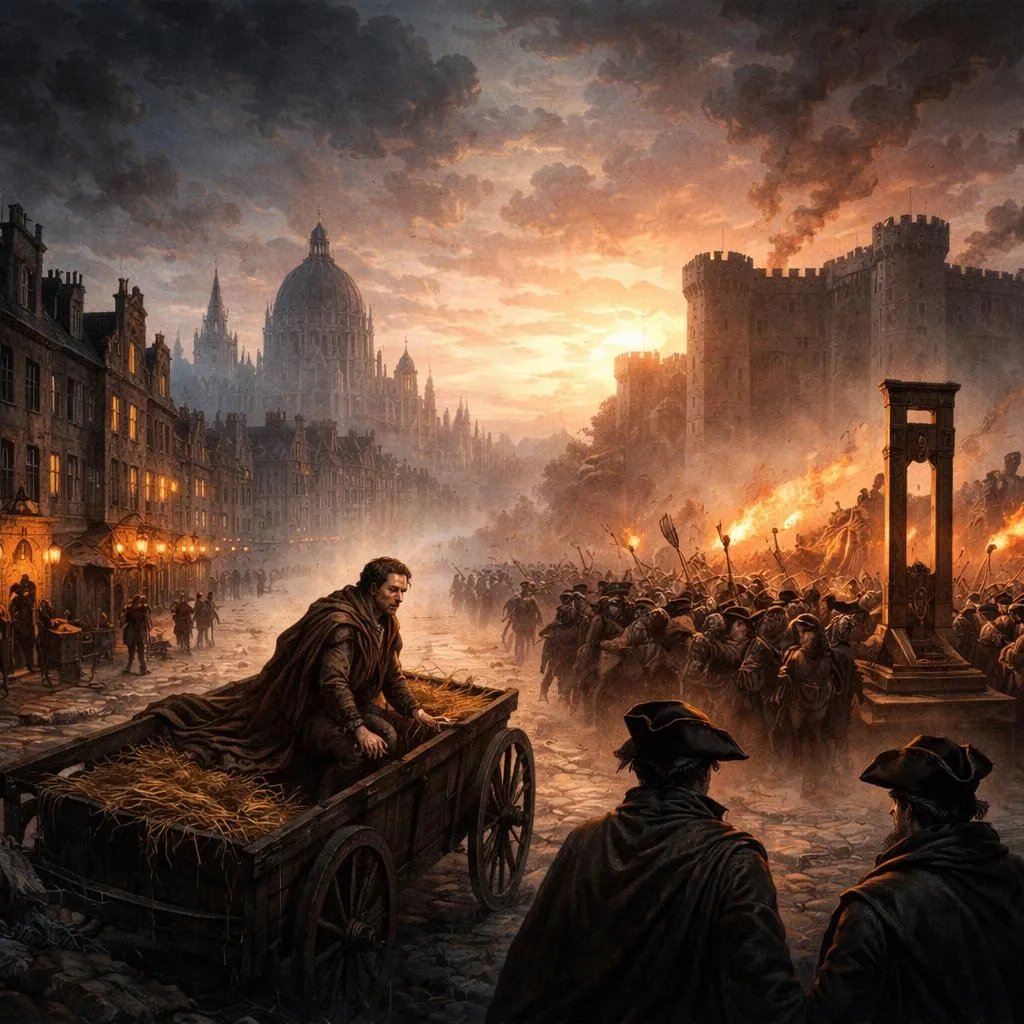

It was the best of times, it was the worst of times, it was the age of wisdom, it was the age of foolishness, it was the epoch of belief, it was the epoch of incredulity, it was the season of Light, it was the season of Darkness, it was the spring of hope, it was the winter of despair, we had everything before us, we had nothing before us, we were all going direct to Heaven, we were all going direct the other way—in short, the period was so far like the present period, that some of its noisiest authorities insisted on its being received, for good or for evil, in the superlative degree of comparison only.
There were a king with a large jaw and a queen with a plain face, on the throne of England; there were a king with a large jaw and a queen with a fair face, on the throne of France. In both countries it was clearer than crystal to the lords of the State preserves of loaves and fishes, that things in general were settled for ever.
It was the year of Our Lord one thousand seven hundred and seventy-five. Spiritual revelations were conceded to England at that favoured period, as at this. Mrs. Southcott had recently attained her five-and-twentieth blessed birthday, of whom a prophetic private in the Life Guards had heralded the sublime appearance by announcing that arrangements were made for the swallowing up of London and Westminster. Even the Cock-lane ghost had been laid only a round dozen of years, after rapping out its messages, as the spirits of this very year last past (supernaturally deficient in originality) rapped out theirs. Mere messages in the earthly order of events had lately come to the English Crown and People, from a congress of British subjects in America: which, strange to relate, have proved more important to the human race than any communications yet received through any of the chickens of the Cock-lane brood.
France, less favoured on the whole as to matters spiritual than her sister of the shield and trident, rolled with exceeding smoothness down hill, making paper money and spending it. Under the guidance of her Christian pastors, she entertained herself, besides, with such humane achievements as sentencing a youth to have his hands cut off, his tongue torn out with pincers, and his body burned alive, because he had not kneeled down in the rain to do honour to a dirty procession of monks which passed within his view, at a distance of some fifty or sixty yards. It is likely enough that, rooted in the woods of France and Norway, there were growing trees, when that sufferer was put to death, already marked by the Woodman, Fate, to come down and be sawn into boards, to make a certain movable framework with a sack and a knife in it, terrible in history. It is likely enough that in the rough outhouses of some tillers of the heavy lands adjacent to Paris, there were sheltered from the weather that very day, rude carts, bespattered with rustic mire, snuffed about by pigs, and roosted in by poultry, which the Farmer, Death, had already set apart to be his tumbrils of the Revolution. But that Woodman and that Farmer, though they work unceasingly, work silently, and no one heard them as they went about with muffled tread: the rather, forasmuch as to entertain any suspicion that they were awake, was to be atheistical and traitorous.
In England, there was scarcely an amount of order and protection to justify much national boasting. Daring burglaries by armed men, and highway robberies, took place in the capital itself every night; families were publicly cautioned not to go out of town without removing their furniture to upholsterers’ warehouses for security; the highwayman in the dark was a City tradesman in the light, and, being recognised and challenged by his fellow- tradesman whom he stopped in his character of “the Captain,” gallantly shot him through the head and rode away; the mall was waylaid by seven robbers, and the guard shot three dead, and then got shot dead himself by the other four, “in consequence of the failure of his ammunition:” after which the mall was robbed in peace; that magnificent potentate, the Lord Mayor of London, was made to stand and deliver on Turnham Green, by one highwayman, who despoiled the illustrious creature in sight of all his retinue; prisoners in London gaols fought battles with their turnkeys, and the majesty of the law fired blunderbusses in among them, loaded with rounds of shot and ball; thieves snipped off diamond crosses from the necks of noble lords at Court drawing-rooms; musketeers went into St. Giles’s, to search for contraband goods, and the mob fired on the musketeers, and the musketeers fired on the mob, and nobody thought any of these occurrences much out of the common way. In the midst of them, the hangman, ever busy and ever worse than useless, was in constant requisition; now, stringing up long rows of miscellaneous criminals; now, hanging a housebreaker on Saturday who had been taken on Tuesday; now, burning people in the hand at Newgate by the dozen, and now burning pamphlets at the door of Westminster Hall; to-day, taking the life of an atrocious murderer, and to-morrow of a wretched pilferer who had robbed a farmer’s boy of sixpence.
All these things, and a thousand like them, came to pass in and close upon the dear old year one thousand seven hundred and seventy-five. Environed by them, while the Woodman and the Farmer worked unheeded, those two of the large jaws, and those other two of the plain and the fair faces, trod with stir enough, and carried their divine rights with a high hand. Thus did the year one thousand seven hundred and seventy-five conduct their Greatnesses, and myriads of small creatures—the creatures of this chronicle among the rest—along the roads that lay before them.
Background and Author Introduction
This passage is the famous opening of A Tale of Two Cities, a historical novel written by Charles Dickens, first published in 1859. Dickens was one of the greatest English novelists of the Victorian era, known for his vivid characters, social criticism, and storytelling that combined drama, humor, and deep empathy for human struggles. A Tale of Two Cities is set during the turbulent times of the French Revolution, contrasting life in London and Paris. The novel explores themes of sacrifice, resurrection, and the clash between tyranny and liberty.
Detailed Interpretation and Significance
The opening lines set the tone for the entire novel by presenting a world of contradictions—hope and despair, wisdom and foolishness, light and darkness. Dickens uses these opposites to highlight the complexity of the era, showing that history is never simply good or bad but a mixture of both. The "best of times" and "worst of times" reflect the social and political upheavals that shaped the 18th century and echo challenges we face today.
The passage introduces the political and social unrest in England and France, hinting at the coming revolution. Dickens paints a vivid picture of injustice, cruelty, and inequality, such as the harsh punishments in France and the lawlessness in England. The metaphorical figures of the Woodman (Fate) and the Farmer (Death) silently preparing the tools of revolution remind readers that great historical changes often happen quietly, unnoticed until they erupt.
Lessons and Insights for Students
-
Understanding History's Complexity: The passage teaches students that history is multifaceted. Events have multiple sides and impacts, and understanding this complexity helps develop critical thinking.
-
Empathy and Justice: Dickens’ portrayal of suffering and injustice encourages readers to empathize with those who are oppressed and to value fairness and human rights.
-
The Power of Change: The novel shows that change is inevitable, sometimes violent, but necessary for progress. Students can learn about resilience and the importance of standing up for justice.
-
Moral Reflection: The contrast between light and darkness invites readers to reflect on their own choices—how wisdom and foolishness coexist, and how belief and skepticism shape our lives.
Application in Life, Study, and Social Situations
-
In Learning: Students can apply the lesson of looking beyond surface appearances to understand deeper truths, whether in history, literature, or current events.
-
In Social Interactions: The novel’s emphasis on empathy and justice can inspire students to be kind and fair in their relationships, recognizing others’ struggles.
-
In Personal Growth: The theme of resurrection and transformation encourages students to believe in second chances and the possibility of personal improvement.
Cultivating Positive Values from the Story
-
Courage and Sacrifice: Characters in the novel demonstrate bravery in the face of danger. Students can learn to face challenges bravely and to value selflessness.
-
Awareness and Responsibility: The silent work of the Woodman and Farmer teaches that even unseen actions have consequences. Students should be mindful of their choices and responsibilities.
-
Critical Thinking: By recognizing contradictions and complexities, students develop the ability to analyze situations critically rather than accept simple explanations.
Conclusion
A Tale of Two Cities remains a powerful story for young readers, offering rich lessons about history, human nature, and morality. It encourages students not only to understand the past but also to apply its lessons in their daily lives—promoting empathy, justice, courage, and thoughtful reflection. Through studying this novel, students can grow intellectually and morally, preparing them to contribute positively to their communities and the world.
