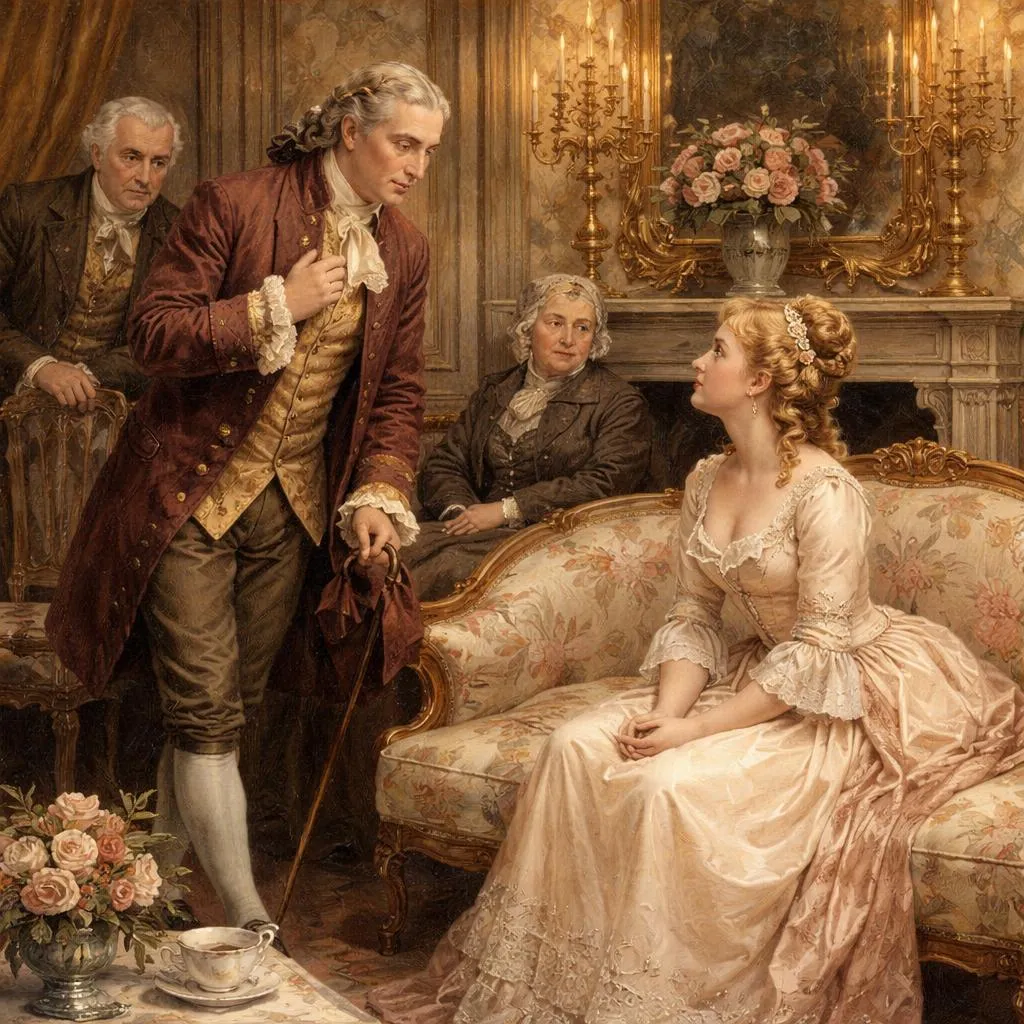

Mr. Stryver having made up his mind to that magnanimous bestowal of good fortune on the Doctor’s daughter, resolved to make her happiness known to her before he left town for the Long Vacation. After some mental debating of the point, he came to the conclusion that it would be as well to get all the preliminaries done with, and they could then arrange at their leisure whether he should give her his hand a week or two before Michaelmas Term, or in the little Christmas vacation between it and Hilary.
As to the strength of his case, he had not a doubt about it, but clearly saw his way to the verdict. Argued with the jury on substantial worldly grounds—the only grounds ever worth taking into account— it was a plain case, and had not a weak spot in it. He called himself for the plaintiff, there was no getting over his evidence, the counsel for the defendant threw up his brief, and the jury did not even turn to consider. After trying it, Stryver, C. J., was satisfied that no plainer case could be.
Accordingly, Mr. Stryver inaugurated the Long Vacation with a formal proposal to take Miss Manette to Vauxhall Gardens; that failing, to Ranelagh; that unaccountably failing too, it behoved him to present himself in Soho, and there declare his noble mind.
Towards Soho, therefore, Mr. Stryver shouldered his way from the Temple, while the bloom of the Long Vacation’s infancy was still upon it. Anybody who had seen him projecting himself into Soho while he was yet on Saint Dunstan’s side of Temple Bar, bursting in his full-blown way along the pavement, to the jostlement of all weaker people, might have seen how safe and strong he was.
His way taking him past Tellson’s, and he both banking at Tellson’s and knowing Mr. Lorry as the intimate friend of the Manettes, it entered Mr. Stryver’s mind to enter the bank, and reveal to Mr. Lorry the brightness of the Soho horizon. So, he pushed open the door with the weak rattle in its throat, stumbled down the two steps, got past the two ancient cashiers, and shouldered himself into the musty back closet where Mr. Lorry sat at great books ruled for figures, with perpendicular iron bars to his window as if that were ruled for figures too, and everything under the clouds were a sum.
“Halloa!” said Mr. Stryver. “How do you do? I hope you are well!”
It was Stryver’s grand peculiarity that he always seemed too big for any place, or space. He was so much too big for Tellson’s, that old clerks in distant corners looked up with looks of remonstrance, as though he squeezed them against the wall. The House itself, magnificently reading the paper quite in the far-off perspective, lowered displeased, as if the Stryver head had been butted into its responsible waistcoat.
The discreet Mr. Lorry said, in a sample tone of the voice he would recommend under the circumstances, “How do you do, Mr. Stryver? How do you do, sir?” and shook hands. There was a peculiarity in his manner of shaking hands, always to be seen in any clerk at Tellson’s who shook hands with a customer when the House pervaded the air. He shook in a self-abnegating way, as one who shook for Tellson and Co.
“Can I do anything for you, Mr. Stryver?” asked Mr. Lorry, in his business character.
“Why, no, thank you; this is a private visit to yourself, Mr. Lorry; I have come for a private word.”
“Oh indeed!” said Mr. Lorry, bending down his ear, while his eye strayed to the House afar off.
“I am going,” said Mr. Stryver, leaning his arms confidentially on the desk: whereupon, although it was a large double one, there appeared to be not half desk enough for him: “I am going to make an offer of myself in marriage to your agreeable little friend, Miss Manette, Mr. Lorry.”
“Oh dear me!” cried Mr. Lorry, rubbing his chin, and looking at his visitor dubiously.
“Oh dear me, sir?” repeated Stryver, drawing back. “Oh dear you, sir? What may your meaning be, Mr. Lorry?”
“My meaning,” answered the man of business, “is, of course, friendly and appreciative, and that it does you the greatest credit, and— in short, my meaning is everything you could desire. But—really, you know, Mr. Stryver—” Mr. Lorry paused, and shook his head at him in the oddest manner, as if he were compelled against his will to add, internally, “you know there really is so much too much of you!”
“Well!” said Stryver, slapping the desk with his contentious hand, opening his eyes wider, and taking a long breath, “if I understand you, Mr. Lorry, I’ll be hanged!”
Mr. Lorry adjusted his little wig at both ears as a means towards that end, and bit the feather of a pen.
“D—n it all, sir!” said Stryver, staring at him, “am I not eligible?”
“Oh dear yes! Yes. Oh yes, you’re eligible!” said Mr. Lorry. “If you say eligible, you are eligible.”
“Am I not prosperous?” asked Stryver.
“Oh! if you come to prosperous, you are prosperous,” said Mr. Lorry.
“And advancing?”
“If you come to advancing you know,” said Mr. Lorry, delighted to be able to make another admission, “nobody can doubt that.”
“Then what on earth is your meaning, Mr. Lorry?” demanded Stryver, perceptibly crestfallen.
“Well! I—Were you going there now?” asked Mr. Lorry.
“Straight!” said Stryver, with a plump of his fist on the desk.
“Then I think I wouldn’t, if I was you.”
“Why?” said Stryver. “Now, I’ll put you in a corner,” forensically shaking a forefinger at him. “You are a man of business and bound to have a reason. State your reason. Why wouldn’t you go?”
“Because,” said Mr. Lorry, “I wouldn’t go on such an object without having some cause to believe that I should succeed.”
“D—n ME!” cried Stryver, “but this beats everything.”
Mr. Lorry glanced at the distant House, and glanced at the angry Stryver.
“Here’s a man of business—a man of years—a man of experience— IN a Bank,” said Stryver; “and having summed up three leading reasons for complete success, he says there’s no reason at all! Says it with his head on!” Mr. Stryver remarked upon the peculiarity as if it would have been infinitely less remarkable if he had said it with his head off.
“When I speak of success, I speak of success with the young lady; and when I speak of causes and reasons to make success probable, I speak of causes and reasons that will tell as such with the young lady. The young lady, my good sir,” said Mr. Lorry, mildly tapping the Stryver arm, “the young lady. The young lady goes before all.”
“Then you mean to tell me, Mr. Lorry,” said Stryver, squaring his elbows, “that it is your deliberate opinion that the young lady at present in question is a mincing Fool?”
“Not exactly so. I mean to tell you, Mr. Stryver,” said Mr. Lorry, reddening, “that I will hear no disrespectful word of that young lady from any lips; and that if I knew any man—which I hope I do not— whose taste was so coarse, and whose temper was so overbearing, that he could not restrain himself from speaking disrespectfully of that young lady at this desk, not even Tellson’s should prevent my giving him a piece of my mind.”
The necessity of being angry in a suppressed tone had put Mr. Stryver’s blood-vessels into a dangerous state when it was his turn to be angry; Mr. Lorry’s veins, methodical as their courses could usually be, were in no better state now it was his turn.
“That is what I mean to tell you, sir,” said Mr. Lorry. “Pray let there be no mistake about it.”
Mr. Stryver sucked the end of a ruler for a little while, and then stood hitting a tune out of his teeth with it, which probably gave him the toothache. He broke the awkward silence by saying:
“This is something new to me, Mr. Lorry. You deliberately advise me not to go up to Soho and offer myself—MYself, Stryver of the King’s Bench bar?”
“Do you ask me for my advice, Mr. Stryver?”
“Yes, I do.”
“Very good. Then I give it, and you have repeated it correctly.”
“And all I can say of it is,” laughed Stryver with a vexed laugh, “that this—ha, ha!—beats everything past, present, and to come.”
“Now understand me,” pursued Mr. Lorry. “As a man of business, I am not justified in saying anything about this matter, for, as a man of business, I know nothing of it. But, as an old fellow, who has carried Miss Manette in his arms, who is the trusted friend of Miss Manette and of her father too, and who has a great affection for them both, I have spoken. The confidence is not of my seeking, recollect. Now, you think I may not be right?”
“Not I!” said Stryver, whistling. “I can’t undertake to find third parties in common sense; I can only find it for myself. I suppose sense in certain quarters; you suppose mincing bread-and-butter nonsense. It’s new to me, but you are right, I dare say.”
“What I suppose, Mr. Stryver, I claim to characterise for myself—And understand me, sir,” said Mr. Lorry, quickly flushing again, “I will not—not even at Tellson’s—have it characterised for me by any gentleman breathing.”
“There! I beg your pardon!” said Stryver.
“Granted. Thank you. Well, Mr. Stryver, I was about to say:—it might be painful to you to find yourself mistaken, it might be painful to Doctor Manette to have the task of being explicit with you, it might be very painful to Miss Manette to have the task of being explicit with you. You know the terms upon which I have the honour and happiness to stand with the family. If you please, committing you in no way, representing you in no way, I will undertake to correct my advice by the exercise of a little new observation and judgment expressly brought to bear upon it. If you should then be dissatisfied with it, you can but test its soundness for yourself; if, on the other hand, you should be satisfied with it, and it should be what it now is, it may spare all sides what is best spared. What do you say?”
“How long would you keep me in town?”
“Oh! It is only a question of a few hours. I could go to Soho in the evening, and come to your chambers afterwards.”
“Then I say yes,” said Stryver: “I won’t go up there now, I am not so hot upon it as that comes to; I say yes, and I shall expect you to look in to-night. Good morning.”
Then Mr. Stryver turned and burst out of the Bank, causing such a concussion of air on his passage through, that to stand up against it bowing behind the two counters, required the utmost remaining strength of the two ancient clerks. Those venerable and feeble persons were always seen by the public in the act of bowing, and were popularly believed, when they had bowed a customer out, still to keep on bowing in the empty office until they bowed another customer in.
The barrister was keen enough to divine that the banker would not have gone so far in his expression of opinion on any less solid ground than moral certainty. Unprepared as he was for the large pill he had to swallow, he got it down. “And now,” said Mr. Stryver, shaking his forensic forefinger at the Temple in general, when it was down, “my way out of this, is, to put you all in the wrong.”
It was a bit of the art of an Old Bailey tactician, in which he found great relief. “You shall not put me in the wrong, young lady,” said Mr. Stryver; “I’ll do that for you.”
Accordingly, when Mr. Lorry called that night as late as ten o’clock, Mr. Stryver, among a quantity of books and papers littered out for the purpose, seemed to have nothing less on his mind than the subject of the morning. He even showed surprise when he saw Mr. Lorry, and was altogether in an absent and preoccupied state.
“Well!” said that good-natured emissary, after a full half-hour of bootless attempts to bring him round to the question. “I have been to Soho.”
“To Soho?” repeated Mr. Stryver, coldly. “Oh, to be sure! What am I thinking of!”
“And I have no doubt,” said Mr. Lorry, “that I was right in the conversation we had. My opinion is confirmed, and I reiterate my advice.”
“I assure you,” returned Mr. Stryver, in the friendliest way, “that I am sorry for it on your account, and sorry for it on the poor father’s account. I know this must always be a sore subject with the family; let us say no more about it.”
“I don’t understand you,” said Mr. Lorry.
“I dare say not,” rejoined Stryver, nodding his head in a smoothing and final way; “no matter, no matter.”
“But it does matter,” Mr. Lorry urged.
“No it doesn’t; I assure you it doesn’t. Having supposed that there was sense where there is no sense, and a laudable ambition where there is not a laudable ambition, I am well out of my mistake, and no harm is done. Young women have committed similar follies often before, and have repented them in poverty and obscurity often before. In an unselfish aspect, I am sorry that the thing is dropped, because it would have been a bad thing for me in a worldly point of view; in a selfish aspect, I am glad that the thing has dropped, because it would have been a bad thing for me in a worldly point of view— it is hardly necessary to say I could have gained nothing by it. There is no harm at all done. I have not proposed to the young lady, and, between ourselves, I am by no means certain, on reflection, that I ever should have committed myself to that extent. Mr. Lorry, you cannot control the mincing vanities and giddinesses of empty-headed girls; you must not expect to do it, or you will always be disappointed. Now, pray say no more about it. I tell you, I regret it on account of others, but I am satisfied on my own account. And I am really very much obliged to you for allowing me to sound you, and for giving me your advice; you know the young lady better than I do; you were right, it never would have done.”
Mr. Lorry was so taken aback, that he looked quite stupidly at Mr. Stryver shouldering him towards the door, with an appearance of showering generosity, forbearance, and goodwill, on his erring head. “Make the best of it, my dear sir,” said Stryver; “say no more about it; thank you again for allowing me to sound you; good night!”
Mr. Lorry was out in the night, before he knew where he was. Mr. Stryver was lying back on his sofa, winking at his ceiling.
Background and Author Introduction
This excerpt is from Charles Dickens' classic novel A Tale of Two Cities, first published in 1859. Dickens is one of the most renowned English novelists of the Victorian era, famous for his vivid characters, social criticism, and intricate plots. A Tale of Two Cities is set during the turbulent times of the French Revolution and explores themes of sacrifice, resurrection, and the struggle between justice and injustice. The story contrasts life in London and Paris, revealing the impact of historical upheaval on individuals.
Detailed Interpretation of the Passage
In this passage, we see Mr. Stryver, a confident and somewhat arrogant lawyer, preparing to propose marriage to Lucie Manette, the daughter of Dr. Manette. Stryver believes his social standing, wealth, and success guarantee his acceptance. However, his friend and banker, Mr. Lorry, gently advises him against this, suggesting that Lucie may not share Stryver’s feelings or that his approach might not succeed. The conversation reveals Stryver’s pride and lack of self-awareness, contrasted with Lorry’s cautious and respectful concern for Lucie’s happiness.
The passage highlights themes of humility, social expectations, and the complexity of human relationships. Stryver’s overconfidence blinds him to the emotional and personal aspects of marriage, while Lorry’s advice reflects a deeper understanding of respect and empathy.
Lessons and Insights for Students
-
Humility and Self-Awareness: Stryver’s character teaches us the importance of humility. No matter how successful or confident we are, it is crucial to listen to others and be aware of our limitations, especially in matters of the heart or personal relationships.
-
Respect for Others’ Feelings: Mr. Lorry’s respectful and protective attitude towards Lucie shows the value of considering others’ feelings and perspectives before making decisions that affect them.
-
Understanding Social Dynamics: The passage also offers insight into social roles and expectations in Dickens’ time. Students can reflect on how societal pressures influence personal choices and the importance of balancing social ambitions with genuine human connection.
Applying These Lessons in Life and Learning
-
In School: When working on group projects or social activities, practice humility by valuing others’ ideas and feedback. Recognize that success is not only about personal achievement but also about cooperation and empathy.
-
In Friendships: Like Mr. Lorry, be attentive and considerate of your friends’ feelings. Sometimes, offering gentle advice or support can prevent misunderstandings and strengthen relationships.
-
In Personal Growth: Reflect on your ambitions and motivations. Are they aligned with your true values and the well-being of those around you? Learning to balance confidence with respect and empathy is a key skill for personal development.
Cultivating Positive Traits from the Story
-
Empathy: Try to understand people’s feelings and situations before acting or judging. This helps build trust and meaningful connections.
-
Patience and Listening: Just as Lorry carefully listens and advises, develop the habit of listening more than speaking, especially in sensitive matters.
-
Self-Reflection: Like Stryver’s eventual recognition of his mistake, make time to reflect on your actions and decisions. This can lead to better choices and growth.
Conclusion
This passage from A Tale of Two Cities offers rich material for students to explore human nature, social expectations, and personal virtues. By studying the characters’ interactions, young readers can gain valuable insights into humility, respect, and thoughtful decision-making. These lessons are timeless and applicable in many areas of life, from school and friendships to future relationships and careers. Embracing these positive qualities will help students grow into compassionate and wise individuals.
