
A beautiful landscape stretches before us, with corn bright but sparse, rye and peas in poor patches, and coarse vegetables standing in for wheat. Both the land and the people who work it seem to be surviving unwillingly, worn down by hardship and ready to wither away.
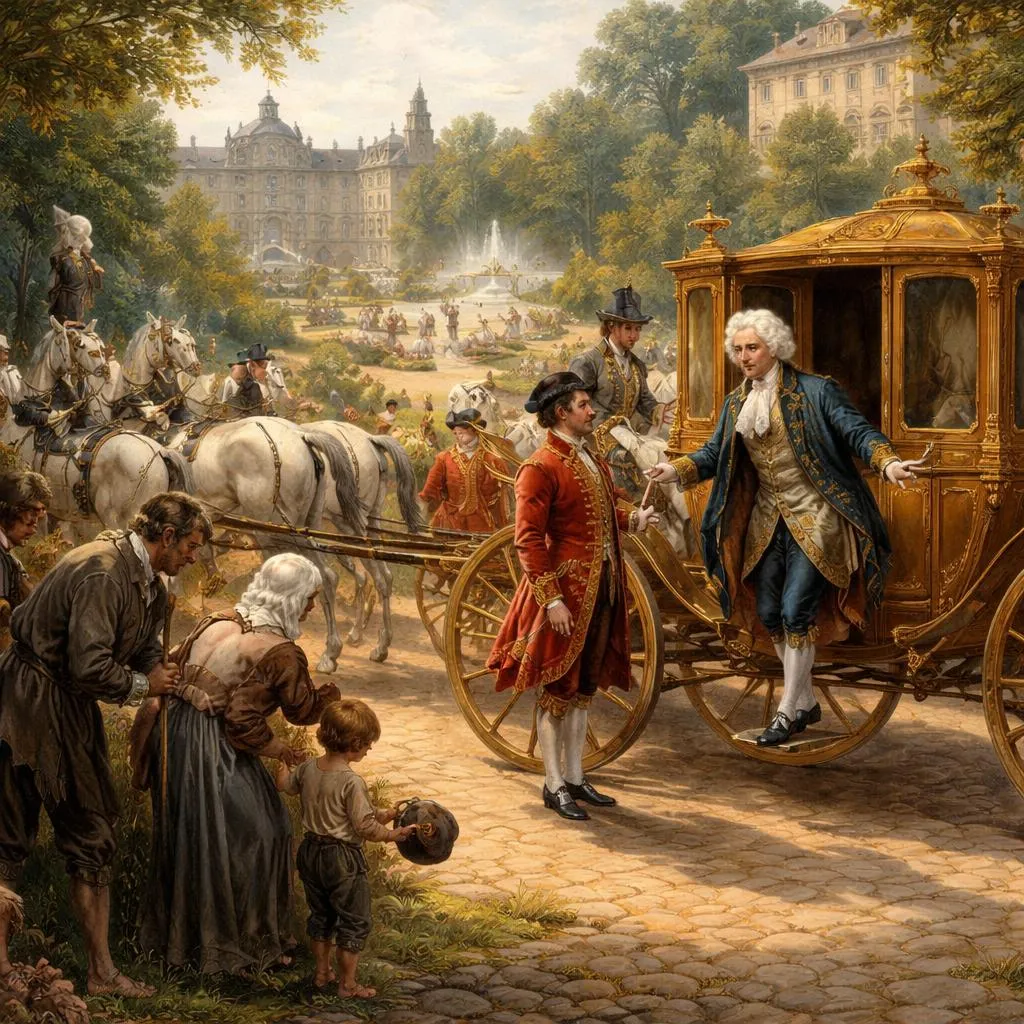
Monsieur the Marquis rides up a steep hill in his heavy carriage, drawn by four horses and guided by two postilions. The setting sun bathes him in a crimson glow, but it fades as the carriage descends the hill. Below lies a small village with a church tower, a windmill, a forest, and a fortress used as a prison. The village is poor, with a single street and humble buildings—a brewery, tannery, tavern, and stable yard. The villagers are poor too, many sitting outside their doors preparing simple meals or washing leaves and grasses to eat. They pay many taxes—to the state, the church, the lord—and yet the village still exists, though barely.
Few children and no dogs are seen. The villagers face a grim choice: a hard life in the village or captivity and death in the prison on the crag above.
Monsieur the Marquis arrives at the posting-house, where peasants stop their work to watch him. He notices their weary faces, worn down by suffering. A grizzled road mender approaches, and the Marquis questions him about a strange man who was seen hanging by the chain of the carriage’s drag. The man, pale and ghostlike, disappeared over the hillside when the carriage stopped.
As the carriage climbs higher, it passes a small burial ground with a crude wooden figure of Christ. A woman kneels there, pleading with the Marquis. Her husband, the forester, has died of want, like so many others. She asks only for a simple stone or wooden marker to show where he lies, so that the place will not be forgotten.
The Marquis listens but continues on, leaving behind the poor village and its suffering people. The night deepens, and the lights of the chateau welcome him home.
Background and Author Introduction
This passage is from A Tale of Two Cities, a famous novel by Charles Dickens, first published in 1859. Dickens was a renowned English writer known for his vivid characters and social commentary. He wrote during the Victorian era, a time of great social inequality and change in England and France. A Tale of Two Cities is set during the turbulent years of the French Revolution and explores themes of sacrifice, resurrection, and the struggle between oppression and freedom.
Dickens was deeply concerned with social justice and often highlighted the plight of the poor and oppressed. His works aimed to raise awareness and inspire compassion among readers.
Detailed Interpretation and Significance
This excerpt vividly portrays the harsh realities of rural life in pre-revolutionary France. The poor crops and struggling villagers symbolize the decay and suffering caused by an unjust social system. The Marquis represents the aristocracy, detached from the pain of the common people. His carriage, heavy and slow, contrasts with the desperate, ghostlike figure clinging to it—a symbol of the oppressed masses who are crushed under the weight of privilege and indifference.
The woman’s plea at the burial ground is a poignant moment that highlights the human cost of poverty and neglect. Her request for a simple grave marker is a powerful metaphor for dignity and remembrance in the face of overwhelming hardship.
The story invites readers to reflect on themes of inequality, responsibility, and empathy. It challenges us to consider how society treats its most vulnerable members and the consequences of ignoring their suffering.
Lessons and Insights for Students
-
Empathy and Compassion: The villagers’ plight encourages students to develop empathy for others, especially those facing difficulties. Understanding others’ struggles fosters kindness and social responsibility.
-
Social Awareness: The story raises awareness about social injustice and inequality. Students can learn to recognize unfairness in their own communities and think about ways to promote fairness and support those in need.
-
Resilience and Hope: Despite hardship, the villagers continue to live and hope. This teaches resilience—the ability to endure challenges and keep moving forward.
-
The Power of Small Acts: The woman’s simple request for a grave marker shows that small acts of recognition and dignity matter deeply. Students can learn that even small gestures can have great significance.
Applying These Lessons in Daily Life
-
In School: Students can practice empathy by supporting classmates who may be struggling, whether academically or socially. They can also engage in community service or awareness projects to help those in need.
-
In Social Settings: Understanding others’ backgrounds and challenges helps build stronger friendships and respectful relationships. Students can be more patient and inclusive.
-
In Personal Growth: Learning about resilience through stories like this encourages students to face their own difficulties with courage and perseverance.
Cultivating Positive Values from the Story
-
Compassion: Encourage students to listen to others’ stories and offer help without judgment.
-
Justice: Inspire them to stand up against unfair treatment and advocate for equality.
-
Responsibility: Teach that those with privilege or power have a duty to care for others.
-
Reflection: Use the story as a prompt for writing or discussion, helping students explore their feelings about social issues and their role in making a difference.
By engaging with this story, students not only improve their reading and critical thinking skills but also develop a deeper understanding of human dignity and social justice—lessons that are vital for their growth as compassionate and responsible individuals.
