
“I have saved him.” This was not just another dream where he returned; he was truly here. Yet, his wife trembled, weighed down by a vague but heavy fear. The air around them was thick and dark, filled with passionate revenge and sudden violence. Innocent people were constantly being executed on vague suspicions and malicious accusations. It was impossible to forget that many as blameless as her husband, and as dear to others as he was to her, shared the same fate every day. Her heart could not feel as light as it should. The shadows of the wintry afternoon were beginning to fall, and even now the dreadful carts rolled through the streets. Her mind searched among the condemned for him, but she clung closer to his real presence and trembled more.
Her father, cheering her, showed a compassionate strength that was remarkable to see. No more garrets, no shoemaking, no One Hundred and Five, North Tower! He had accomplished what he promised: he had saved Charles. Let them all lean on him.
Their household was very frugal—not only because it was the safest way to live, avoiding offending others, but also because they were not rich. Charles, throughout his imprisonment, had to pay heavily for his poor food, his guard, and to support the poorer prisoners. To avoid domestic spying and for economy, they kept no servant. The citizen and citizeness at the courtyard gate occasionally helped, and Jerry, almost entirely transferred to them by Mr. Lorry, had become their daily retainer, sleeping there every night.
An ordinance of the Republic One and Indivisible of Liberty, Equality, Fraternity, or Death required that every house have the names of its inhabitants clearly written on the door or doorpost. Mr. Jerry Cruncher’s name was thus displayed on their doorpost. As the afternoon shadows deepened, Jerry himself appeared, overseeing a painter hired by Doctor Manette to add Charles Evremonde, called Darnay, to the list.
In this time of universal fear and distrust, everyday life changed. In the Doctor’s household, as in many others, daily necessities were bought every evening in small quantities from various shops to avoid attracting attention and envy.
For months, Miss Pross and Mr. Cruncher had acted as purveyors: she carried the money, he the basket. Every afternoon, around the time the public lamps were lit, they went out to make necessary purchases. Although Miss Pross had long been associated with a French family and might have known their language, she had no interest in it and knew no more of it than Mr. Cruncher. Her shopping style was blunt: she would name a noun without any article, and if it wasn’t what she wanted, she’d look around, grab the item, and hold on until the deal was done. She always bargained by holding up one finger fewer than the merchant.
“Now, Mr. Cruncher,” said Miss Pross, her eyes red with happiness, “if you’re ready, I am.”
Jerry hoarsely professed himself at her service. He had worn off all his rust long ago, but nothing would smooth his spiky head.
“There’s all manner of things wanted,” said Miss Pross, “and we shall have a precious time of it. We want wine, among the rest. Nice toasts these Redheads will be drinking, wherever we buy it.”
“It will be much the same to your knowledge, miss, I should think,” retorted Jerry, “whether they drink your health or the Old Un’s.”
“Who’s he?” asked Miss Pross.
Mr. Cruncher, with some hesitation, explained he meant “Old Nick’s.”
“Ha!” said Miss Pross, “it doesn’t need an interpreter to explain these creatures. They have but one meaning: Midnight Murder and Mischief.”
“Hush, dear! Pray, be cautious!” cried Lucie.
“Yes, yes, yes, I’ll be cautious,” said Miss Pross, “but I may say among ourselves, I hope there will be no oniony and tobaccoey smotherings in the form of embracings all round, going on in the streets. Now, Ladybird, never stir from that fire till I come back! Take care of the dear husband you have recovered, and don’t move your pretty head from his shoulder as you have it now, till you see me again! May I ask a question, Doctor Manette, before I go?”
“I think you may take that liberty,” the Doctor answered, smiling.
“For gracious sake, don’t talk about Liberty; we have quite enough of that,” said Miss Pross.
“Hush, dear! Again?” Lucie remonstrated.
“Well, my sweet,” said Miss Pross, nodding emphatically, “the short and the long of it is, that I am a subject of His Most Gracious Majesty King George the Third;” she curtseyed at the name; “and as such, my maxim is, Confound their politics, Frustrate their knavish tricks, On him our hopes we fix, God save the King!”
Mr. Cruncher, in a burst of loyalty, growled the words after Miss Pross, as if at church.
“I’m glad you have so much of the Englishman in you, though I wish you had never taken that cold in your voice,” said Miss Pross approvingly. “But the question, Doctor Manette. Is there any prospect yet of our getting out of this place?”
“I fear not yet. It would be dangerous for Charles yet.”
“Heigh-ho-hum!” said Miss Pross cheerfully, repressing a sigh as she glanced at her darling’s golden hair in the firelight, “then we must have patience and wait: that’s all. We must hold up our heads and fight low, as my brother Solomon used to say. Now, Mr. Cruncher!—Don’t you move, Ladybird!”
They went out, leaving Lucie, her husband, her father, and the child by a bright fire. Mr. Lorry was expected back soon from the Banking House. Miss Pross had lit the lamp but put it aside to enjoy the firelight undisturbed. Little Lucie sat by her grandfather, hands clasped through his arm, and he, in a voice barely above a whisper, began to tell her a story of a great and powerful Fairy who had opened a prison wall and freed a captive who had once helped the Fairy. All was calm and quiet, and Lucie felt more at ease than before.
Suddenly, she cried out, “What is that?”
“My dear!” said her father, stopping his story and laying his hand on hers, “command yourself. What a disordered state you are in! The least thing—nothing—startles you! YOU, your father’s daughter!”
“I thought, my father,” said Lucie, pale and faltering, “that I heard strange feet upon the stairs.”
“My love, the staircase is as still as Death.”
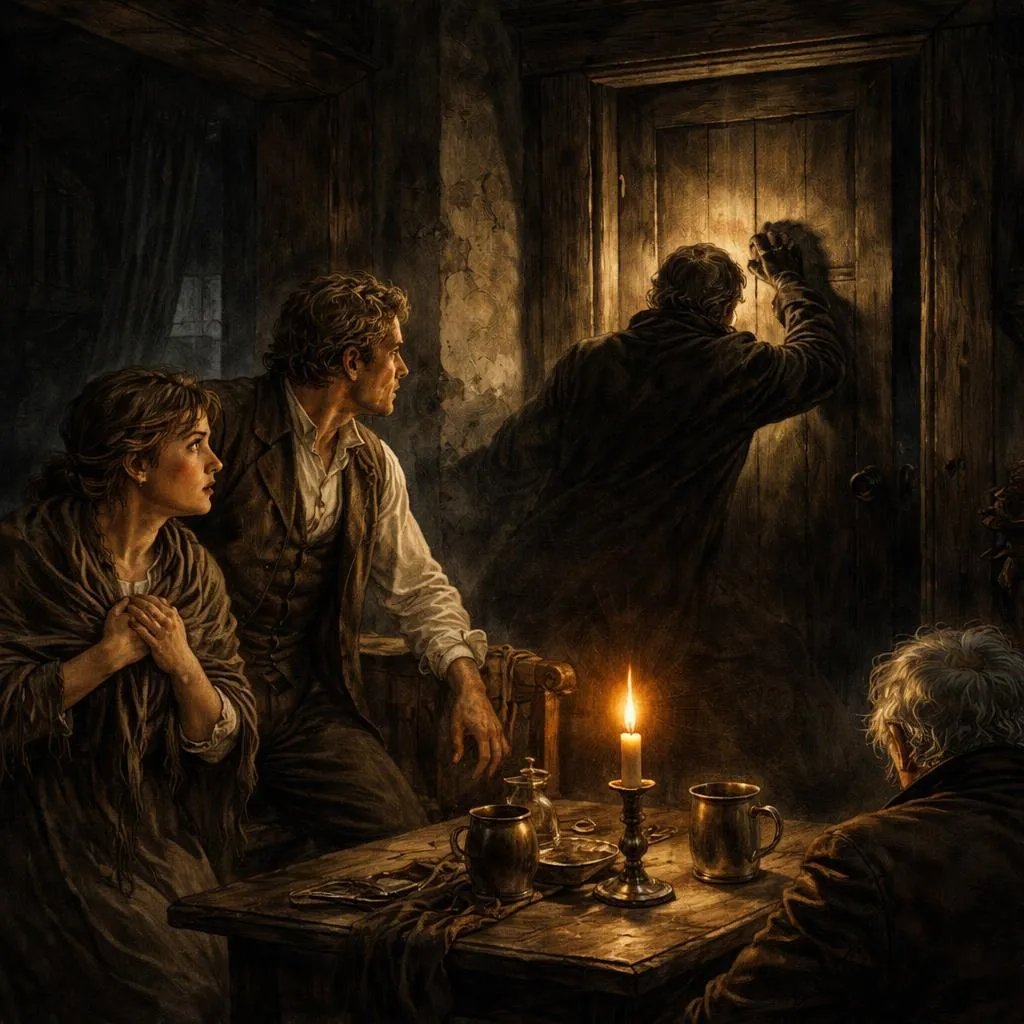
As he said the word, there was a blow on the door.
“Oh father, father. What can this be! Hide Charles. Save him!”
“My child,” said the Doctor, rising and laying his hand on her shoulder, “I HAVE saved him. What weakness is this, my dear! Let me go to the door.”
He took the lamp in his hand, crossed the two outer rooms, and opened the door. Four rough men in red caps, armed with sabres and pistols, entered.
“The Citizen Evremonde, called Darnay,” said the first.
“Who seeks him?” answered Darnay.
“I seek him. We seek him. I know you, Evremonde; I saw you before the Tribunal today. You are again the prisoner of the Republic.”
The four surrounded him, where he stood with his wife and child clinging to him.
“Tell me how and why am I again a prisoner?”
“It is enough that you return straight to the Conciergerie and will know tomorrow. You are summoned for tomorrow.”
Doctor Manette, turned to stone by this visitation, stood with the lamp as if a statue holding it. After the words were spoken, he put the lamp down, confronted the speaker, and gently took him by the loose front of his red woollen shirt.
“You know him, you have said. Do you know me?”
“Yes, I know you, Citizen Doctor.”
“We all know you, Citizen Doctor,” said the others.
He looked from one to another, and in a low voice asked after a pause, “Will you answer his question to me then? How does this happen?”
“Citizen Doctor,” said the first reluctantly, “he has been denounced to the Section of Saint Antoine. This citizen,” pointing to the second man, “is from Saint Antoine.”
The man nodded and added, “He is accused by Saint Antoine.”
“Of what?” asked the Doctor.
“Citizen Doctor,” said the first, “ask no more. If the Republic demands sacrifices from you, without doubt you as a good patriot will be happy to make them. The Republic goes before all. The People is supreme. Evremonde, we are pressed.”
“One word,” the Doctor entreated. “Will you tell me who denounced him?”
“It is against rule,” answered the first, “but you can ask Him of Saint Antoine here.”
The Doctor turned to the man, who shifted uneasily, rubbed his beard, and said, “Well! Truly it is against rule. But he is denounced—and gravely—by the Citizen and Citizeness Defarge. And by one other.”
“What other?”
“Do YOU ask, Citizen Doctor?”
“Yes.”
“Then,” said the man with a strange look, “you will be answered tomorrow. Now, I am dumb!”
Background and Author Introduction
This passage is from A Tale of Two Cities, a historical novel by Charles Dickens, first published in 1859. Dickens is one of the most famous English novelists, known for his vivid characters and social commentary. A Tale of Two Cities is set during the turbulent times of the French Revolution, contrasting the cities of London and Paris, and exploring themes of sacrifice, resurrection, and the struggle for justice.
The story follows characters caught in the chaos of revolution, highlighting the suffering of innocents and the harshness of political upheaval. Dickens wrote this novel to show the dangers of social injustice and the hope for redemption through love and courage.
Detailed Interpretation and Significance
This excerpt captures the tension and fear during the French Revolution’s Reign of Terror. Charles Darnay, a man imprisoned unjustly, has been saved once but is now threatened again. His wife Lucie’s trembling fear reflects the uncertainty and danger of the time. The presence of Doctor Manette, a former prisoner himself, brings a sense of hope and resilience.
The passage also shows the oppressive atmosphere, where even daily life is shadowed by suspicion and violence. The law demands that every inhabitant’s name be displayed publicly, symbolizing the loss of privacy and safety. The characters’ cautious shopping and secretive behavior illustrate the constant fear of betrayal.
The arrival of the red-capped men, agents of the revolutionary government, signals the relentless power of the Republic and its demand for sacrifices. The mention of the Defarges, who are key revolutionary figures, hints at the personal and political conflicts driving the story.
Lessons and Insights for Students
-
Courage in Adversity: The characters demonstrate bravery in the face of danger. Students can learn the importance of standing firm and supporting loved ones during difficult times.
-
The Value of Compassion: Doctor Manette’s gentle strength and Miss Pross’s loyalty show how kindness and care can provide comfort amidst fear.
-
The Impact of Social Injustice: The story highlights how injustice and fear can destroy lives. It encourages students to think critically about fairness, justice, and the consequences of societal divisions.
-
Patience and Hope: Despite the uncertainty, the characters hold on to hope and patience, valuable lessons for anyone facing challenges.
How to Apply These Lessons in Life
-
In School: When facing academic challenges, students can remember to be patient and courageous, just like Lucie and her family.
-
In Social Situations: Showing compassion and loyalty to friends and family, like Miss Pross, builds strong relationships.
-
In Understanding History and Society: This story encourages students to learn about history and the importance of justice, helping them become thoughtful and responsible citizens.
-
Developing Positive Attitudes: The characters’ resilience teaches the value of hope and perseverance, qualities that help in personal growth.
Cultivating Positive Spirit and Behavior
-
Empathy: Understand others’ fears and struggles, just as the characters empathize with each other.
-
Bravery: Stand up for what is right, even when it is difficult.
-
Loyalty: Support your friends and family in times of need.
-
Patience: Learn to wait calmly for better times, maintaining hope.
By reflecting on these themes, students can grow not only in knowledge but in character, preparing them for life’s challenges with strength and kindness.
