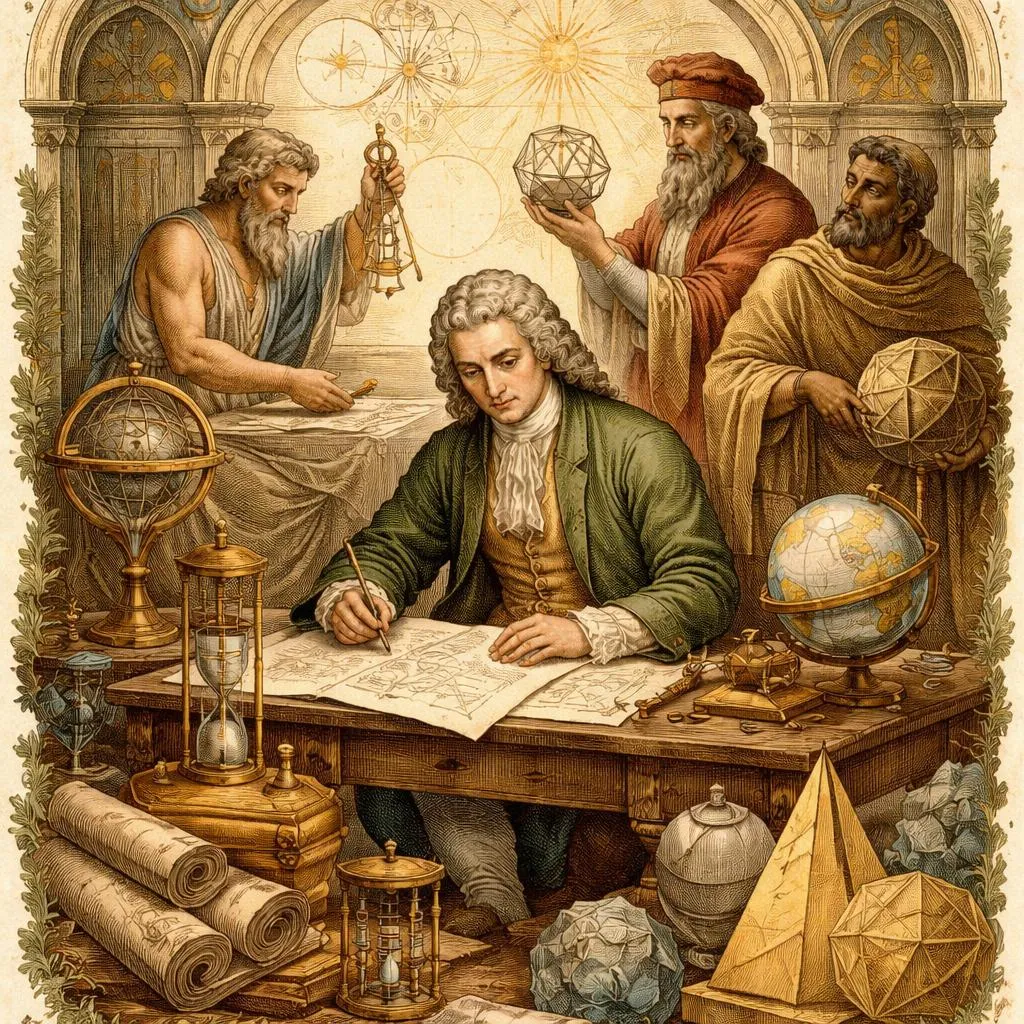

Brook Taylor, born at Edmonton on August 18, 1685, and died in London on December 29, 1731, was educated at St. John's College, Cambridge, and was among the most enthusiastic of Newton's admirers. From the year 1712 onwards he wrote numerous papers in the Philosophical Transactions , in which, among other things, he discussed the motion of projectiles, the centre of oscillation, and the forms taken by liquids when raised by capillarity. In 1719 he resigned the secretaryship of the Royal Society and abandoned the study of mathematics. His earliest work, and that by which he is generally known, is his Methodus Incrementorum Directa et Inversa , published in London in 1715. This contains [prop. 7] a proof of the well-known theorem
f ( x + h ) = f ( x ) + hf′ ( x ) + h 2 /2! f ″( x ) + ... ,
by which a function of a single variable can be expanded in powers of it. He does not consider the convergency of the series, and the proof which involves numerous assumptions is not worth reproducing. The work also includes several theorems on interpolation. Taylor was the earliest writer to deal with theorems on the change of the independent variable; he was perhaps the first to realize the possibility of a calculus of operation, and just as he denotes the n th differential coefficient of y by y n so he uses y -1 to represent the integral of y ; lastly, he is usually recognized as the creator of the theory of finite differences.
The applications of the calculus to various questions given in the Methodus have hardly received that attention they deserve. The most important of them is the theory of the transverse vibrations of strings, a problem which had baffled previous investigators. In this investigation Taylor shews that the number of half-vibrations executed in a second is
where L is the length of the string, N its weight, P the weight which stretches it, and D the length of a seconds pendulum. This is correct, but in arriving at it he assumes that every point of the string will pass through its position of equilibrium at the same instant, a restriction which D'Alembert subsequently shewed to be unnecessary. Taylor also found the form which the string assumes at any instant.
The Methodus also contains the earliest determination of the differential equation of the path of a ray of light when traversing a heterogeneous medium; and, assuming that the density of the air depends only in its distance from the earth's surface, Taylor obtained by means of quadratures the approximate form of the curve. The form of the catenary and the determination of the centres of oscillation and percussion are also discussed.
A treatise on perspective by Taylor, published in 1719, contains the earliest general enunciation of the principle of vanishing points; though the idea of vanishing points for horizontal and parallel lines in a picture hung in a vertical plane had been enunciated by Guido Ubaldi in his Perspectivae Libri , Pisa, 1600, and by Stevinus in his Sciagraphia , Leyden, 1608.
Introduction to Brook Taylor and His Work
Brook Taylor was a brilliant mathematician born in 1685 in Edmonton, England. He studied at Cambridge University and was a great admirer of Sir Isaac Newton, one of the most famous scientists in history. Taylor made important contributions to mathematics, particularly in the field of calculus, which is a branch of mathematics that deals with change and motion. His most famous work, Methodus Incrementorum Directa et Inversa (1715), introduced what we now call the Taylor series—a way to represent functions as infinite sums of terms calculated from the function’s derivatives.
Background and Creation of Taylor’s Work
During the early 18th century, mathematics was rapidly evolving. Scientists and mathematicians were eager to understand the natural world through precise calculations and formulas. Taylor’s work came at a time when calculus was still new and being developed by great minds like Newton and Leibniz. Taylor contributed by formalizing ideas that helped mathematicians and scientists solve complex problems involving motion, light, and vibrations.
Understanding Taylor’s Contributions
Taylor’s theorem allows us to approximate complicated functions with simpler polynomial expressions. This is extremely useful in physics, engineering, and computer science because it makes calculations easier and more manageable. For example, when studying the vibrations of strings on musical instruments or the path of light through different materials, Taylor’s formulas help predict behavior accurately.
He also worked on the theory of finite differences, which is a method used to study changes in sequences and functions, laying groundwork for numerical analysis used in computers today.
Significance of Taylor’s Discoveries
One of Taylor’s important achievements was analyzing the vibrations of strings, which helped explain how musical instruments produce sound. He showed how the frequency of vibration depends on the string’s length, weight, and tension. This understanding is fundamental in acoustics and instrument design.
Taylor also explored how light travels through varying densities of air, contributing to optics, the study of light. His work on perspective in art introduced the principle of vanishing points, which artists use to create realistic three-dimensional images on flat surfaces.
Lessons and Inspirations for Students
Studying Taylor’s life and work teaches us several valuable lessons:
- Curiosity and Perseverance: Taylor’s dedication to understanding complex problems shows the importance of being curious and persistent in learning.
- Interdisciplinary Thinking: His work combined mathematics, physics, and even art, demonstrating how knowledge in one area can enhance understanding in another.
- Foundation for Modern Science: Taylor’s discoveries are the building blocks for many modern technologies, reminding us that foundational knowledge is crucial for innovation.
How Students Can Apply These Lessons
- In Learning: When facing difficult subjects, students should remember Taylor’s example and keep exploring different approaches until they find solutions.
- In Problem-Solving: Using step-by-step methods like Taylor’s series can help break down complex problems into manageable parts.
- In Creativity: Understanding principles like perspective can improve artistic skills, while mathematical thinking can enhance logical reasoning.
Cultivating Positive Attitudes and Skills
Taylor’s life encourages students to develop:
- Analytical Thinking: Breaking down problems logically and carefully.
- Open-Mindedness: Being willing to explore new ideas and challenge assumptions.
- Attention to Detail: Precision is important in both mathematics and everyday tasks.
Conclusion
Brook Taylor’s contributions go beyond mathematics; they inspire a mindset of exploration, creativity, and resilience. By learning about his work, students gain not only knowledge but also valuable skills and attitudes that can help them succeed in school, social life, and future careers. Embracing the spirit of discovery and the joy of learning can lead to great achievements, just as it did for Taylor.
