
The Round Table soon heard of the challenge, and of course it was a good deal discussed, for such things interested the boys. The king thought I ought now to set forth in quest of adventures, so that I might gain renown and be the more worthy to meet Sir Sagramor when the several years should have rolled away. I excused myself for the present; I said it would take me three or four years yet to get things well fixed up and going smoothly; then I should be ready; all the chances were that at the end of that time Sir Sagramor would still be out grailing, so no valuable time would be lost by the postponement; I should then have been in office six or seven years, and I believed my system and machinery would be so well developed that I could take a holiday without its working any harm.
I was pretty well satisfied with what I had already accomplished. In various quiet nooks and corners I had the beginnings of all sorts of industries under way—nuclei of future vast factories, the iron and steel missionaries of my future civilization. In these were gathered together the brightest young minds I could find, and I kept agents out raking the country for more, all the time. I was training a crowd of ignorant folk into experts—experts in every sort of handiwork and scientific calling. These nurseries of mine went smoothly and privately along undisturbed in their obscure country retreats, for nobody was allowed to come into their precincts without a special permit—for I was afraid of the Church.
I had started a teacher-factory and a lot of Sunday-schools the first thing; as a result, I now had an admirable system of graded schools in full blast in those places, and also a complete variety of Protestant congregations all in a prosperous and growing condition. Everybody could be any kind of a Christian he wanted to; there was perfect freedom in that matter. But I confined public religious teaching to the churches and the Sunday-schools, permitting nothing of it in my other educational buildings. I could have given my own sect the preference and made everybody a Presbyterian without any trouble, but that would have been to affront a law of human nature: spiritual wants and instincts are as various in the human family as are physical appetites, complexions, and features, and a man is only at his best, morally, when he is equipped with the religious garment whose color and shape and size most nicely accommodate themselves to the spiritual complexion, angularities, and stature of the individual who wears it; and, besides, I was afraid of a united Church; it makes a mighty power, the mightiest conceivable, and then when it by and by gets into selfish hands, as it is always bound to do, it means death to human liberty and paralysis to human thought.
All mines were royal property, and there were a good many of them. They had formerly been worked as savages always work mines—holes grubbed in the earth and the mineral brought up in sacks of hide by hand, at the rate of a ton a day; but I had begun to put the mining on a scientific basis as early as I could.
Yes, I had made pretty handsome progress when Sir Sagramor’s challenge struck me.
Four years rolled by—and then! Well, you would never imagine it in the world. Unlimited power is the ideal thing when it is in safe hands. The despotism of heaven is the one absolutely perfect government. An earthly despotism would be the absolutely perfect earthly government, if the conditions were the same, namely, the despot the perfectest individual of the human race, and his lease of life perpetual. But as a perishable perfect man must die, and leave his despotism in the hands of an imperfect successor, an earthly despotism is not merely a bad form of government, it is the worst form that is possible.
My works showed what a despot could do with the resources of a kingdom at his command. Unsuspected by this dark land, I had the civilization of the nineteenth century booming under its very nose! It was fenced away from the public view, but there it was, a gigantic and unassailable fact—and to be heard from, yet, if I lived and had luck. There it was, as sure a fact and as substantial a fact as any serene volcano, standing innocent with its smokeless summit in the blue sky and giving no sign of the rising hell in its bowels. My schools and churches were children four years before; they were grown-up now; my shops of that day were vast factories now; where I had a dozen trained men then, I had a thousand now; where I had one brilliant expert then, I had fifty now. I stood with my hand on the cock, so to speak, ready to turn it on and flood the midnight world with light at any moment. But I was not going to do the thing in that sudden way. It was not my policy. The people could not have stood it; and, moreover, I should have had the Established Roman Catholic Church on my back in a minute.
No, I had been going cautiously all the while. I had had confidential agents trickling through the country some time, whose office was to undermine knighthood by imperceptible degrees, and to gnaw a little at this and that and the other superstition, and so prepare the way gradually for a better order of things. I was turning on my light one-candle-power at a time, and meant to continue to do so.
I had scattered some branch schools secretly about the kingdom, and they were doing very well. I meant to work this racket more and more, as time wore on, if nothing occurred to frighten me. One of my deepest secrets was my West Point—my military academy. I kept that most jealously out of sight; and I did the same with my naval academy which I had established at a remote seaport. Both were prospering to my satisfaction.
Clarence was twenty-two now, and was my head executive, my right hand. He was a darling; he was equal to anything; there wasn’t anything he couldn’t turn his hand to. Of late I had been training him for journalism, for the time seemed about right for a start in the newspaper line; nothing big, but just a small weekly for experimental circulation in my civilization-nurseries. He took to it like a duck; there was an editor concealed in him, sure. Already he had doubled himself in one way; he talked sixth century and wrote nineteenth. His journalistic style was climbing, steadily; it was already up to the back settlement Alabama mark, and couldn’t be told from the editorial output of that region either by matter or flavor.
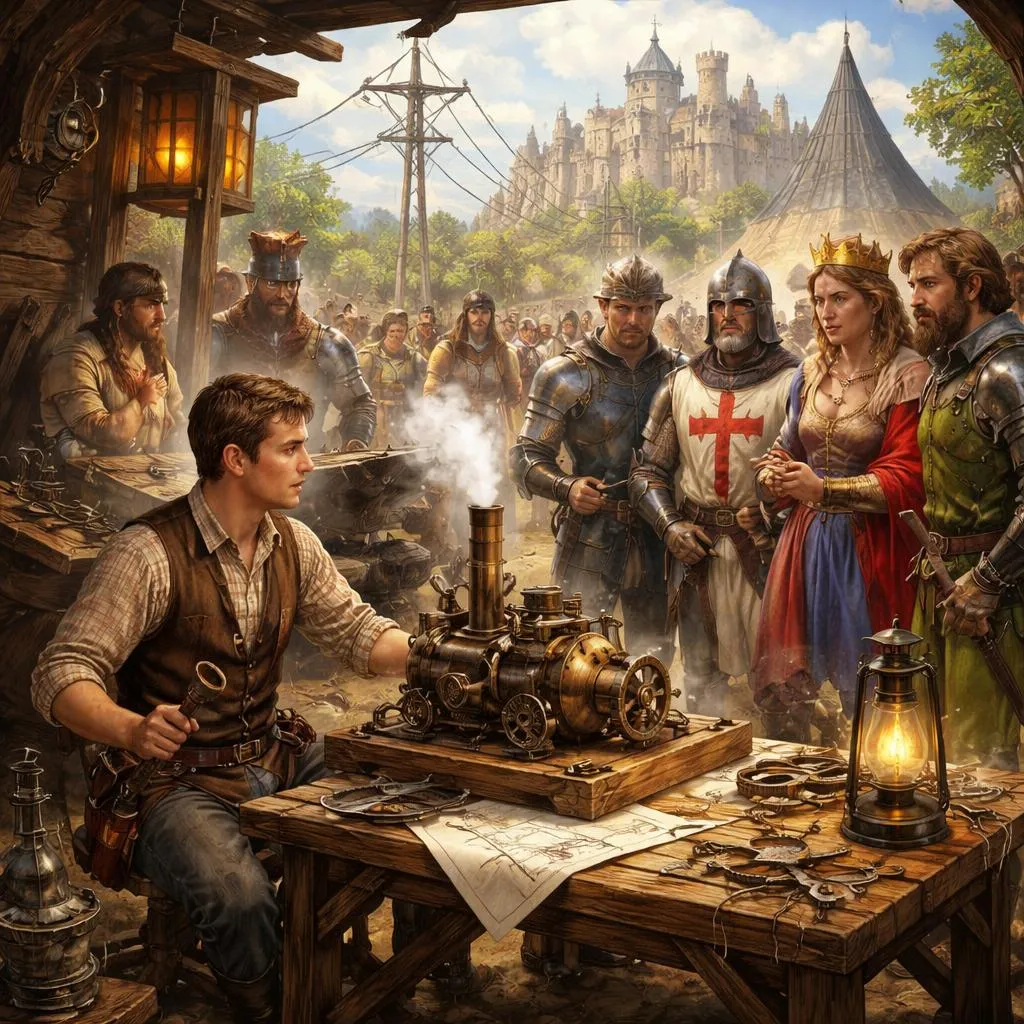
We had another large departure on hand, too. This was a telegraph and a telephone; our first venture in this line. These wires were for private service only, as yet, and must be kept private until a riper day should come. We had a gang of men on the road, working mainly by night. They were stringing ground wires; we were afraid to put up poles, for they would attract too much inquiry. Ground wires were good enough, in both instances, for my wires were protected by an insulation of my own invention which was perfect. My men had orders to strike across country, avoiding roads, and establishing connection with any considerable towns whose lights betrayed their presence, and leaving experts in charge. Nobody could tell you how to find any place in the kingdom, for nobody ever went intentionally to any place, but only struck it by accident in his wanderings, and then generally left it without thinking to inquire what its name was. At one time and another we had sent out topographical expeditions to survey and map the kingdom, but the priests had always interfered and raised trouble. So we had given the thing up, for the present; it would be poor wisdom to antagonize the Church.
As for the general condition of the country, it was as it had been when I arrived in it, to all intents and purposes. I had made changes, but they were necessarily slight, and they were not noticeable. Thus far, I had not even meddled with taxation, outside of the taxes which provided the royal revenues. I had systematized those, and put the service on an effective and righteous basis. As a result, these revenues were already quadrupled, and yet the burden was so much more equably distributed than before, that all the kingdom felt a sense of relief, and the praises of my administration were hearty and general.
Personally, I struck an interruption, now, but I did not mind it, it could not have happened at a better time. Earlier it could have annoyed me, but now everything was in good hands and swimming right along. The king had reminded me several times, of late, that the postponement I had asked for, four years before, had about run out now. It was a hint that I ought to be starting out to seek adventures and get up a reputation of a size to make me worthy of the honor of breaking a lance with Sir Sagramor, who was still out grailing, but was being hunted for by various relief expeditions, and might be found any year, now. So you see I was expecting this interruption; it did not take me by surprise.
Background and Author Introduction
This passage is from "A Connecticut Yankee in King Arthur's Court," a classic novel written by Mark Twain, one of America's greatest authors known for his sharp wit and social commentary. Published in 1889, the novel combines adventure, fantasy, and satire. Twain uses the story to explore themes of progress, technology, and the clash between modern and medieval values.
The novel tells the story of a 19th-century American engineer who, through a mysterious accident, finds himself transported back to the time of King Arthur and the Knights of the Round Table. Using his knowledge of science and technology, he attempts to modernize the medieval society, often clashing with the established Church and feudal system.
Detailed Interpretation and Significance
In this excerpt, the narrator describes his efforts to bring progress and enlightenment to a backward kingdom. He has secretly built schools, factories, and even military academies, training young people and spreading knowledge. His goal is to prepare the society for a better future, but he must proceed cautiously to avoid provoking the powerful Church and entrenched traditions.
The story highlights the tension between innovation and tradition, freedom and control, and the dangers of absolute power—even when wielded by a well-meaning despot. The narrator’s reflections on despotism reveal Twain’s skepticism about concentrated authority, emphasizing that even the best rulers are mortal and their successors imperfect.
Lessons and Insights for Students
-
The Value of Education and Knowledge: The narrator’s dedication to creating schools and training experts shows how education is the foundation for progress. Students can learn that continuous learning and curiosity are essential for personal growth and societal improvement.
-
Courage to Challenge Tradition: The story encourages young readers to question outdated beliefs and systems, especially when they hinder progress or freedom. It teaches the importance of critical thinking and standing up for what is right, even when it is difficult.
-
Patience and Strategic Planning: The narrator does not rush his reforms but works carefully and quietly, understanding that change takes time. This is a valuable lesson in perseverance and the importance of thoughtful action.
-
Respect for Diversity: By allowing freedom of religion and avoiding imposing his own beliefs, the narrator respects individual differences. This promotes tolerance and understanding—key qualities for peaceful coexistence.
-
The Responsibility of Power: The passage warns about the dangers of absolute power and the need for leaders to be just and wise. Students can reflect on the importance of fairness, humility, and accountability in leadership roles.
Applying These Lessons in Daily Life
-
In Learning: Embrace education as a lifelong journey. Just like the narrator builds schools and trains experts, students should seek knowledge actively, ask questions, and develop new skills.
-
In Social Interactions: Respect others’ beliefs and opinions, just as the narrator allows religious freedom. This helps build friendships and a harmonious community.
-
In Facing Challenges: Be patient and plan carefully when working on goals. Change often requires time and steady effort, so persistence is key.
-
In Leadership and Responsibility: Whether in school groups or at home, practice fairness and listen to others. Understand that leadership is about serving and helping, not controlling.
Cultivating Positive Traits from the Story
-
Innovation: Encourage creativity and problem-solving by thinking about new ways to improve your environment or help others.
-
Courage: Stand up for your values and be willing to challenge unfair rules or ideas respectfully.
-
Tolerance: Appreciate diversity and learn from people with different backgrounds and perspectives.
-
Wisdom: Make thoughtful decisions and consider the consequences of your actions.
By engaging with this story, students can not only enjoy an exciting adventure but also gain valuable insights into history, ethics, and personal development. Mark Twain’s novel remains a timeless guide to understanding the complexities of progress and human nature.
