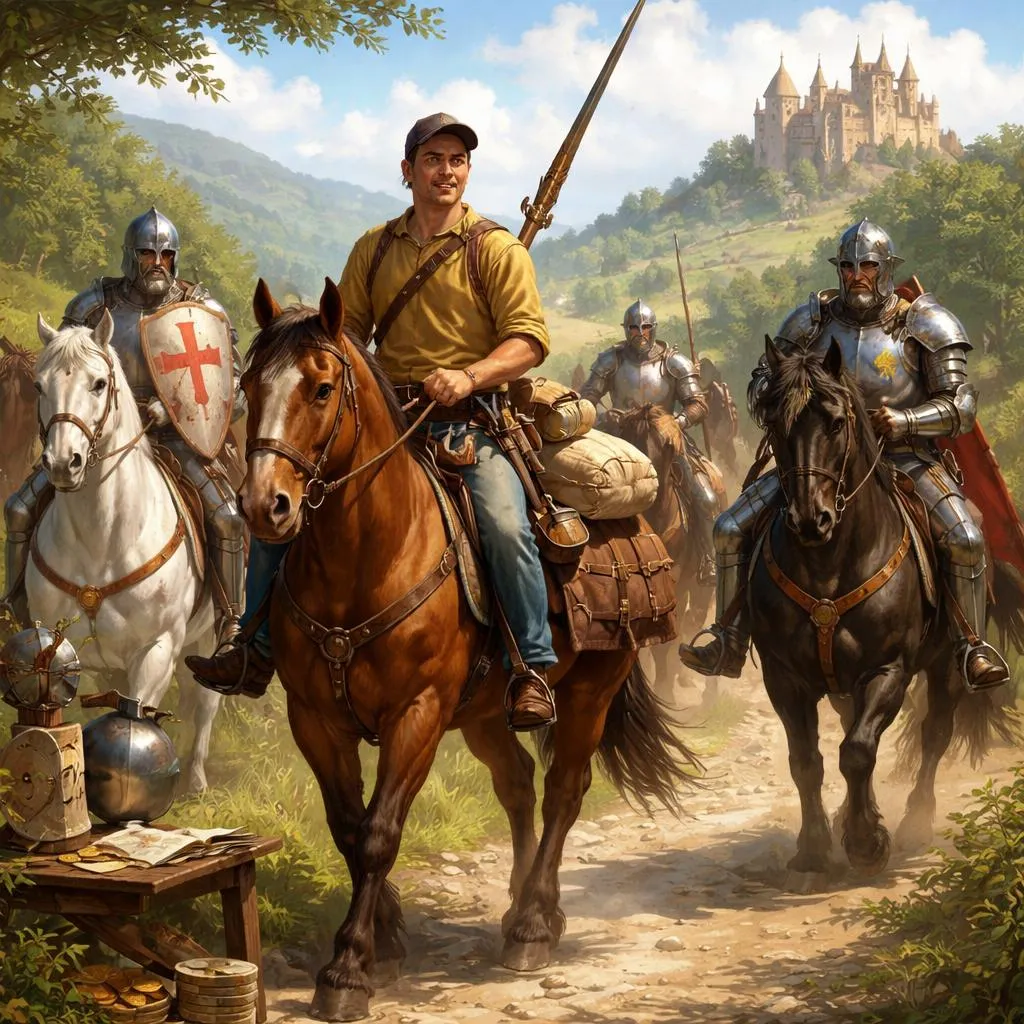

Sandy and I were on the road again, next morning, bright and early. It was so good to open up one’s lungs and take in whole luscious barrels-ful of the blessed God’s untainted, dew-fashioned, woodland-scented air once more, after suffocating body and mind for two days and nights in the moral and physical stenches of that intolerable old buzzard-roost! I mean, for me: of course the place was all right and agreeable enough for Sandy, for she had been used to high life all her days.
Poor girl, her jaws had had a wearisome rest now for a while, and I was expecting to get the consequences. I was right; but she had stood by me most helpfully in the castle, and had mightily supported and reinforced me with gigantic foolishnesses which were worth more for the occasion than wisdoms double their size; so I thought she had earned a right to work her mill for a while, if she wanted to, and I felt not a pang when she started it up:
“Now turn we unto Sir Marhaus that rode with the damsel of thirty winter of age southward—”
“Are you going to see if you can work up another half-stretch on the trail of the cowboys, Sandy?”
“Even so, fair my lord.”
“Go ahead, then. I won’t interrupt this time, if I can help it. Begin over again; start fair, and shake out all your reefs, and I will load my pipe and give good attention.”
“Now turn we unto Sir Marhaus that rode with the damsel of thirty winter of age southward. And so they came into a deep forest, and by fortune they were nighted, and rode along in a deep way, and at the last they came into a courtelage where abode the duke of South Marches, and there they asked harbour. And on the morn the duke sent unto Sir Marhaus, and bad him make him ready. And so Sir Marhaus arose and armed him, and there was a mass sung afore him, and he brake his fast, and so mounted on horseback in the court of the castle, there they should do the battle. So there was the duke already on horseback, clean armed, and his six sons by him, and every each had a spear in his hand, and so they encountered, whereas the duke and his two sons brake their spears upon him, but Sir Marhaus held up his spear and touched none of them. Then came the four sons by couples, and two of them brake their spears, and so did the other two. And all this while Sir Marhaus touched them not. Then Sir Marhaus ran to the duke, and smote him with his spear that horse and man fell to the earth. And so he served his sons. And then Sir Marhaus alight down, and bad the duke yield him or else he would slay him. And then some of his sons recovered, and would have set upon Sir Marhaus. Then Sir Marhaus said to the duke, Cease thy sons, or else I will do the uttermost to you all. When the duke saw he might not escape the death, he cried to his sons, and charged them to yield them to Sir Marhaus. And they kneeled all down and put the pommels of their swords to the knight, and so he received them. And then they holp up their father, and so by their common assent promised unto Sir Marhaus never to be foes unto King Arthur, and thereupon at Whitsuntide after, to come he and his sons, and put them in the king’s grace.*
[*Footnote: The story is borrowed, language and all, from the Morte d’Arthur.—M.T.]
“Even so standeth the history, fair Sir Boss. Now ye shall wit that that very duke and his six sons are they whom but few days past you also did overcome and send to Arthur’s court!”
“Why, Sandy, you can’t mean it!”
“An I speak not sooth, let it be the worse for me.”
“Well, well, well,—now who would ever have thought it? One whole duke and six dukelets; why, Sandy, it was an elegant haul. Knight-errantry is a most chuckle-headed trade, and it is tedious hard work, too, but I begin to see that there is money in it, after all, if you have luck. Not that I would ever engage in it as a business, for I wouldn’t. No sound and legitimate business can be established on a basis of speculation. A successful whirl in the knight-errantry line—now what is it when you blow away the nonsense and come down to the cold facts? It’s just a corner in pork, that’s all, and you can’t make anything else out of it. You’re rich—yes,—suddenly rich—for about a day, maybe a week; then somebody corners the market on you , and down goes your bucket-shop; ain’t that so, Sandy?”
“Whethersoever it be that my mind miscarrieth, bewraying simple language in such sort that the words do seem to come endlong and overthwart—”
“There’s no use in beating about the bush and trying to get around it that way, Sandy, it’s so, just as I say. I know it’s so. And, moreover, when you come right down to the bedrock, knight-errantry is worse than pork; for whatever happens, the pork’s left, and so somebody’s benefited anyway; but when the market breaks, in a knight-errantry whirl, and every knight in the pool passes in his checks, what have you got for assets? Just a rubbish-pile of battered corpses and a barrel or two of busted hardware. Can you call those assets? Give me pork, every time. Am I right?”
“Ah, peradventure my head being distraught by the manifold matters whereunto the confusions of these but late adventured haps and fortunings whereby not I alone nor you alone, but every each of us, meseemeth—”
“No, it’s not your head, Sandy. Your head’s all right, as far as it goes, but you don’t know business; that’s where the trouble is. It unfits you to argue about business, and you’re wrong to be always trying. However, that aside, it was a good haul, anyway, and will breed a handsome crop of reputation in Arthur’s court. And speaking of the cowboys, what a curious country this is for women and men that never get old. Now there’s Morgan le Fay, as fresh and young as a Vassar pullet, to all appearances, and here is this old duke of the South Marches still slashing away with sword and lance at his time of life, after raising such a family as he has raised. As I understand it, Sir Gawaine killed seven of his sons, and still he had six left for Sir Marhaus and me to take into camp. And then there was that damsel of sixty winter of age still excursioning around in her frosty bloom—How old are you, Sandy?”
It was the first time I ever struck a still place in her. The mill had shut down for repairs, or something.
Background and Author Introduction
This excerpt is drawn from a story inspired by the Morte d’Arthur, a famous collection of Arthurian legends compiled by Sir Thomas Malory in the 15th century. Malory’s work is one of the most important sources for the tales of King Arthur, his knights, and the chivalric adventures that have shaped Western literature and culture. The Morte d’Arthur blends history, myth, and romance, presenting tales of bravery, loyalty, honor, and tragedy. The story here involves Sir Marhaus, a knight of the Round Table, and depicts a classic chivalric battle and themes of honor and reconciliation.
Detailed Interpretation and Significance
The passage captures the spirit of medieval knight-errantry—knights traveling, seeking adventure, and engaging in battles to uphold justice and loyalty. Sir Marhaus’s encounter with the Duke of South Marches and his sons is a vivid example of the challenges knights faced: physical combat, tests of courage, and the quest for peace through strength. The story also contrasts the idealism of knighthood with the harsh realities of life, as the narrator reflects on the fleeting nature of success and the "business" of knight-errantry.
The dialogue between the narrator and Sandy adds a modern, somewhat humorous perspective on the old tales. It highlights the tension between romantic ideals and practical realities, a theme that resonates with readers of all ages. The mention of characters like Morgan le Fay and Sir Gawaine ties this episode into the larger Arthurian mythos, enriching the tapestry of legends.
Lessons and Insights for Students
-
Courage and Honor: The knights demonstrate bravery in battle and honor in victory and defeat. Students can learn the importance of standing up for what is right, facing challenges bravely, and treating others with respect even in conflict.
-
Loyalty and Reconciliation: The story ends with the defeated duke and his sons pledging loyalty to King Arthur, showing that true strength includes the ability to forgive and reconcile. This teaches the value of resolving disputes peacefully and maintaining alliances.
-
Reality vs. Idealism: The narrator’s reflections remind students that while ideals are important, understanding the practical side of life is equally crucial. This balance is key in making wise decisions in school, friendships, and future careers.
-
The Power of Storytelling: Sandy’s storytelling, despite its “gigantic foolishnesses,” supports and encourages the narrator. This shows how stories can inspire, comfort, and teach us, even when they seem fanciful.
Applying These Lessons in Daily Life
-
In Learning: Embrace challenges like knights do, with courage and determination. When faced with difficult subjects, persist and seek help, knowing that effort leads to growth.
-
In Social Situations: Practice loyalty and fairness in friendships. When conflicts arise, aim for reconciliation and understanding rather than prolonged hostility.
-
In Personal Growth: Balance dreams with reality. Set goals but be prepared to adapt and learn from setbacks, much like the narrator’s view on the “business” of knight-errantry.
-
In Creativity: Use storytelling as a tool to express yourself and connect with others. Like Sandy, your imagination can be a source of strength and joy.
Cultivating Positive Traits from the Story
-
Bravery: Face fears and challenges head-on, whether in public speaking, exams, or social situations.
-
Respect: Honor others’ views and backgrounds, fostering a supportive community.
-
Wisdom: Learn from both successes and failures, understanding that every experience contributes to your growth.
-
Imagination: Keep your creativity alive; it can help solve problems and enrich your life.
Conclusion
This passage from an Arthurian-inspired tale offers rich material for students to explore timeless themes of courage, honor, loyalty, and the balance between idealism and reality. By reflecting on these stories, young readers can gain valuable insights that apply not only to literature but also to everyday life, helping them grow into thoughtful, brave, and compassionate individuals.
