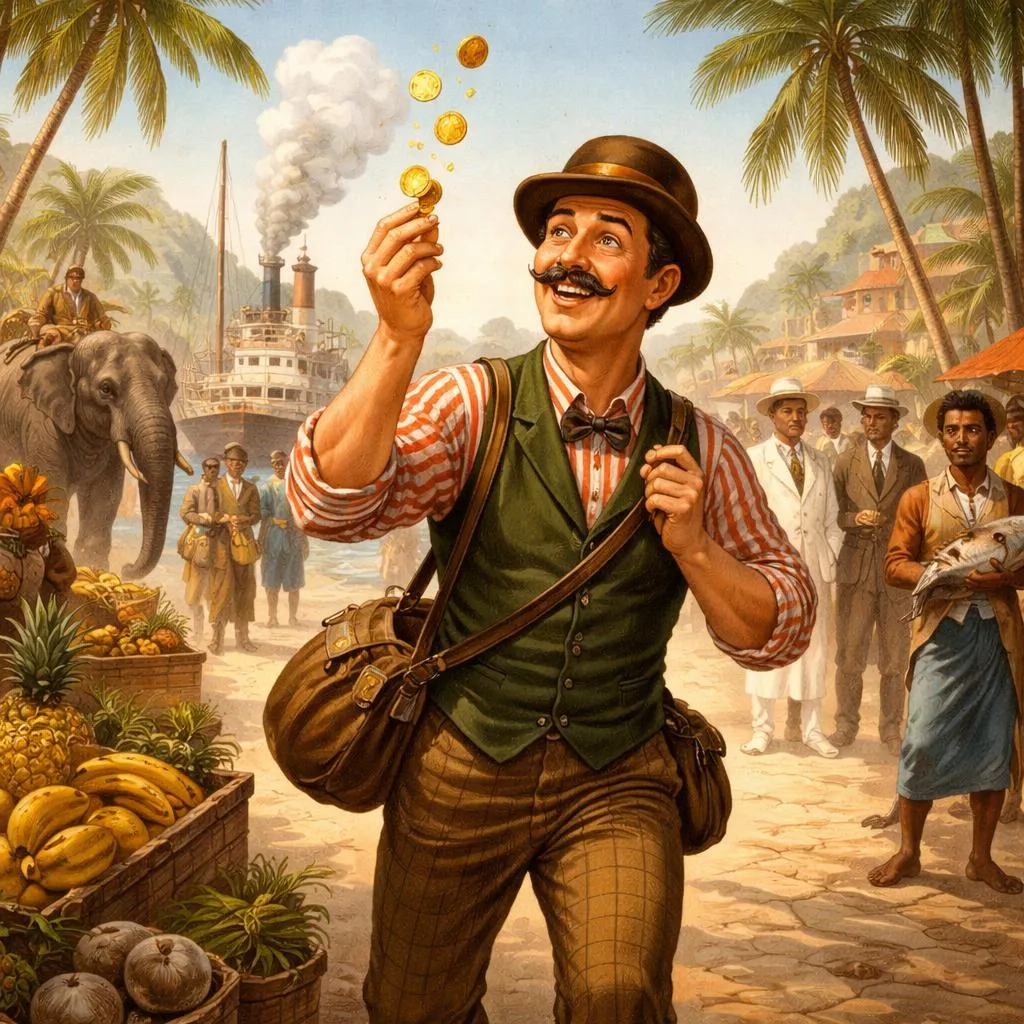

The Carnatic set sail from Hong Kong at half-past six on the 7th of November, heading full steam toward Japan. She carried a large cargo and a well-filled cabin of passengers. However, two state-rooms in the rear, those booked by Phileas Fogg, remained empty.
The next day, a passenger with a half-stupefied eye, staggering gait, and disheveled hair emerged from the second cabin and tottered to a seat on deck. It was Passepartout. What had happened to him was this: shortly after Fix left the opium den, two waiters lifted the unconscious Passepartout and carried him to the bed reserved for smokers. Three hours later, haunted even in his dreams by a fixed idea, the poor fellow awoke and struggled against the narcotic's stupefying influence. The thought of an unfulfilled duty shook off his torpor, and he hurried from the drunken abode. Staggering, holding himself up against walls, falling and crawling again, driven by instinct, he kept crying out, "The Carnatic! The Carnatic!"
The steamer lay puffing alongside the quay, about to depart. Passepartout had only a few steps to go; rushing upon the plank, he crossed it and fell unconscious on deck just as the Carnatic moved off. Several sailors, accustomed to such scenes, carried the poor Frenchman down into the second cabin. Passepartout did not wake until they were 150 miles from China. Thus, the next morning, he found himself on the Carnatic's deck, eagerly inhaling the sea breeze. The fresh air sobered him. He began to collect his senses, a difficult task, but at last recalled the previous evening's events—Fix's revelation and the opium house.
"It is evident," he said to himself, "that I have been abominably drunk! What will Mr. Fogg say? At least I have not missed the steamer, which is the most important thing."
Then, thinking of Fix, he added, "As for that rascal, I hope we are rid of him and that he has not dared, as he proposed, to follow us on board the Carnatic. A detective on the track of Mr. Fogg, accused of robbing the Bank of England! Pshaw! Mr. Fogg is no more a robber than I am a murderer."
Should he reveal Fix's real mission to his master? Would it be wise to tell the part the detective was playing? Or should he wait until Mr. Fogg returned to London and then tell him that a metropolitan police agent had followed him around the world, laughing about it? It was worth considering. The first thing was to find Mr. Fogg and apologize for his strange behavior.
Passepartout got up and, as well as he could with the steamer rolling, proceeded to the after-deck. He saw no one resembling either his master or Aouda. "Good!" he muttered. "Aouda has not risen yet, and Mr. Fogg has probably found some partners at whist."
He descended to the saloon. Mr. Fogg was not there. Passepartout asked the purser the number of his master's state-room. The purser replied he did not know any passenger named Fogg.
"I beg your pardon," said Passepartout persistently. "He is a tall gentleman, quiet and not very talkative, and has with him a young lady—"
"There is no young lady on board," interrupted the purser. "Here is a list of passengers; you may see for yourself."
Passepartout scanned the list but found no Fogg. Suddenly an idea struck him.
"Ah! Am I on the Carnatic?"
"Yes."
"On the way to Yokohama?"
"Certainly."
Passepartout had feared he was on the wrong boat, but though on the Carnatic, his master was not there.
He fell thunderstruck into a seat. He saw it all now. He remembered the sailing time had changed, that he should have informed his master but had not. It was his fault Mr. Fogg and Aouda missed the steamer. Yet it was more the traitor's fault, who, to separate him from his master and detain the latter at Hong Kong, had tricked him into getting drunk! He now saw the detective's trick; Mr. Fogg was certainly ruined, his bet lost, and he himself perhaps arrested and imprisoned! At this thought, Passepartout tore his hair. Ah, if Fix ever came within reach, what a settling of accounts there would be!
After his first depression, Passepartout calmed and studied his situation. It was not enviable. He was on the way to Japan. What should he do when he got there? His pocket was empty; not a single shilling or penny. His passage had been paid in advance, and he had five or six days to decide his future. He ate heartily, for Mr. Fogg, Aouda, and himself, as if Japan were a desert with nothing to eat.
At dawn on the 13th, the Carnatic entered Yokohama port, an important Pacific port where mail steamers and travelers between North America, China, Japan, and Oriental islands called. It was situated in Yeddo Bay, near the second capital of the Japanese Empire and the Tycoon's residence, the civil Emperor before the Mikado, the spiritual Emperor, absorbed his office. The Carnatic anchored at the quay near the custom-house amid ships flying all nations' flags.
Passepartout timidly went ashore on this curious land of the Sons of the Sun. With nothing better to do, he let chance guide him to wander aimlessly through Yokohama's streets. At first, he found himself in a thoroughly European quarter, with low-fronted houses adorned with verandas and neat peristyles. This quarter occupied the space between the "promontory of the Treaty" and the river, filled with mixed crowds of Americans, English, Chinese, and Dutch merchants ready to buy or sell anything. The Frenchman felt as alone among them as if dropped among Hottentots.
At least, he had one resource: the French and English consuls at Yokohama. But he shrank from telling his adventure story, intimately connected with his master’s, and decided to try all other aid means first. As chance did not favor him in the European quarter, he entered the native Japanese quarter, determined to push on to Yeddo if necessary.
The Japanese quarter, called Benten after the sea goddess worshipped on nearby islands, showed him beautiful fir and cedar groves, sacred gates of unique architecture, bridges half-hidden by bamboo and reeds, temples shaded by immense cedars, holy retreats sheltering Buddhist priests and Confucian sectaries, and endless streets filled with rose-tinted, red-cheeked children playing among short-legged poodles and yellowish cats.
The streets were crowded with people: priests passing in processions, beating dreary tambourines; police and customs officers with pointed lacquered hats and two sabres; soldiers clad in blue cotton with white stripes and guns; Mikado’s guards in silken doubles, hauberks, and mail coats; and many military folk of all ranks, as respected in Japan as despised in China. Passepartout also saw begging friars, long-robed pilgrims, and simple civilians with jet-black hair, big heads, long torsos, slender legs, short stature, and complexions from copper to dead white, but never yellow like the Chinese.
He noticed curious carriages and palanquins, barrows with sails, bamboo litters, and women—not especially handsome—taking little steps on little feet wearing canvas shoes, straw sandals, and wooden clogs, with tight eyes, flat chests, blackened teeth, and gowns crossed with silk scarves tied in enormous knots behind ornaments seemingly borrowed by modern Parisian ladies from Japanese dames.
Passepartout wandered hours amid this motley crowd, peering into rich and curious shops glittering with Japanese ornaments, restaurants decorated with streamers and banners, tea-houses where fragrant tea was drunk with saki (a rice liquor), and comfortable smoking-houses puffing fine stringy tobacco, not opium, almost unknown in Japan. He went on until he reached fields with vast rice plantations. There he saw dazzling camellias blooming on trees, bamboo enclosures with cherry, plum, and apple trees cultivated more for blossoms than fruit, guarded by oddly shaped, grinning scarecrows protecting from sparrows, pigeons, ravens, and other birds. Large eagles perched on cedar branches; herons solemnly stood on one leg amid weeping willows; crows, ducks, hawks, wild birds, and many cranes, sacred to the Japanese symbolizing long life and prosperity, were everywhere.
As he strolled, Passepartout spotted some violets among shrubs.
"Good!" he said, "I'll have some supper."
But smelling them, he found them odorless.
"No chance there," he thought.
Though he had eaten a hearty breakfast before leaving the Carnatic, walking all day made hunger pressing. He noticed butcher stalls lacked mutton, goat, or pork; knowing it was sacrilege to kill cattle preserved for farming, he decided meat was scarce in Yokohama—and he was right. Without butcher’s meat, he wished for wild boar, deer, partridge, quail, game, or fish, which the Japanese ate almost exclusively with rice. But he resolved to keep a stout heart and postpone his meal till the next morning.
Night came, and Passepartout re-entered the native quarter, wandering through lantern-lit streets, watching dancers performing skilled steps and bounds, and astrologers standing outdoors with telescopes. He reached the harbor lit by fishermen’s resin torches as they fished from boats.
The streets quieted, and the patrol, officers in splendid costumes surrounded by their suites, whom Passepartout thought looked like ambassadors, succeeded the bustling crowd. Each time a company passed, Passepartout chuckled, saying to himself, "Good! Another Japanese embassy departing for Europe!"
Background and Author Introduction
This passage is from Around the World in Eighty Days, a classic adventure novel written by Jules Verne, a French author known for pioneering the science fiction genre. Published in 1873, the novel follows the journey of Phileas Fogg, a precise and wealthy English gentleman, who wagers that he can circumnavigate the globe in eighty days. His loyal French valet, Passepartout, accompanies him, encountering numerous adventures and challenges along the way.
Jules Verne’s works often combined detailed scientific knowledge with imaginative storytelling, inspiring generations of readers to explore the world and dream of new possibilities. His vivid descriptions of exotic locations and cultures, as seen in this passage about Japan, reflect the 19th-century European fascination with distant lands.
Detailed Interpretation and Significance
This excerpt highlights a critical moment in the story where Passepartout, separated from his master due to a malicious plot, finds himself alone and vulnerable in a foreign land. The narrative vividly portrays his confusion, determination, and resilience as he navigates unfamiliar surroundings.
The detailed depiction of Yokohama and Japanese culture serves not only as a backdrop but also enriches the story’s theme of cross-cultural exploration. It contrasts Passepartout’s European background with the distinct customs, architecture, and social life of Japan, emphasizing the novel’s celebration of global diversity.
Moreover, Passepartout’s struggle with opium’s effects and his subsequent resolve to find and aid Mr. Fogg illustrate themes of loyalty, courage, and perseverance. These qualities are central to the novel’s message that determination and faith can overcome obstacles.
Lessons and Insights for Students
-
Resilience and Problem-Solving: Passepartout’s experience teaches the importance of staying calm and thinking clearly in difficult situations. Even when separated from his master and in a strange place, he does not give up but looks for solutions.
-
Cultural Awareness: The passage offers a glimpse into Japanese culture, encouraging readers to appreciate and respect different traditions and ways of life. Understanding cultural diversity fosters empathy and broadens one’s worldview.
-
Loyalty and Responsibility: Passepartout’s concern for Mr. Fogg and his sense of duty highlight the value of loyalty and taking responsibility for one’s actions, even when mistakes occur.
-
Courage to Face the Unknown: Venturing into unfamiliar territory requires bravery and openness, qualities that help individuals grow and learn.
Applying These Lessons in Life
-
In Learning: Students can apply Passepartout’s persistence by approaching challenges with patience and determination, whether in studies or new skills.
-
In Social Situations: Embracing cultural differences and showing respect to others’ customs can improve friendships and teamwork in diverse environments.
-
In Personal Growth: Recognizing mistakes and taking responsibility, as Passepartout does, builds character and trustworthiness.
-
In Facing Challenges: Like Passepartout, students can cultivate courage to step out of comfort zones, explore new ideas, and adapt to change.
Cultivating Positive Traits from the Story
-
Loyalty: Practice standing by friends and family, offering support in times of need.
-
Curiosity: Develop an interest in learning about other cultures, languages, and histories.
-
Resilience: When setbacks occur, focus on solutions rather than dwelling on problems.
-
Empathy: Try to understand others’ feelings and perspectives, especially when they differ from your own.
Reflection and Appreciation
Reading this story invites young readers to embark on their own journeys of discovery—whether through books, travel, or new experiences. It encourages them to be brave, thoughtful, and open-minded, qualities that enrich life and foster meaningful connections.
By following Passepartout’s adventure, students learn that even when things go wrong, determination, kindness, and a willingness to learn can light the way forward. This timeless tale continues to inspire readers to explore the world and themselves with courage and heart.
