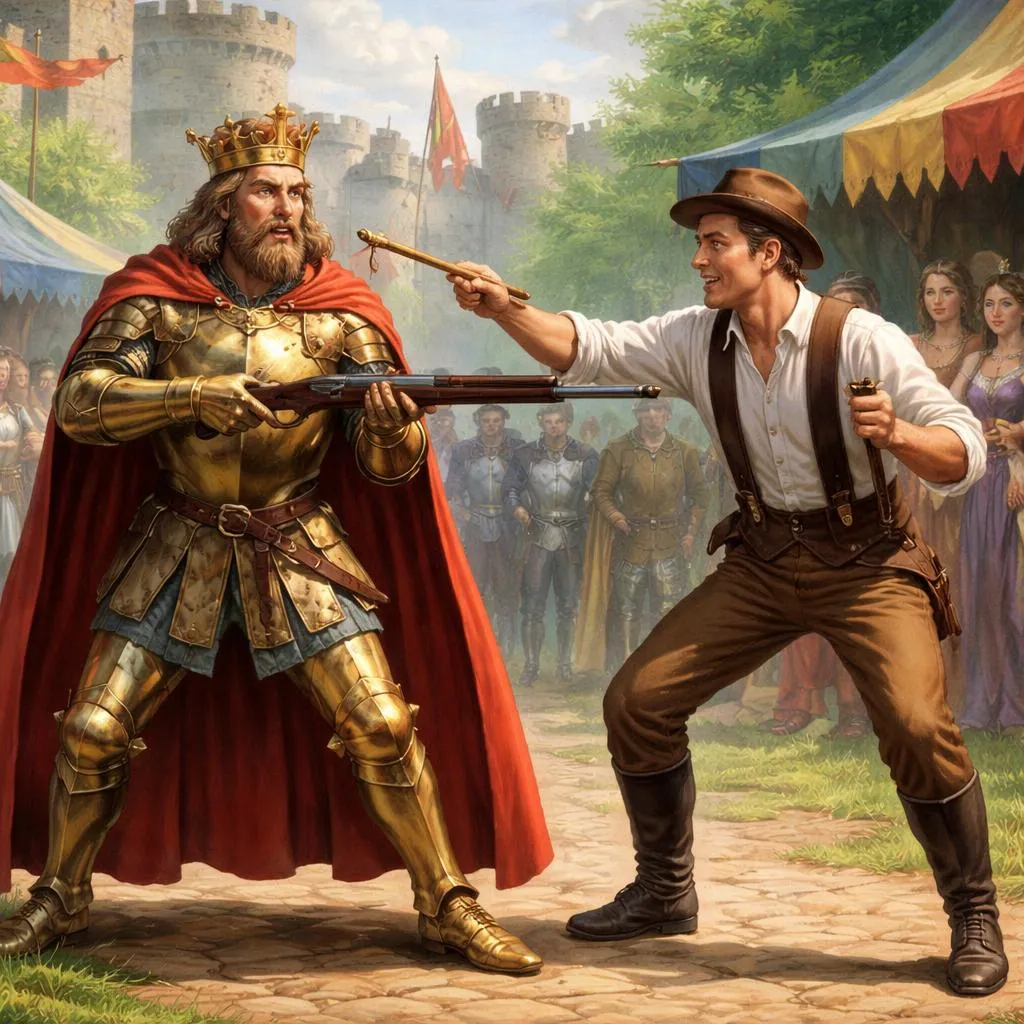

On the morning of the fourth day, when it was just sunrise, and we had been tramping an hour in the chill dawn, I came to a resolution: the king must be drilled; things could not go on so, he must be taken in hand and deliberately and conscientiously drilled, or we couldn’t ever venture to enter a dwelling; the very cats would know this masquerader for a humbug and no peasant. So I called a halt and said:
“Sire, as between clothes and countenance, you are all right, there is no discrepancy; but as between your clothes and your bearing, you are all wrong, there is a most noticeable discrepancy. Your soldierly stride, your lordly port—these will not do. You stand too straight, your looks are too high, too confident. The cares of a kingdom do not stoop the shoulders, they do not droop the chin, they do not depress the high level of the eye-glance, they do not put doubt and fear in the heart and hang out the signs of them in slouching body and unsure step. It is the sordid cares of the lowly born that do these things. You must learn the trick; you must imitate the trademarks of poverty, misery, oppression, insult, and the other several and common inhumanities that sap the manliness out of a man and make him a loyal and proper and approved subject and a satisfaction to his masters, or the very infants will know you for better than your disguise, and we shall go to pieces at the first hut we stop at. Pray try to walk like this.”
The king took careful note, and then tried an imitation.
“Pretty fair—pretty fair. Chin a little lower, please—there, very good. Eyes too high; pray don’t look at the horizon, look at the ground, ten steps in front of you. Ah—that is better, that is very good. Wait, please; you betray too much vigor, too much decision; you want more of a shamble. Look at me, please—this is what I mean.... Now you are getting it; that is the idea—at least, it sort of approaches it.... Yes, that is pretty fair. But! There is a great big something wanting, I don’t quite know what it is. Please walk thirty yards, so that I can get a perspective on the thing.... Now, then—your head’s right, speed’s right, shoulders right, eyes right, chin right, gait, carriage, general style right—everything’s right! And yet the fact remains, the aggregate’s wrong. The account don’t balance. Do it again, please.... Now I think I begin to see what it is. Yes, I’ve struck it. You see, the genuine spiritlessness is wanting; that’s what’s the trouble. It’s all amateur—mechanical details all right, almost to a hair; everything about the delusion perfect, except that it don’t delude.”
“What, then, must one do, to prevail?”
“Let me think... I can’t seem to quite get at it. In fact, there isn’t anything that can right the matter but practice. This is a good place for it: roots and stony ground to break up your stately gait, a region not liable to interruption, only one field and one hut in sight, and they so far away that nobody could see us from there. It will be well to move a little off the road and put in the whole day drilling you, sire.”
After the drill had gone on a little while, I said:
“Now, sire, imagine that we are at the door of the hut yonder, and the family are before us. Proceed, please—accost the head of the house.”
The king unconsciously straightened up like a monument, and said, with frozen austerity:
“Varlet, bring a seat; and serve to me what cheer ye have.”
“Ah, your grace, that is not well done.”
“In what lacketh it?”
“These people do not call each other varlets.”
“Nay, is that true?”
“Yes; only those above them call them so.”
“Then must I try again. I will call him villein.”
“No-no; for he may be a freeman.”
“Ah—so. Then peradventure I should call him goodman.”
“That would answer, your grace, but it would be still better if you said friend, or brother.”
“Brother!—to dirt like that?”
“Ah, but we are pretending to be dirt like that, too.”
“It is even true. I will say it. Brother, bring a seat, and thereto what cheer ye have, withal. Now ‘tis right.”
“Not quite, not wholly right. You have asked for one, not us —for one, not both; food for one, a seat for one.”
The king looked puzzled—he wasn’t a very heavy weight, intellectually. His head was an hour-glass; it could stow an idea, but it had to do it a grain at a time, not the whole idea at once.
“Would you have a seat also—and sit?”
“If I did not sit, the man would perceive that we were only pretending to be equals—and playing the deception pretty poorly, too.”
“It is well and truly said! How wonderful is truth, come it in whatsoever unexpected form it may! Yes, he must bring out seats and food for both, and in serving us present not ewer and napkin with more show of respect to the one than to the other.”
“And there is even yet a detail that needs correcting. He must bring nothing outside; we will go in—in among the dirt, and possibly other repulsive things,—and take the food with the household, and after the fashion of the house, and all on equal terms, except the man be of the serf class; and finally, there will be no ewer and no napkin, whether he be serf or free. Please walk again, my liege. There—it is better—it is the best yet; but not perfect. The shoulders have known no ignobler burden than iron mail, and they will not stoop.”
“Give me, then, the bag. I will learn the spirit that goeth with burdens that have not honor. It is the spirit that stoopeth the shoulders, I ween, and not the weight; for armor is heavy, yet it is a proud burden, and a man standeth straight in it.... Nay, but me no buts, offer me no objections. I will have the thing. Strap it upon my back.”
He was complete now with that knapsack on, and looked as little like a king as any man I had ever seen. But it was an obstinate pair of shoulders; they could not seem to learn the trick of stooping with any sort of deceptive naturalness. The drill went on, I prompting and correcting:
“Now, make believe you are in debt, and eaten up by relentless creditors; you are out of work—which is horse-shoeing, let us say—and can get none; and your wife is sick, your children are crying because they are hungry—”
And so on, and so on. I drilled him as representing in turn all sorts of people out of luck and suffering dire privations and misfortunes. But lord, it was only just words, words—they meant nothing in the world to him, I might just as well have whistled. Words realize nothing, vivify nothing to you, unless you have suffered in your own person the thing which the words try to describe. There are wise people who talk ever so knowingly and complacently about “the working classes,” and satisfy themselves that a day’s hard intellectual work is very much harder than a day’s hard manual toil, and is righteously entitled to much bigger pay. Why, they really think that, you know, because they know all about the one, but haven’t tried the other. But I know all about both; and so far as I am concerned, there isn’t money enough in the universe to hire me to swing a pickaxe thirty days, but I will do the hardest kind of intellectual work for just as near nothing as you can cipher it down—and I will be satisfied, too.
Intellectual “work” is misnamed; it is a pleasure, a dissipation, and is its own highest reward. The poorest paid architect, engineer, general, author, sculptor, painter, lecturer, advocate, legislator, actor, preacher, singer is constructively in heaven when he is at work; and as for the musician with the fiddle-bow in his hand who sits in the midst of a great orchestra with the ebbing and flowing tides of divine sound washing over him—why, certainly, he is at work, if you wish to call it that, but lord, it’s a sarcasm just the same. The law of work does seem utterly unfair—but there it is, and nothing can change it: the higher the pay in enjoyment the worker gets out of it, the higher shall be his pay in cash, also. And it’s also the very law of those transparent swindles, transmissible nobility and kingship.
Background and Author Introduction
This passage is from Mark Twain’s classic novel The Prince and the Pauper, first published in 1881. Twain, one of America’s greatest writers and humorists, used this story to explore themes of social inequality, identity, and empathy. The novel tells the story of two boys—one a prince and the other a poor pauper—who swap places and experience each other’s vastly different lives. Twain’s sharp wit and keen social observation make this book a powerful critique of class distinctions and injustice.
Detailed Interpretation and Significance
In this excerpt, the narrator is instructing the prince on how to convincingly imitate the posture and demeanor of a poor commoner. The prince’s natural regal bearing betrays him, so he must learn to walk and behave as someone burdened by hardship and poverty. The drill is not just about physical appearance but about embodying the spirit of suffering and humility that poverty imposes.
This scene highlights the difficulty of truly understanding another person’s experience without living it. The narrator emphasizes that words alone cannot convey the reality of hardship; only lived experience can. This is a profound lesson on empathy and the limits of superficial understanding.
Moreover, the passage critiques social roles and the artificiality of class distinctions. The prince must learn to appear downtrodden to be accepted by the common folk, showing how society’s judgments are based on outward appearances and behaviors shaped by social status.
Lessons and Insights for Students
-
Empathy Through Experience: The story teaches that true empathy requires more than just imagining another’s situation; it demands a deep effort to understand their feelings and struggles. Students can learn to be more compassionate by listening carefully and trying to see the world from others’ perspectives.
-
The Power of Humility: The prince’s attempt to humble himself shows the importance of humility in social interactions. Recognizing one’s own privileges and limitations can foster respect and kindness toward others.
-
Critical Thinking About Social Roles: The novel encourages readers to question societal structures and stereotypes. Students can reflect on how appearances and social labels influence how we treat others and how they might challenge unfair judgments.
-
The Value of Practice and Perseverance: The prince’s repeated efforts to master the demeanor of a pauper illustrate that learning new skills—whether social, emotional, or intellectual—requires patience and persistence.
Application in Daily Life
-
In School: Students can apply empathy by supporting classmates who may be struggling or feeling excluded. Understanding different backgrounds can improve teamwork and friendship.
-
In Social Situations: Practicing humility and kindness helps build stronger relationships. Being aware of social differences without judgment fosters inclusiveness.
-
In Personal Growth: Embracing challenges and practicing new behaviors, like the prince does, can help students develop resilience and adaptability.
Cultivating Positive Qualities from the Story
-
Empathy: Encourage students to read diverse stories and engage in role-playing activities to better understand others’ experiences.
-
Humility: Teach the value of recognizing one’s own strengths and weaknesses and respecting others regardless of their status.
-
Perseverance: Highlight the importance of practice and learning from mistakes, as the prince does while training to fit into a new social role.
-
Critical Awareness: Promote discussions about fairness, social justice, and the impact of stereotypes to develop thoughtful and socially conscious individuals.
By exploring The Prince and the Pauper, students not only enjoy a captivating story but also gain valuable life lessons that help them grow into empathetic, humble, and socially aware individuals.
