
“Matthew—Matthew—what is the matter? Matthew, are you sick?”
It was Marilla who spoke, alarm in every jerky word. Anne came through the hall, her hands full of white narcissus,—it was long before Anne could love the sight or odor of white narcissus again,—in time to hear her and to see Matthew standing in the porch doorway, a folded paper in his hand, and his face strangely drawn and gray. Anne dropped her flowers and sprang across the kitchen to him at the same moment as Marilla. They were both too late; before they could reach him Matthew had fallen across the threshold.
“He’s fainted,” gasped Marilla. “Anne, run for Martin—quick, quick! He’s at the barn.”
Martin, the hired man, who had just driven home from the post office, started at once for the doctor, calling at Orchard Slope on his way to send Mr. and Mrs. Barry over. Mrs. Lynde, who was there on an errand, came too. They found Anne and Marilla distractedly trying to restore Matthew to consciousness.
Mrs. Lynde pushed them gently aside, tried his pulse, and then laid her ear over his heart. She looked at their anxious faces sorrowfully and the tears came into her eyes.
“Oh, Marilla,” she said gravely. “I don’t think—we can do anything for him.”
“Mrs. Lynde, you don’t think—you can’t think Matthew is—is—” Anne could not say the dreadful word; she turned sick and pallid.
“Child, yes, I’m afraid of it. Look at his face. When you’ve seen that look as often as I have you’ll know what it means.”
Anne looked at the still face and there beheld the seal of the Great Presence.
When the doctor came he said that death had been instantaneous and probably painless, caused in all likelihood by some sudden shock. The secret of the shock was discovered to be in the paper Matthew had held and which Martin had brought from the office that morning. It contained an account of the failure of the Abbey Bank.
The news spread quickly through Avonlea, and all day friends and neighbors thronged Green Gables and came and went on errands of kindness for the dead and living. For the first time shy, quiet Matthew Cuthbert was a person of central importance; the white majesty of death had fallen on him and set him apart as one crowned.
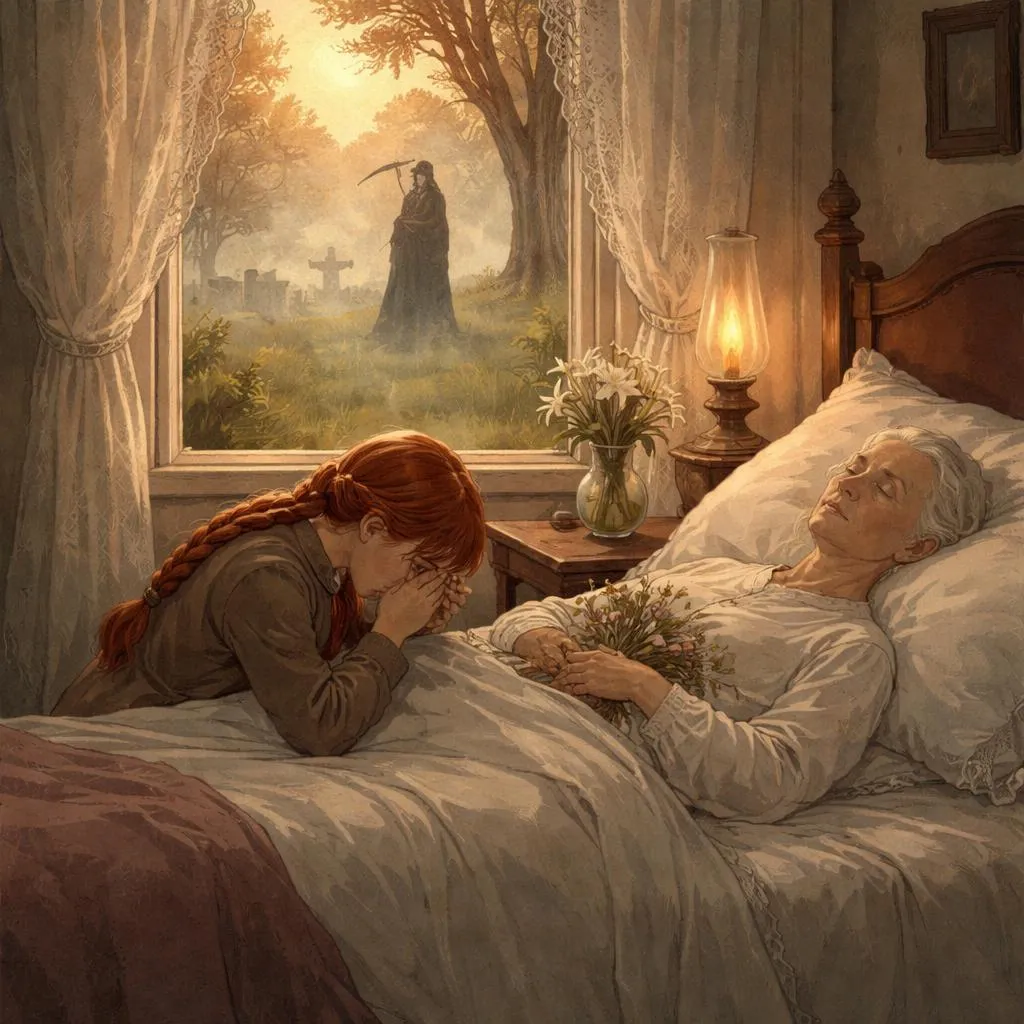
When the calm night came softly down over Green Gables the old house was hushed and tranquil. In the parlor lay Matthew Cuthbert in his coffin, his long gray hair framing his placid face on which there was a little kindly smile as if he but slept, dreaming pleasant dreams. There were flowers about him—sweet old-fashioned flowers which his mother had planted in the homestead garden in her bridal days and for which Matthew had always had a secret, wordless love. Anne had gathered them and brought them to him, her anguished, tearless eyes burning in her white face. It was the last thing she could do for him.
The Barrys and Mrs. Lynde stayed with them that night. Diana, going to the east gable, where Anne was standing at her window, said gently:
“Anne dear, would you like to have me sleep with you tonight?”
“Thank you, Diana.” Anne looked earnestly into her friend’s face. “I think you won’t misunderstand me when I say I want to be alone. I’m not afraid. I haven’t been alone one minute since it happened—and I want to be. I want to be quite silent and quiet and try to realize it. I can’t realize it. Half the time it seems to me that Matthew can’t be dead; and the other half it seems as if he must have been dead for a long time and I’ve had this horrible dull ache ever since.”
Diana did not quite understand. Marilla’s impassioned grief, breaking all the bounds of natural reserve and lifelong habit in its stormy rush, she could comprehend better than Anne’s tearless agony. But she went away kindly, leaving Anne alone to keep her first vigil with sorrow.
Anne hoped that the tears would come in solitude. It seemed to her a terrible thing that she could not shed a tear for Matthew, whom she had loved so much and who had been so kind to her, Matthew who had walked with her last evening at sunset and was now lying in the dim room below with that awful peace on his brow. But no tears came at first, even when she knelt by her window in the darkness and prayed, looking up to the stars beyond the hills—no tears, only the same horrible dull ache of misery that kept on aching until she fell asleep, worn out with the day’s pain and excitement.
In the night she awakened, with the stillness and the darkness about her, and the recollection of the day came over her like a wave of sorrow. She could see Matthew’s face smiling at her as he had smiled when they parted at the gate that last evening—she could hear his voice saying, “My girl—my girl that I’m proud of.” Then the tears came and Anne wept her heart out. Marilla heard her and crept in to comfort her.
“There—there—don’t cry so, dearie. It can’t bring him back. It—it—isn’t right to cry so. I knew that today, but I couldn’t help it then. He’d always been such a good, kind brother to me—but God knows best.”
“Oh, just let me cry, Marilla,” sobbed Anne. “The tears don’t hurt me like that ache did. Stay here for a little while with me and keep your arm round me—so. I couldn’t have Diana stay, she’s good and kind and sweet—but it’s not her sorrow—she’s outside of it and she couldn’t come close enough to my heart to help me. It’s our sorrow—yours and mine. Oh, Marilla, what will we do without him?”
“We’ve got each other, Anne. I don’t know what I’d do if you weren’t here—if you’d never come. Oh, Anne, I know I’ve been kind of strict and harsh with you maybe—but you mustn’t think I didn’t love you as well as Matthew did, for all that. I want to tell you now when I can. It’s never been easy for me to say things out of my heart, but at times like this it’s easier. I love you as dear as if you were my own flesh and blood and you’ve been my joy and comfort ever since you came to Green Gables.”
Two days afterwards they carried Matthew Cuthbert over his homestead threshold and away from the fields he had tilled and the orchards he had loved and the trees he had planted; and then Avonlea settled back to its usual placidity and even at Green Gables affairs slipped into their old groove and work was done and duties fulfilled with regularity as before, although always with the aching sense of “loss in all familiar things.” Anne, new to grief, thought it almost sad that it could be so—that they COULD go on in the old way without Matthew. She felt something like shame and remorse when she discovered that the sunrises behind the firs and the pale pink buds opening in the garden gave her the old inrush of gladness when she saw them—that Diana’s visits were pleasant to her and that Diana’s merry words and ways moved her to laughter and smiles—that, in brief, the beautiful world of blossom and love and friendship had lost none of its power to please her fancy and thrill her heart, that life still called to her with many insistent voices.
“It seems like disloyalty to Matthew, somehow, to find pleasure in these things now that he has gone,” she said wistfully to Mrs. Allan one evening when they were together in the manse garden. “I miss him so much—all the time—and yet, Mrs. Allan, the world and life seem very beautiful and interesting to me for all. Today Diana said something funny and I found myself laughing. I thought when it happened I could never laugh again. And it somehow seems as if I oughtn’t to.”
“When Matthew was here he liked to hear you laugh and he liked to know that you found pleasure in the pleasant things around you,” said Mrs. Allan gently. “He is just away now; and he likes to know it just the same. I am sure we should not shut our hearts against the healing influences that nature offers us. But I can understand your feeling. I think we all experience the same thing. We resent the thought that anything can please us when someone we love is no longer here to share the pleasure with us, and we almost feel as if we were unfaithful to our sorrow when we find our interest in life returning to us.”
“I was down to the graveyard to plant a rosebush on Matthew’s grave this afternoon,” said Anne dreamily. “I took a slip of the little white Scotch rosebush his mother brought out from Scotland long ago; Matthew always liked those roses the best—they were so small and sweet on their thorny stems. It made me feel glad that I could plant it by his grave—as if I were doing something that must please him in taking it there to be near him. I hope he has roses like them in heaven. Perhaps the souls of all those little white roses that he has loved so many summers were all there to meet him. I must go home now. Marilla is all alone and she gets lonely at twilight.”
“She will be lonelier still, I fear, when you go away again to college,” said Mrs. Allan.
Anne did not reply; she said good night and went slowly back to green Gables. Marilla was sitting on the front door-steps and Anne sat down beside her. The door was open behind them, held back by a big pink conch shell with hints of sea sunsets in its smooth inner convolutions.
Anne gathered some sprays of pale-yellow honeysuckle and put them in her hair. She liked the delicious hint of fragrance, as some aerial benediction, above her every time she moved.
“Doctor Spencer was here while you were away,” Marilla said. “He says that the specialist will be in town tomorrow and he insists that I must go in and have my eyes examined. I suppose I’d better go and have it over. I’ll be more than thankful if the man can give me the right kind of glasses to suit my eyes. You won’t mind staying here alone while I’m away, will you? Martin will have to drive me in and there’s ironing and baking to do.”
“I shall be all right. Diana will come over for company for me. I shall attend to the ironing and baking beautifully—you needn’t fear that I’ll starch the handkerchiefs or flavor the cake with liniment.”
Marilla laughed.
“What a girl you were for making mistakes in them days, Anne. You were always getting into scrapes. I did use to think you were possessed. Do you mind the time you dyed your hair?”
“Yes, indeed. I shall never forget it,” smiled Anne, touching the heavy braid of hair that was wound about her shapely head. “I laugh a little now sometimes when I think what a worry my hair used to be to me—but I don’t laugh MUCH, because it was a very real trouble then. I did suffer terribly over my hair and my freckles. My freckles are really gone; and people are nice enough to tell me my hair is auburn now—all but Josie Pye. She informed me yesterday that she really thought it was redder than ever, or at least my black dress made it look redder, and she asked me if people who had red hair ever got used to having it. Marilla, I’ve almost decided to give up trying to like Josie Pye. I’ve made what I would once have called a heroic effort to like her, but Josie Pye won’t BE liked.”
“Josie is a Pye,” said Marilla sharply, “so she can’t help being disagreeable. I suppose people of that kind serve some useful purpose in society, but I must say I don’t know what it is any more than I know the use of thistles. Is Josie going to teach?”
“No, she is going back to Queen’s next year. So are Moody Spurgeon and Charlie Sloane. Jane and Ruby are going to teach and they have both got schools—Jane at Newbridge and Ruby at some place up west.”
“Gilbert Blythe is going to teach too, isn’t he?”
“Yes”—briefly.
“What a nice-looking fellow he is,” said Marilla absently. “I saw him in church last Sunday and he seemed so tall and manly. He looks a lot like his father did at the same age. John Blythe was a nice boy. We used to be real good friends, he and I. People called him my beau.”
Anne looked up with swift interest.
“Oh, Marilla—and what happened?—why didn’t you—”
“We had a quarrel. I wouldn’t forgive him when he asked me to. I meant to, after awhile—but I was sulky and angry and I wanted to punish him first. He never came back—the Blythes were all mighty independent. But I always felt—rather sorry. I’ve always kind of wished I’d forgiven him when I had the chance.”
“So you’ve had a bit of romance in your life, too,” said Anne softly.
“Yes, I suppose you might call it that. You wouldn’t think so to look at me, would you? But you never can tell about people from their outsides. Everybody has forgot about me and John. I’d forgotten myself. But it all came back to me when I saw Gilbert last Sunday.”
Background and Author Introduction
This passage is from Anne of Green Gables, a beloved classic novel written by Canadian author Lucy Maud Montgomery. Published in 1908, the story follows Anne Shirley, an imaginative and spirited orphan girl who is mistakenly sent to live with Marilla and Matthew Cuthbert, siblings who had intended to adopt a boy to help them on their farm in the fictional village of Avonlea on Prince Edward Island. The novel is renowned for its vivid portrayal of rural life, the warmth of human relationships, and the growth of a young girl into a mature young woman.
Lucy Maud Montgomery drew inspiration from her own childhood and the landscapes of Prince Edward Island. Her writing style combines humor, emotional depth, and a strong sense of place, which has made Anne of Green Gables a timeless story cherished by readers worldwide.
Detailed Interpretation and Significance
This excerpt depicts a pivotal and deeply emotional moment in the story: the sudden death of Matthew Cuthbert, Anne’s beloved guardian and a gentle, kind-hearted man who had quietly supported Anne’s dreams and growth. His death shocks the community and leaves Anne and Marilla grieving profoundly. The passage explores themes of loss, grief, and the process of healing.
Matthew’s death is sudden and caused by a shock—news of the bank failure, which symbolizes the fragility of life and the unexpected nature of tragedy. Anne’s initial inability to cry and her eventual emotional release highlight the complex ways people experience grief. The story also touches on the importance of companionship and understanding during sorrow, as shown in the interactions between Anne, Marilla, Diana, and Mrs. Lynde.
Despite the pain, life continues, and Anne learns that finding joy and laughter again is not disloyalty to those who have passed but a natural part of healing. This realization is a powerful message about resilience and hope.
Lessons and Insights for Students
-
Understanding Grief: The passage teaches that grief is a personal and often complicated experience. It may not always involve tears immediately; sometimes, it feels like a dull ache. Recognizing this helps students understand their own emotions and those of others when facing loss.
-
The Value of Compassion: Marilla’s and Mrs. Lynde’s support for Anne shows how kindness and presence can comfort those who are hurting. Students can learn the importance of empathy and being there for friends and family in difficult times.
-
Resilience and Moving Forward: Anne’s journey from shock to acceptance illustrates resilience. It encourages young readers to find strength within themselves to face challenges and continue living fully, honoring the memory of loved ones by embracing life’s beauty.
-
Appreciation of Nature and Simple Joys: Anne’s love for flowers and nature, even in sorrow, reminds students to find solace and inspiration in the natural world and everyday moments.
-
Honesty and Emotional Expression: The dialogue between Anne and Marilla emphasizes the importance of expressing feelings openly and honestly, rather than bottling them up.
Applying These Lessons in Daily Life
-
In School: Students can support classmates who may be going through tough times by offering a listening ear or simple acts of kindness. They can also reflect on their own feelings and seek help when overwhelmed.
-
In Friendships: Understanding that everyone grieves differently helps maintain patience and compassion in friendships. Being present and respectful of others’ emotions strengthens bonds.
-
In Family: Sharing feelings with family members, like Anne and Marilla do, builds trust and mutual support, which is essential during hardships.
-
Personal Growth: Embracing resilience means learning from difficulties and continuing to pursue goals with hope and courage, just as Anne does.
Cultivating Positive Values from the Story
- Kindness: Matthew’s gentle nature and Anne’s gratitude highlight the power of kindness in creating meaningful relationships.
- Courage: Facing loss and continuing to live fully requires bravery, an important trait for young people to develop.
- Hope: Anne’s eventual laughter and joy symbolize hope’s role in healing.
- Friendship: The support from Diana and others shows that friends are vital during both happy and sad times.
- Self-Reflection: Anne’s introspection about her feelings and experiences encourages students to think deeply about their own lives and emotions.
Conclusion
This passage from Anne of Green Gables offers a rich exploration of grief, love, and resilience. It invites students to understand the complexities of human emotions and the importance of compassion, hope, and friendship. By learning from Anne’s experience, young readers can develop emotional intelligence and positive values that will help them navigate their own lives with strength and kindness.
