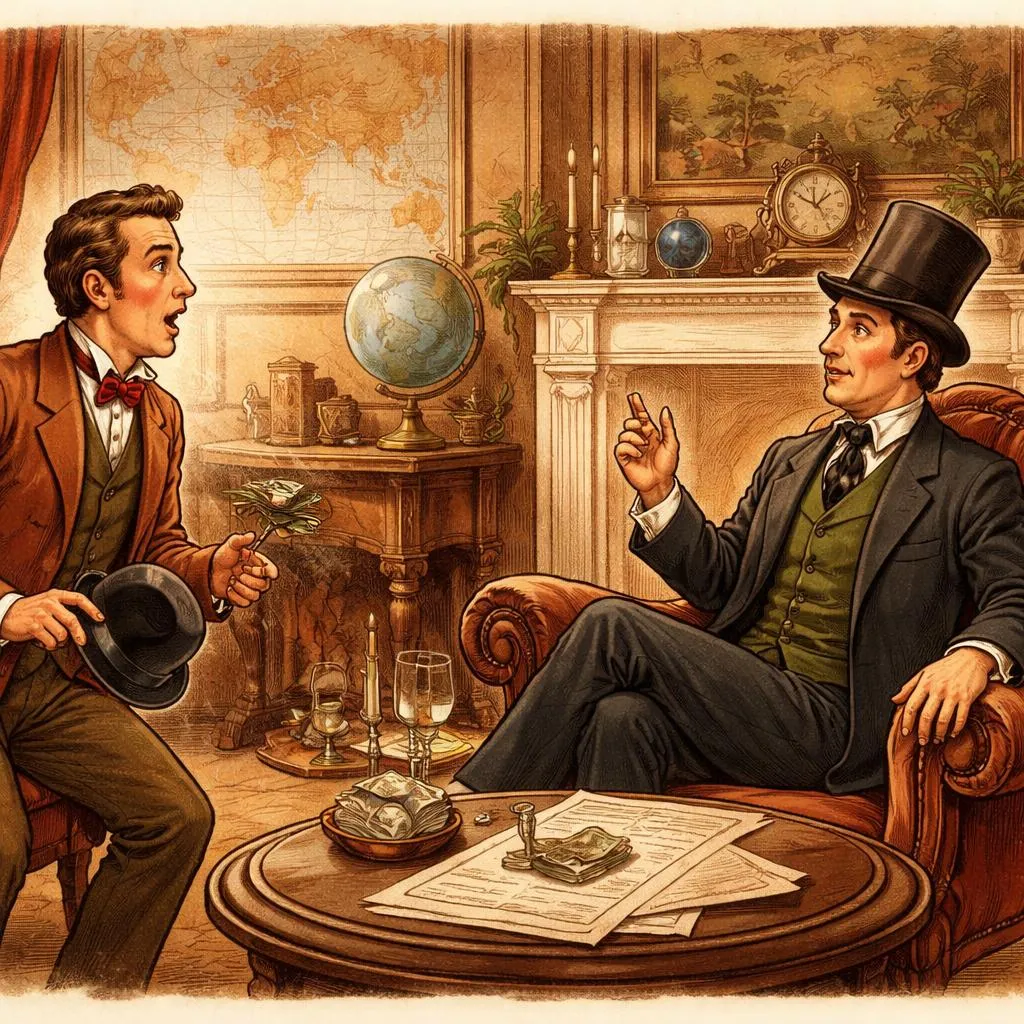

Having won twenty guineas at whist, and taken leave of his friends, Phileas Fogg, at twenty–five minutes past seven, left the Reform Club.
Passepartout, who had conscientiously studied the programme of his duties, was more than surprised to see his master guilty of the inexactness of appearing at this unaccustomed hour; for, according to rule, he was not due in Saville Row until precisely midnight.
Mr. Fogg repaired to his bedroom, and called out, "Passepartout!"
Passepartout did not reply. It could not be he who was called; it was not the right hour.
"Passepartout!" repeated Mr. Fogg, without raising his voice.
Passepartout made his appearance.
"I've called you twice," observed his master.
"But it is not midnight," responded the other, showing his watch.
"I know it; I don't blame you. We start for Dover and Calais in ten minutes."
A puzzled grin overspread Passepartout's round face; clearly he had not comprehended his master.
"Monsieur is going to leave home?"
"Yes," returned Phileas Fogg. "We are going round the world."
Passepartout opened wide his eyes, raised his eyebrows, held up his hands, and seemed about to collapse, so overcome was he with stupefied astonishment.
"Round the world!" he murmured.
"In eighty days," responded Mr. Fogg. "So we haven't a moment to lose."
"But the trunks?" gasped Passepartout, unconsciously swaying his head from right to left.
"We'll have no trunks; only a carpet–bag, with two shirts and three pairs of stockings for me, and the same for you. We'll buy our clothes on the way. Bring down my mackintosh and traveling–cloak, and some stout shoes, though we shall do little walking. Make haste!"
Passepartout tried to reply, but could not. He went out, mounted to his own room, fell into a chair, and muttered: "That's good, that is! And I, who wanted to remain quiet!"
He mechanically set about making the preparations for departure. Around the world in eighty days! Was his master a fool? No. Was this a joke, then? They were going to Dover; good! To Calais; good again! After all, Passepartout, who had been away from France five years, would not be sorry to set foot on his native soil again. Perhaps they would go as far as Paris, and it would do his eyes good to see Paris once more. But surely a gentleman so chary of his steps would stop there; no doubt—but, then, it was none the less true that he was going away, this so domestic person hitherto!
By eight o'clock Passepartout had packed the modest carpet–bag, containing the wardrobes of his master and himself; then, still troubled in mind, he carefully shut the door of his room, and descended to Mr. Fogg.
Mr. Fogg was quite ready. Under his arm might have been observed a red–bound copy of Bradshaw's Continental Railway Steam Transit and General Guide, with its timetables showing the arrival and departure of steamers and railways. He took the carpet–bag, opened it, and slipped into it a goodly roll of Bank of England notes, which would pass wherever he might go.
"You have forgotten nothing?" asked he.
"Nothing, monsieur."
"My mackintosh and cloak?"
"Here they are."
"Good! Take this carpet–bag," handing it to Passepartout. "Take good care of it, for there are twenty thousand pounds in it."
Passepartout nearly dropped the bag, as if the twenty thousand pounds were in gold, and weighed him down.
Master and man then descended, the street–door was double–locked, and at the end of Saville Row they took a cab and drove rapidly to Charing Cross. The cab stopped before the railway station at twenty minutes past eight. Passepartout jumped off the box and followed his master, who, after paying the cabman, was about to enter the station, when a poor beggar–woman, with a child in her arms, her naked feet smeared with mud, her head covered with a wretched bonnet, from which hung a tattered feather, and her shoulders shrouded in a ragged shawl, approached, and mournfully asked for alms.
Mr. Fogg took out the twenty guineas he had just won at whist, and handed them to the beggar, saying, "Here, my good woman. I'm glad that I met you;" and passed on.
Passepartout had a moist sensation about the eyes; his master's action touched his susceptible heart.
Two first–class tickets for Paris having been speedily purchased, Mr. Fogg was crossing the station to the train, when he perceived his five friends of the Reform.
"Well, gentlemen," said he, "I'm off, you see; and, if you will examine my passport when I get back, you will be able to judge whether I have accomplished the journey agreed upon."
"Oh, that would be quite unnecessary, Mr. Fogg," said Ralph politely. "We will trust your word, as a gentleman of honour."
"You do not forget when you are due in London again?" asked Stuart.
"In eighty days; on Saturday, the 21st of December, 1872, at a quarter before nine p.m. Good–bye, gentlemen."
Phileas Fogg and his servant seated themselves in a first–class carriage at twenty minutes before nine; five minutes later the whistle screamed, and the train slowly glided out of the station.
The night was dark, and a fine, steady rain was falling. Phileas Fogg, snugly ensconced in his corner, did not open his lips. Passepartout, not yet recovered from his stupefaction, clung mechanically to the carpet–bag, with its enormous treasure.
Just as the train was whirling through Sydenham, Passepartout suddenly uttered a cry of despair.
"What's the matter?" asked Mr. Fogg.
"Alas! In my hurry—I—I forgot—"
"What?"
"To turn off the gas in my room!"
"Very well, young man," returned Mr. Fogg, coolly; "it will burn—at your expense."
Background and Author Introduction
This excerpt is from the classic novel Around the World in Eighty Days by Jules Verne, a French author renowned for his adventure and science fiction stories. Written in 1873, the novel captures the spirit of the 19th-century fascination with exploration and technological progress. Verne’s vivid imagination and detailed descriptions make his works timeless, inspiring generations of readers to dream of adventure and discovery.
Story Overview and Significance
The story follows Phileas Fogg, a precise and wealthy English gentleman, who wagers that he can travel around the world in just eighty days. Accompanied by his loyal French servant, Passepartout, Fogg embarks on a journey filled with challenges, unexpected events, and cultural encounters. This passage introduces the beginning of their ambitious trip, highlighting Fogg’s punctuality, determination, and generosity, as well as Passepartout’s surprise and growing admiration.
The novel is not only a thrilling adventure but also a reflection on human ingenuity, courage, and the power of determination. It explores themes such as time management, the impact of technology (like railways and steamships), and the importance of kindness and trust.
Lessons and Insights for Students
-
The Value of Determination and Planning
Phileas Fogg’s confidence and detailed planning show how setting clear goals and preparing carefully can help overcome even the most daunting challenges. Students can learn to approach their studies and personal goals with similar focus and discipline. -
Adaptability and Open-mindedness
Throughout the journey, Fogg and Passepartout must adapt to new cultures, unexpected delays, and obstacles. This teaches the importance of flexibility and open-mindedness in life, especially when facing change or uncertainty. -
Generosity and Compassion
Fogg’s act of giving twenty guineas to a poor woman despite his tight schedule reminds us that kindness should not be forgotten, even when we are busy. Students can be encouraged to practice empathy and generosity in their daily lives. -
Courage to Take Risks
Fogg’s decision to travel around the world on a tight schedule is a bold risk. This encourages young readers to step out of their comfort zones and embrace challenges as opportunities for growth.
How to Apply These Lessons in Life
- In Learning: Just like Fogg’s meticulous planning, students can organize their study schedules and set realistic goals to achieve academic success.
- In Social Situations: Showing kindness and understanding, as Fogg does, helps build strong friendships and positive relationships.
- In Personal Growth: Being open to new experiences and cultures broadens horizons and fosters respect for diversity.
- In Problem-Solving: When unexpected problems arise, staying calm and thinking creatively, like Fogg, can lead to effective solutions.
Cultivating Positive Traits from the Story
- Punctuality and Responsibility: Fogg’s strict adherence to time teaches the importance of being punctual and responsible.
- Loyalty and Support: Passepartout’s dedication shows the value of supporting those we care about.
- Curiosity and Adventure: Encouraging a spirit of curiosity motivates students to explore new ideas and places.
- Generosity: Acts of kindness enrich both the giver and receiver, fostering a caring community.
Reflection and Appreciation
Reading Around the World in Eighty Days invites young readers to imagine the excitement of travel and discovery while learning about perseverance and kindness. The story’s blend of adventure and moral lessons makes it an excellent choice for students to develop both their imagination and character. By reflecting on Fogg’s journey, students can appreciate the rewards of courage, planning, and compassion in their own lives.
