
It seemed to me that this quaint lie was most simply and beautifully told; but then I had heard it only once, and that makes a difference; it was pleasant to the others when it was fresh, no doubt.
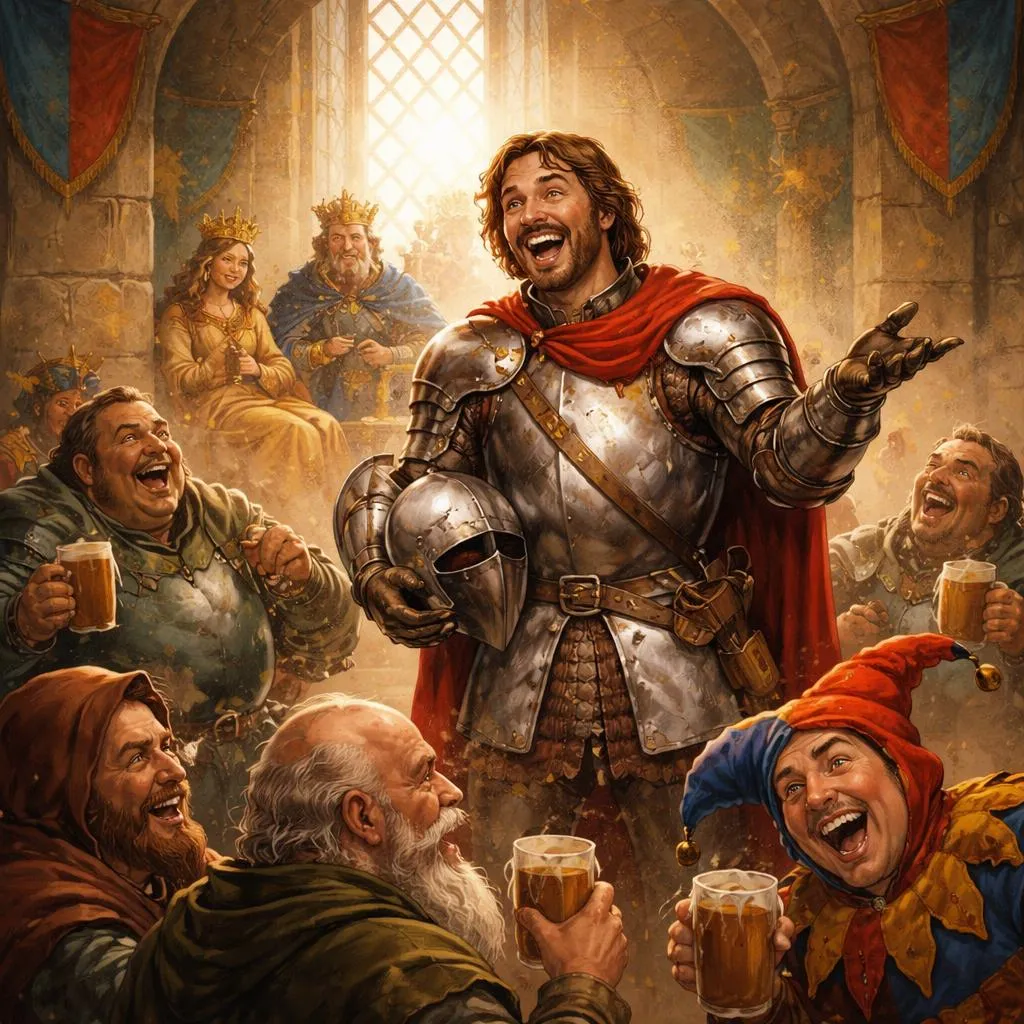
Sir Dinadan the Humorist was the first to awake, and he soon roused the rest with a practical joke of a sufficiently poor quality. He tied some metal mugs to a dog’s tail and turned him loose, and he tore around and around the place in a frenzy of fright, with all the other dogs bellowing after him and battering and crashing against everything that came in their way and making altogether a chaos of confusion and a most deafening din and turmoil; at which every man and woman of the multitude laughed till the tears flowed, and some fell out of their chairs and wallowed on the floor in ecstasy. It was just like so many children. Sir Dinadan was so proud of his exploit that he could not keep from telling over and over again, to weariness, how the immortal idea happened to occur to him; and as is the way with humorists of his breed, he was still laughing at it after everybody else had got through. He was so set up that he concluded to make a speech —of course a humorous speech. I think I never heard so many old played-out jokes strung together in my life. He was worse than the minstrels, worse than the clown in the circus. It seemed peculiarly sad to sit here, thirteen hundred years before I was born, and listen again to poor, flat, worm-eaten jokes that had given me the dry gripes when I was a boy thirteen hundred years afterwards. It about convinced me that there isn’t any such thing as a new joke possible. Everybody laughed at these antiquities —but then they always do; I had noticed that, centuries later. However, of course the scoffer didn’t laugh—I mean the boy. No, he scoffed; there wasn’t anything he wouldn’t scoff at. He said the most of Sir Dinadan’s jokes were rotten and the rest were petrified. I said “petrified” was good; as I believed, myself, that the only right way to classify the majestic ages of some of those jokes was by geologic periods. But that neat idea hit the boy in a blank place, for geology hadn’t been invented yet. However, I made a note of the remark, and calculated to educate the commonwealth up to it if I pulled through. It is no use to throw a good thing away merely because the market isn’t ripe yet.
Now Sir Kay arose and began to fire up on his history-mill with me for fuel. It was time for me to feel serious, and I did. Sir Kay told how he had encountered me in a far land of barbarians, who all wore the same ridiculous garb that I did—a garb that was a work of enchantment, and intended to make the wearer secure from hurt by human hands. However he had nullified the force of the enchantment by prayer, and had killed my thirteen knights in a three hours’ battle, and taken me prisoner, sparing my life in order that so strange a curiosity as I was might be exhibited to the wonder and admiration of the king and the court. He spoke of me all the time, in the blandest way, as “this prodigious giant,” and “this horrible sky-towering monster,” and “this tusked and taloned man-devouring ogre”, and everybody took in all this bosh in the naivest way, and never smiled or seemed to notice that there was any discrepancy between these watered statistics and me. He said that in trying to escape from him I sprang into the top of a tree two hundred cubits high at a single bound, but he dislodged me with a stone the size of a cow, which “all-to brast” the most of my bones, and then swore me to appear at Arthur’s court for sentence. He ended by condemning me to die at noon on the 21st; and was so little concerned about it that he stopped to yawn before he named the date.
I was in a dismal state by this time; indeed, I was hardly enough in my right mind to keep the run of a dispute that sprung up as to how I had better be killed, the possibility of the killing being doubted by some, because of the enchantment in my clothes. And yet it was nothing but an ordinary suit of fifteen-dollar slop-shops. Still, I was sane enough to notice this detail, to wit: many of the terms used in the most matter-of-fact way by this great assemblage of the first ladies and gentlemen in the land would have made a Comanche blush. Indelicacy is too mild a term to convey the idea. However, I had read “Tom Jones,” and “Roderick Random,” and other books of that kind, and knew that the highest and first ladies and gentlemen in England had remained little or no cleaner in their talk, and in the morals and conduct which such talk implies, clear up to a hundred years ago; in fact clear into our own nineteenth century—in which century, broadly speaking, the earliest samples of the real lady and real gentleman discoverable in English history—or in European history, for that matter—may be said to have made their appearance. Suppose Sir Walter, instead of putting the conversations into the mouths of his characters, had allowed the characters to speak for themselves? We should have had talk from Rebecca and Ivanhoe and the soft lady Rowena which would embarrass a tramp in our day. However, to the unconsciously indelicate all things are delicate. King Arthur’s people were not aware that they were indecent and I had presence of mind enough not to mention it.
They were so troubled about my enchanted clothes that they were mightily relieved, at last, when old Merlin swept the difficulty away for them with a common-sense hint. He asked them why they were so dull—why didn’t it occur to them to strip me. In half a minute I was as naked as a pair of tongs! And dear, dear, to think of it: I was the only embarrassed person there. Everybody discussed me; and did it as unconcernedly as if I had been a cabbage. Queen Guenever was as naively interested as the rest, and said she had never seen anybody with legs just like mine before. It was the only compliment I got—if it was a compliment.
Finally I was carried off in one direction, and my perilous clothes in another. I was shoved into a dark and narrow cell in a dungeon, with some scant remnants for dinner, some moldy straw for a bed, and no end of rats for company.
Background and Author Introduction
This passage is from Mark Twain’s novel A Connecticut Yankee in King Arthur’s Court, first published in 1889. Twain, one of America’s greatest humorists and social critics, uses this story to blend fantasy, satire, and historical fiction. The novel tells the tale of a 19th-century American engineer who is mysteriously transported back in time to the age of King Arthur. Twain uses this imaginative setup to explore themes of progress, technology, social justice, and human nature.
Detailed Interpretation and Significance
The excerpt captures the humorous and often absurd clash between modern and medieval worlds. The protagonist, a man from the future, observes the knights and nobles of Arthurian legend with a mix of irony and disbelief. The practical joke by Sir Dinadan and the exaggerated tales told by Sir Kay highlight the contrast between the chivalric ideals and the often ridiculous reality behind them.
Twain’s narrative style combines a playful tone with sharp social commentary. The “quaint lie” and the “old played-out jokes” symbolize how stories and traditions can become distorted or lose meaning over time. The protagonist’s reflections on the language and manners of the past reveal Twain’s critique of social pretenses and hypocrisy, both in the medieval setting and in his own time.
The enchanted clothing and the protagonist’s imprisonment illustrate the tension between superstition and reason, a recurring theme in the novel. The character Merlin’s practical advice to strip the protagonist naked to break the enchantment represents the triumph of common sense over blind belief.
Lessons and Insights for Students
-
Critical Thinking and Skepticism: The story encourages readers to question accepted truths and traditions. Just as the protagonist doubts the knights’ tales and the power of enchantments, students should learn to think critically about information and not accept everything at face value.
-
Humor as a Tool for Reflection: Twain’s use of humor helps to expose human follies and social flaws. Students can appreciate how laughter and satire can be powerful ways to understand and critique the world around them.
-
Understanding Historical Context: The novel blends historical legend with modern ideas, showing how perspectives change over time. This encourages students to explore history with an open mind and recognize the influence of culture and time on stories and beliefs.
-
Respect for Knowledge and Progress: The protagonist’s background as an engineer symbolizes the importance of science and technology in advancing society. Students can be inspired to value education and innovation while respecting the lessons of the past.
-
Empathy and Open-mindedness: The protagonist’s experience as an outsider in a strange world teaches the importance of empathy and adaptability. Students can learn to appreciate different cultures and viewpoints, which is vital in today’s diverse society.
Applying the Story’s Spirit in Daily Life
-
In Learning: Embrace curiosity and question assumptions. Approach studies with a balance of skepticism and openness, much like the protagonist navigating an unfamiliar world.
-
In Social Interactions: Use humor kindly to ease tensions and build connections, but be mindful of others’ feelings. Like Sir Dinadan’s jokes, humor can unite people when used thoughtfully.
-
In Facing Challenges: Apply reason and common sense to solve problems, as Merlin advises. Don’t be afraid to strip away unnecessary complications to find clear solutions.
-
In Developing Character: Cultivate resilience and adaptability. The protagonist’s journey shows that unexpected situations require courage and flexibility.
Encouraging Positive Values
Students can learn from the protagonist’s experience to develop virtues such as honesty, bravery, and humility. Recognizing the flaws in others and oneself with humor and grace helps build strong character. The novel also promotes the value of standing up for what is right, questioning injustice, and using knowledge responsibly.
By reading and reflecting on A Connecticut Yankee in King Arthur’s Court, young readers gain not only entertainment but also a deeper understanding of history, society, and human nature. They are invited to think independently, appreciate the power of storytelling, and carry forward the spirit of inquiry and kindness in their own lives.
