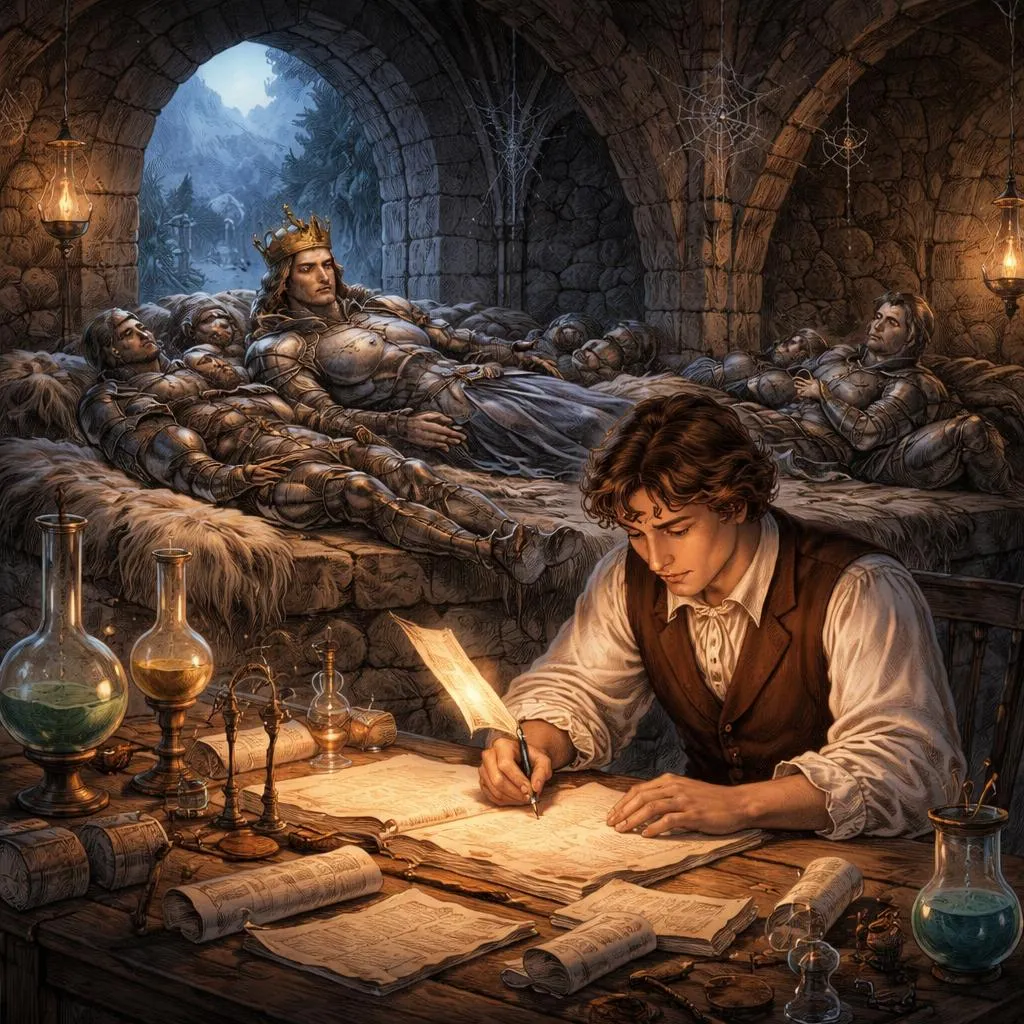

I, Clarence, must write it for him. He proposed that we two go out and see if any help could be accorded the wounded. I was strenuous against the project. I said that if there were many, we could do but little for them; and it would not be wise for us to trust ourselves among them, anyway. But he could seldom be turned from a purpose once formed; so we shut off the electric current from the fences, took an escort along, climbed over the enclosing ramparts of dead knights, and moved out upon the field. The first wounded mall who appealed for help was sitting with his back against a dead comrade. When The Boss bent over him and spoke to him, the man recognized him and stabbed him. That knight was Sir Meliagraunce, as I found out by tearing off his helmet. He will not ask for help any more.
We carried The Boss to the cave and gave his wound, which was not very serious, the best care we could. In this service we had the help of Merlin, though we did not know it. He was disguised as a woman, and appeared to be a simple old peasant goodwife. In this disguise, with brown-stained face and smooth shaven, he had appeared a few days after The Boss was hurt and offered to cook for us, saying her people had gone off to join certain new camps which the enemy were forming, and that she was starving. The Boss had been getting along very well, and had amused himself with finishing up his record.
We were glad to have this woman, for we were short handed. We were in a trap, you see—a trap of our own making. If we stayed where we were, our dead would kill us; if we moved out of our defenses, we should no longer be invincible. We had conquered; in turn we were conquered. The Boss recognized this; we all recognized it. If we could go to one of those new camps and patch up some kind of terms with the enemy—yes, but The Boss could not go, and neither could I, for I was among the first that were made sick by the poisonous air bred by those dead thousands. Others were taken down, and still others. To-morrow—
To-morrow. It is here. And with it the end. About midnight I awoke, and saw that hag making curious passes in the air about The Boss’s head and face, and wondered what it meant. Everybody but the dynamo-watch lay steeped in sleep; there was no sound. The woman ceased from her mysterious foolery, and started tip-toeing toward the door. I called out:
“Stop! What have you been doing?”
She halted, and said with an accent of malicious satisfaction:
“Ye were conquerors; ye are conquered! These others are perishing —you also. Ye shall all die in this place—every one—except him. He sleepeth now—and shall sleep thirteen centuries. I am Merlin!”
Then such a delirium of silly laughter overtook him that he reeled about like a drunken man, and presently fetched up against one of our wires. His mouth is spread open yet; apparently he is still laughing. I suppose the face will retain that petrified laugh until the corpse turns to dust.
The Boss has never stirred—sleeps like a stone. If he does not wake to-day we shall understand what kind of a sleep it is, and his body will then be borne to a place in one of the remote recesses of the cave where none will ever find it to desecrate it. As for the rest of us—well, it is agreed that if any one of us ever escapes alive from this place, he will write the fact here, and loyally hide this Manuscript with The Boss, our dear good chief, whose property it is, be he alive or dead.
Background and Author Introduction
This excerpt is from "The Last of the Winnebagos," a story written by Connie Willis, a renowned science fiction author known for her imaginative storytelling and deep exploration of human nature. The story is set in a dystopian future where humanity faces great challenges, blending elements of fantasy and science fiction. Willis often uses her narratives to explore themes of survival, loyalty, and the consequences of war.
Detailed Interpretation and Significance
The passage depicts a grim scene of a battlefield littered with the dead and wounded knights, symbolizing the aftermath of conflict and the futility of war. The characters, including "The Boss" and Clarence, represent resilience and leadership amid despair. The presence of Merlin, disguised as a humble woman, adds a mystical element, suggesting that hope and wisdom can come from unexpected places. The story explores themes of sacrifice, the inevitability of change, and the complex nature of victory and defeat.
The narrative also touches on the idea of being trapped by one’s own actions—both physically and metaphorically. The characters are caught between the dangers of staying put and the risks of moving forward, reflecting the difficult choices people face in times of crisis. The sleep of "The Boss" for thirteen centuries hints at a long pause or waiting period before renewal or awakening, symbolizing hope for the future despite current suffering.
Lessons and Insights for Students
-
Courage and Leadership: The Boss’s determination to help the wounded despite the dangers teaches the importance of bravery and responsibility. Students can learn that true leaders act selflessly and face challenges head-on.
-
Compassion in Adversity: The effort to aid the injured, even when resources are limited, highlights empathy and kindness. This encourages young readers to care for others, especially in difficult times.
-
Wisdom and Adaptability: Merlin’s disguise and mysterious actions remind us that wisdom can be hidden in unlikely forms and that adaptability is crucial. Students should be open-minded and ready to learn from unexpected sources.
-
Understanding Consequences: The story demonstrates how actions have consequences, sometimes trapping people in difficult situations. This can help students think critically about their choices and the impact they have on themselves and others.
Applying These Lessons in Daily Life
-
In Learning: Just as the characters face tough decisions, students can develop problem-solving skills by approaching challenges thoughtfully and seeking help when needed.
-
In Social Situations: Showing compassion and leadership among peers fosters a supportive environment. Standing up for others and acting with kindness builds strong friendships.
-
In Personal Growth: Embracing change and learning from mistakes helps students grow. Like Merlin’s hidden identity, sometimes growth comes from unexpected experiences.
Cultivating Positive Values from the Story
-
Resilience: Encourage students to keep trying even when situations seem hopeless, just like the characters who continue to care for each other despite overwhelming odds.
-
Empathy: Promote activities that help students understand others’ feelings, reinforcing the story’s message about helping those in need.
-
Critical Thinking: Use the story’s complex scenarios to practice analyzing problems and considering different perspectives.
-
Respect for History and Stories: Understanding that stories carry lessons from the past can inspire students to value literature and learn from it.
Conclusion
This story offers rich material for young readers to explore themes of bravery, compassion, and wisdom. By reflecting on the characters’ struggles and choices, students can gain insights into their own lives and develop skills that will help them navigate challenges both in school and beyond. Encouraging discussion and creative projects based on the story can deepen understanding and make these lessons memorable and meaningful.
