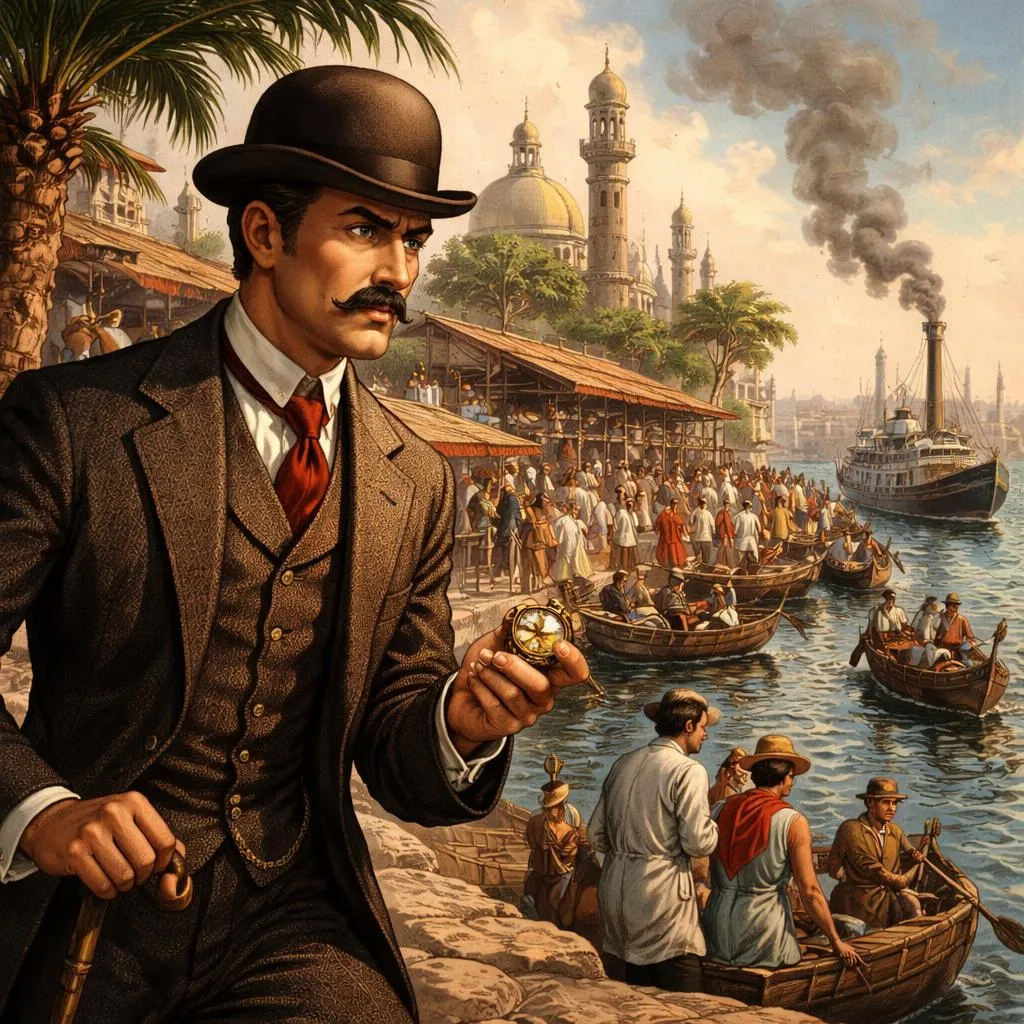

The circumstances under which this telegraphic dispatch about Phileas Fogg was sent were as follows:
The steamer Mongolia, belonging to the Peninsular and Oriental Company, built of iron, of two thousand eight hundred tons burden, and five hundred horse–power, was due at eleven o'clock a.m. on Wednesday, the 9th of October, at Suez. The Mongolia plied regularly between Brindisi and Bombay via the Suez Canal, and was one of the fastest steamers belonging to the company, always making more than ten knots an hour between Brindisi and Suez, and nine and a half between Suez and Bombay.
Two men were promenading up and down the wharves, among the crowd of natives and strangers who were sojourning at this once straggling village—now, thanks to the enterprise of M. Lesseps, a fast–growing town. One was the British consul at Suez, who, despite the prophecies of the English Government, and the unfavourable predictions of Stephenson, was in the habit of seeing, from his office window, English ships daily passing to and fro on the great canal, by which the old roundabout route from England to India by the Cape of Good Hope was abridged by at least a half. The other was a small, slight–built personage, with a nervous, intelligent face, and bright eyes peering out from under eyebrows which he was incessantly twitching. He was just now manifesting unmistakable signs of impatience, nervously pacing up and down, and unable to stand still for a moment. This was Fix, one of the detectives who had been dispatched from England in search of the bank robber; it was his task to narrowly watch every passenger who arrived at Suez, and to follow up all who seemed to be suspicious characters, or bore a resemblance to the description of the criminal, which he had received two days before from the police headquarters at London. The detective was evidently inspired by the hope of obtaining the splendid reward which would be the prize of success, and awaited with a feverish impatience, easy to understand, the arrival of the steamer Mongolia.
"So you say, consul," asked he for the twentieth time, "that this steamer is never behind time?"
"No, Mr. Fix," replied the consul. "She was bespoken yesterday at Port Said, and the rest of the way is of no account to such a craft. I repeat that the Mongolia has been in advance of the time required by the company's regulations, and gained the prize awarded for excess of speed."
"Does she come directly from Brindisi?"
"Directly from Brindisi; she takes on the Indian mails there, and she left there Saturday at five p.m. Have patience, Mr. Fix; she will not be late. But really, I don't see how, from the description you have, you will be able to recognise your man, even if he is on board the Mongolia."
"A man rather feels the presence of these fellows, consul, than recognises them. You must have a scent for them, and a scent is like a sixth sense which combines hearing, seeing, and smelling. I've arrested more than one of these gentlemen in my time, and, if my thief is on board, I'll answer for it; he'll not slip through my fingers."
"I hope so, Mr. Fix, for it was a heavy robbery."
"A magnificent robbery, consul; fifty–five thousand pounds! We don't often have such windfalls. Burglars are getting to be so contemptible nowadays! A fellow gets hung for a handful of shillings!"
"Mr. Fix," said the consul, "I like your way of talking, and hope you'll succeed; but I fear you will find it far from easy. Don't you see, the description which you have there has a singular resemblance to an honest man?"
"Consul," remarked the detective, dogmatically, "great robbers always resemble honest folks. Fellows who have rascally faces have only one course to take, and that is to remain honest; otherwise they would be arrested off–hand. The artistic thing is, to unmask honest countenances; it's no light task, I admit, but a real art."
Mr. Fix evidently was not wanting in a tinge of self–conceit.
Little by little the scene on the quay became more animated; sailors of various nations, merchants, ship–brokers, porters, fellahs, bustled to and fro as if the steamer were immediately expected. The weather was clear, and slightly chilly. The minarets of the town loomed above the houses in the pale rays of the sun. A jetty pier, some two thousand yards along, extended into the roadstead. A number of fishing–smacks and coasting boats, some retaining the fantastic fashion of ancient galleys, were discernible on the Red Sea.
As he passed among the busy crowd, Fix, according to habit, scrutinised the passers–by with a keen, rapid glance.
It was now half–past ten.
"The steamer doesn't come!" he exclaimed, as the port clock struck.
"She can't be far off now," returned his companion.
"How long will she stop at Suez?"
"Four hours; long enough to get in her coal. It is thirteen hundred and ten miles from Suez to Aden, at the other end of the Red Sea, and she has to take in a fresh coal supply."
"And does she go from Suez directly to Bombay?"
"Without putting in anywhere."
"Good!" said Fix. "If the robber is on board he will no doubt get off at Suez, so as to reach the Dutch or French colonies in Asia by some other route. He ought to know that he would not be safe an hour in India, which is English soil."
"Unless," objected the consul, "he is exceptionally shrewd. An English criminal, you know, is always better concealed in London than anywhere else."
This observation furnished the detective food for thought, and meanwhile the consul went away to his office. Fix, left alone, was more impatient than ever, having a presentiment that the robber was on board the Mongolia. If he had indeed left London intending to reach the New World, he would naturally take the route via India, which was less watched and more difficult to watch than that of the Atlantic. But Fix's reflections were soon interrupted by a succession of sharp whistles, which announced the arrival of the Mongolia. The porters and fellahs rushed down the quay, and a dozen boats pushed off from the shore to go and meet the steamer. Soon her gigantic hull appeared passing along between the banks, and eleven o'clock struck as she anchored in the road. She brought an unusual number of passengers, some of whom remained on deck to scan the picturesque panorama of the town, while the greater part disembarked in the boats, and landed on the quay.
Fix took up a position, and carefully examined each face and figure which made its appearance. Presently one of the passengers, after vigorously pushing his way through the importunate crowd of porters, came up to him and politely asked if he could point out the English consulate, at the same time showing a passport which he wished to have visaed. Fix instinctively took the passport, and with a rapid glance read the description of its bearer. An involuntary motion of surprise nearly escaped him, for the description in the passport was identical with that of the bank robber which he had received from Scotland Yard.
"Is this your passport?" asked he.
"No, it's my master's."
"And your master is—"
"He stayed on board."
"But he must go to the consul's in person, so as to establish his identity."
"Oh, is that necessary?"
"Quite indispensable."
"And where is the consulate?"
"There, on the corner of the square," said Fix, pointing to a house two hundred steps off.
"I'll go and fetch my master, who won't be much pleased, however, to be disturbed."
The passenger bowed to Fix, and returned to the steamer.
Background and Author Introduction
This excerpt is from the classic adventure novel Around the World in Eighty Days, written by the French author Jules Verne in 1873. Verne is known as one of the pioneers of science fiction and adventure literature. His works often combine detailed scientific knowledge with exciting storytelling, inspiring generations of readers to explore the world and imagine new possibilities. Around the World in Eighty Days captures the spirit of the 19th century’s fascination with travel, technology, and exploration, centered on the daring journey of Phileas Fogg, a meticulous English gentleman who wagers that he can circumnavigate the globe in just eighty days.
Detailed Story Interpretation and Significance
In this passage, we see the detective Fix anxiously awaiting the arrival of the steamer Mongolia at the Suez Canal, hoping to catch a bank robber believed to be on board. The scene is vivid and bustling, showing the importance of the Suez Canal as a strategic point connecting Europe and Asia. The dialogue between Fix and the British consul highlights themes of suspicion, identity, and the challenge of distinguishing truth from appearances. Fix’s belief that great criminals often look like honest men adds a layer of irony and complexity to the story, reminding readers that appearances can be deceiving.
This part of the story sets the stage for the suspense and intrigue that will follow as Phileas Fogg’s journey unfolds. It also reflects the technological advances of the era—steamships, telegraphs, and global communication—which made such a journey possible and captured the imagination of readers worldwide.
Lessons and Insights for Students
-
Critical Thinking and Perception: Fix’s difficulty in identifying the criminal based on appearance teaches us that we should not judge people solely by how they look. Instead, we should develop critical thinking skills and look deeper into facts and behaviors before forming opinions.
-
Patience and Observation: Fix’s waiting and careful scrutiny of passengers show the importance of patience and attention to detail—skills valuable in both academic study and everyday life.
-
Courage and Determination: Phileas Fogg’s journey, hinted at in this passage, is a testament to human courage and determination. Students can learn to set ambitious goals and pursue them with perseverance, even when faced with uncertainty.
-
The Value of Technology and Innovation: The novel celebrates the power of new technologies like steamships and telegraphs, encouraging students to appreciate scientific progress and its impact on society.
Applications in Life, Learning, and Social Situations
-
In Learning: Just as Fix carefully analyzes clues, students should develop strong observation and analytical skills to solve problems and understand complex subjects.
-
In Social Interactions: The story warns against making quick judgments about others. Students can practice empathy and open-mindedness by getting to know people beyond first impressions.
-
In Personal Growth: The spirit of adventure and resilience shown by Fogg encourages students to embrace challenges and remain calm under pressure, qualities that will help them in exams, projects, and future careers.
Cultivating Positive Values from the Story
-
Honesty and Integrity: Despite the detective’s suspicion, the novel ultimately celebrates honesty. Students should strive to be trustworthy and sincere in their actions.
-
Curiosity and Open-mindedness: Verne’s work inspires curiosity about the world. Students can cultivate a love of learning by exploring new cultures, sciences, and ideas.
-
Perseverance: Fogg’s unwavering commitment to his goal teaches the importance of persistence, even when obstacles arise.
Conclusion
Around the World in Eighty Days is more than just an exciting adventure; it is a rich source of lessons about human nature, technology, and the spirit of exploration. By reading and reflecting on this story, students can develop valuable skills and attitudes that will serve them well in school and in life. Embracing the curiosity, patience, and determination exemplified in the novel can help young readers become thoughtful, courageous, and open-minded individuals ready to navigate their own journeys in the world.
