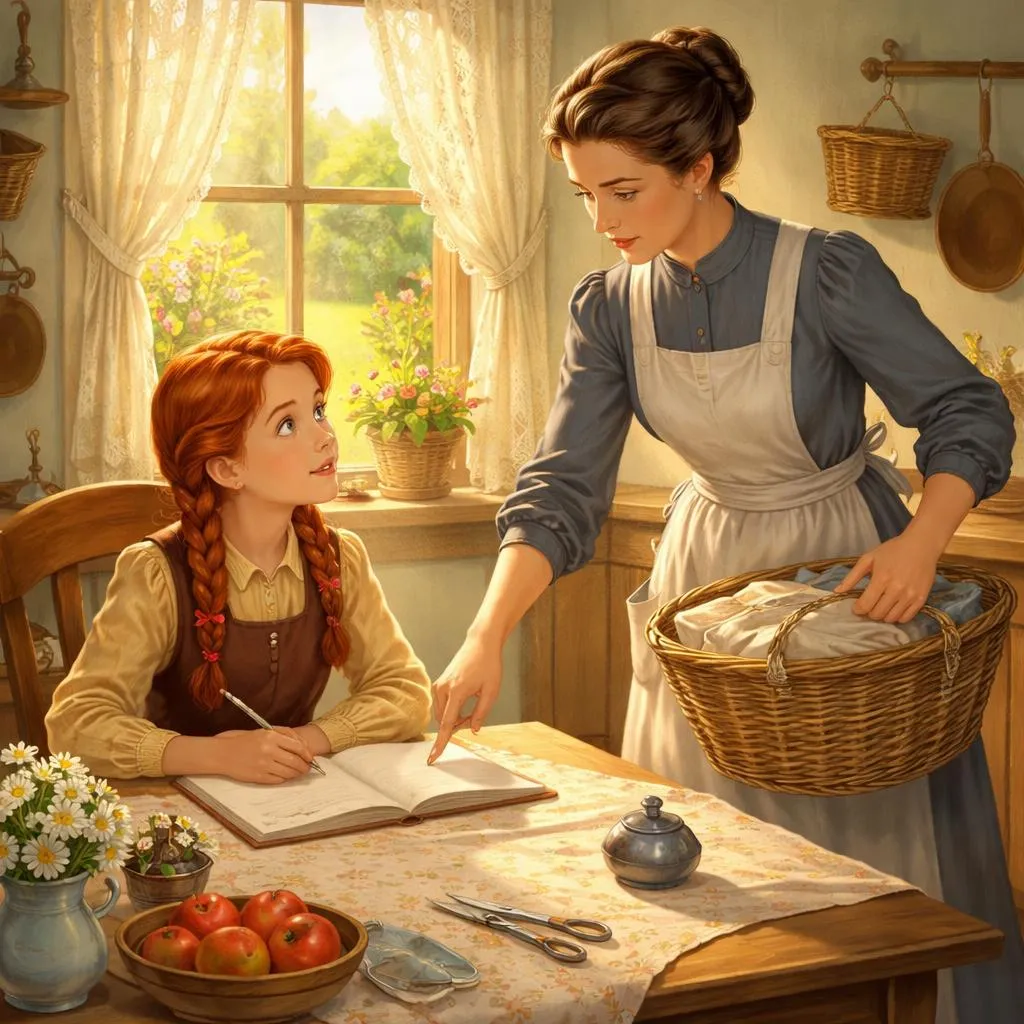

For reasons best known to herself, Marilla did not tell Anne that she was to stay at Green Gables until the next afternoon. During the forenoon she kept the child busy with various tasks and watched over her with a keen eye while she did them. By noon she had concluded that Anne was smart and obedient, willing to work and quick to learn; her most serious shortcoming seemed to be a tendency to fall into daydreams in the middle of a task and forget all about it until such time as she was sharply recalled to earth by a reprimand or a catastrophe.
When Anne had finished washing the dinner dishes she suddenly confronted Marilla with the air and expression of one desperately determined to learn the worst. Her thin little body trembled from head to foot; her face flushed and her eyes dilated until they were almost black; she clasped her hands tightly and said in an imploring voice:
“Oh, please, Miss Cuthbert, won’t you tell me if you are going to send me away or not? I’ve tried to be patient all the morning, but I really feel that I cannot bear not knowing any longer. It’s a dreadful feeling. Please tell me.”
“You haven’t scalded the dishcloth in clean hot water as I told you to do,” said Marilla immovably. “Just go and do it before you ask any more questions, Anne.”
Anne went and attended to the dishcloth. Then she returned to Marilla and fastened imploring eyes of the latter’s face. “Well,” said Marilla, unable to find any excuse for deferring her explanation longer, “I suppose I might as well tell you. Matthew and I have decided to keep you—that is, if you will try to be a good little girl and show yourself grateful. Why, child, whatever is the matter?”
“I’m crying,” said Anne in a tone of bewilderment. “I can’t think why. I’m glad as glad can be. Oh, GLAD doesn’t seem the right word at all. I was glad about the White Way and the cherry blossoms—but this! Oh, it’s something more than glad. I’m so happy. I’ll try to be so good. It will be uphill work, I expect, for Mrs. Thomas often told me I was desperately wicked. However, I’ll do my very best. But can you tell me why I’m crying?”
“I suppose it’s because you’re all excited and worked up,” said Marilla disapprovingly. “Sit down on that chair and try to calm yourself. I’m afraid you both cry and laugh far too easily. Yes, you can stay here and we will try to do right by you. You must go to school; but it’s only a fortnight till vacation so it isn’t worth while for you to start before it opens again in September.”
“What am I to call you?” asked Anne. “Shall I always say Miss Cuthbert? Can I call you Aunt Marilla?”
“No; you’ll call me just plain Marilla. I’m not used to being called Miss Cuthbert and it would make me nervous.”
“It sounds awfully disrespectful to just say Marilla,” protested Anne.
“I guess there’ll be nothing disrespectful in it if you’re careful to speak respectfully. Everybody, young and old, in Avonlea calls me Marilla except the minister. He says Miss Cuthbert—when he thinks of it.”
“I’d love to call you Aunt Marilla,” said Anne wistfully. “I’ve never had an aunt or any relation at all—not even a grandmother. It would make me feel as if I really belonged to you. Can’t I call you Aunt Marilla?”
“No. I’m not your aunt and I don’t believe in calling people names that don’t belong to them.”
“But we could imagine you were my aunt.”
“I couldn’t,” said Marilla grimly.
“Do you never imagine things different from what they really are?” asked Anne wide-eyed.
“No.”
“Oh!” Anne drew a long breath. “Oh, Miss—Marilla, how much you miss!”
“I don’t believe in imagining things different from what they really are,” retorted Marilla. “When the Lord puts us in certain circumstances He doesn’t mean for us to imagine them away. And that reminds me. Go into the sitting room, Anne—be sure your feet are clean and don’t let any flies in—and bring me out the illustrated card that’s on the mantelpiece. The Lord’s Prayer is on it and you’ll devote your spare time this afternoon to learning it off by heart. There’s to be no more of such praying as I heard last night.”
“I suppose I was very awkward,” said Anne apologetically, “but then, you see, I’d never had any practice. You couldn’t really expect a person to pray very well the first time she tried, could you? I thought out a splendid prayer after I went to bed, just as I promised you I would. It was nearly as long as a minister’s and so poetical. But would you believe it? I couldn’t remember one word when I woke up this morning. And I’m afraid I’ll never be able to think out another one as good. Somehow, things never are so good when they’re thought out a second time. Have you ever noticed that?”
“Here is something for you to notice, Anne. When I tell you to do a thing I want you to obey me at once and not stand stock-still and discourse about it. Just you go and do as I bid you.”
Anne promptly departed for the sitting-room across the hall; she failed to return; after waiting ten minutes Marilla laid down her knitting and marched after her with a grim expression. She found Anne standing motionless before a picture hanging on the wall between the two windows, with her eyes astar with dreams. The white and green light strained through apple trees and clustering vines outside fell over the rapt little figure with a half-unearthly radiance.
“Anne, whatever are you thinking of?” demanded Marilla sharply.
Anne came back to earth with a start.
“That,” she said, pointing to the picture—a rather vivid chromo entitled, “Christ Blessing Little Children”—”and I was just imagining I was one of them—that I was the little girl in the blue dress, standing off by herself in the corner as if she didn’t belong to anybody, like me. She looks lonely and sad, don’t you think? I guess she hadn’t any father or mother of her own. But she wanted to be blessed, too, so she just crept shyly up on the outside of the crowd, hoping nobody would notice her—except Him. I’m sure I know just how she felt. Her heart must have beat and her hands must have got cold, like mine did when I asked you if I could stay. She was afraid He mightn’t notice her. But it’s likely He did, don’t you think? I’ve been trying to imagine it all out—her edging a little nearer all the time until she was quite close to Him; and then He would look at her and put His hand on her hair and oh, such a thrill of joy as would run over her! But I wish the artist hadn’t painted Him so sorrowful looking. All His pictures are like that, if you’ve noticed. But I don’t believe He could really have looked so sad or the children would have been afraid of Him.”
“Anne,” said Marilla, wondering why she had not broken into this speech long before, “you shouldn’t talk that way. It’s irreverent—positively irreverent.”
Anne’s eyes marveled.
“Why, I felt just as reverent as could be. I’m sure I didn’t mean to be irreverent.”
“Well I don’t suppose you did—but it doesn’t sound right to talk so familiarly about such things. And another thing, Anne, when I send you after something you’re to bring it at once and not fall into mooning and imagining before pictures. Remember that. Take that card and come right to the kitchen. Now, sit down in the corner and learn that prayer off by heart.”
Anne set the card up against the jugful of apple blossoms she had brought in to decorate the dinner-table—Marilla had eyed that decoration askance, but had said nothing—propped her chin on her hands, and fell to studying it intently for several silent minutes.
“I like this,” she announced at length. “It’s beautiful. I’ve heard it before—I heard the superintendent of the asylum Sunday school say it over once. But I didn’t like it then. He had such a cracked voice and he prayed it so mournfully. I really felt sure he thought praying was a disagreeable duty. This isn’t poetry, but it makes me feel just the same way poetry does. ‘Our Father who art in heaven hallowed be Thy name.’ That is just like a line of music. Oh, I’m so glad you thought of making me learn this, Miss—Marilla.”
“Well, learn it and hold your tongue,” said Marilla shortly.
Anne tipped the vase of apple blossoms near enough to bestow a soft kiss on a pink-cupped bud, and then studied diligently for some moments longer.
“Marilla,” she demanded presently, “do you think that I shall ever have a bosom friend in Avonlea?”
“A—a what kind of friend?”
“A bosom friend—an intimate friend, you know—a really kindred spirit to whom I can confide my inmost soul. I’ve dreamed of meeting her all my life. I never really supposed I would, but so many of my loveliest dreams have come true all at once that perhaps this one will, too. Do you think it’s possible?”
“Diana Barry lives over at Orchard Slope and she’s about your age. She’s a very nice little girl, and perhaps she will be a playmate for you when she comes home. She’s visiting her aunt over at Carmody just now. You’ll have to be careful how you behave yourself, though. Mrs. Barry is a very particular woman. She won’t let Diana play with any little girl who isn’t nice and good.”
Anne looked at Marilla through the apple blossoms, her eyes aglow with interest.
“What is Diana like? Her hair isn’t red, is it? Oh, I hope not. It’s bad enough to have red hair myself, but I positively couldn’t endure it in a bosom friend.”
“Diana is a very pretty little girl. She has black eyes and hair and rosy cheeks. And she is good and smart, which is better than being pretty.”
Marilla was as fond of morals as the Duchess in Wonderland, and was firmly convinced that one should be tacked on to every remark made to a child who was being brought up.
But Anne waved the moral inconsequently aside and seized only on the delightful possibilities before it.
“Oh, I’m so glad she’s pretty. Next to being beautiful oneself—and that’s impossible in my case—it would be best to have a beautiful bosom friend. When I lived with Mrs. Thomas she had a bookcase in her sitting room with glass doors. There weren’t any books in it; Mrs. Thomas kept her best china and her preserves there—when she had any preserves to keep. One of the doors was broken. Mr. Thomas smashed it one night when he was slightly intoxicated. But the other was whole and I used to pretend that my reflection in it was another little girl who lived in it. I called her Katie Maurice, and we were very intimate. I used to talk to her by the hour, especially on Sunday, and tell her everything. Katie was the comfort and consolation of my life. We used to pretend that the bookcase was enchanted and that if I only knew the spell I could open the door and step right into the room where Katie Maurice lived, instead of into Mrs. Thomas’ shelves of preserves and china. And then Katie Maurice would have taken me by the hand and led me out into a wonderful place, all flowers and sunshine and fairies, and we would have lived there happy for ever after. When I went to live with Mrs. Hammond it just broke my heart to leave Katie Maurice. She felt it dreadfully, too, I know she did, for she was crying when she kissed me good-bye through the bookcase door. There was no bookcase at Mrs. Hammond’s. But just up the river a little way from the house there was a long green little valley, and the loveliest echo lived there. It echoed back every word you said, even if you didn’t talk a bit loud. So I imagined that it was a little girl called Violetta and we were great friends and I loved her almost as well as I loved Katie Maurice—not quite, but almost, you know. The night before I went to the asylum I said good-bye to Violetta, and oh, her good-bye came back to me in such sad, sad tones. I had become so attached to her that I hadn’t the heart to imagine a bosom friend at the asylum, even if there had been any scope for imagination there.”
“I think it’s just as well there wasn’t,” said Marilla drily. “I don’t approve of such goings-on. You seem to half believe your own imaginations. It will be well for you to have a real live friend to put such nonsense out of your head. But don’t let Mrs. Barry hear you talking about your Katie Maurices and your Violettas or she’ll think you tell stories.”
“Oh, I won’t. I couldn’t talk of them to everybody—their memories are too sacred for that. But I thought I’d like to have you know about them. Oh, look, here’s a big bee just tumbled out of an apple blossom. Just think what a lovely place to live—in an apple blossom! Fancy going to sleep in it when the wind was rocking it. If I wasn’t a human girl I think I’d like to be a bee and live among the flowers.”
“Yesterday you wanted to be a sea gull,” sniffed Marilla. “I think you are very fickle minded. I told you to learn that prayer and not talk. But it seems impossible for you to stop talking if you’ve got anybody that will listen to you. So go up to your room and learn it.”
“Oh, I know it pretty nearly all now—all but just the last line.”
“Well, never mind, do as I tell you. Go to your room and finish learning it well, and stay there until I call you down to help me get tea.”
“Can I take the apple blossoms with me for company?” pleaded Anne.
“No; you don’t want your room cluttered up with flowers. You should have left them on the tree in the first place.”
“I did feel a little that way, too,” said Anne. “I kind of felt I shouldn’t shorten their lovely lives by picking them—I wouldn’t want to be picked if I were an apple blossom. But the temptation was IRRESISTIBLE. What do you do when you meet with an irresistible temptation?”
“Anne, did you hear me tell you to go to your room?”
Anne sighed, retreated to the east gable, and sat down in a chair by the window.
“There—I know this prayer. I learned that last sentence coming upstairs. Now I’m going to imagine things into this room so that they’ll always stay imagined. The floor is covered with a white velvet carpet with pink roses all over it and there are pink silk curtains at the windows. The walls are hung with gold and silver brocade tapestry. The furniture is mahogany. I never saw any mahogany, but it does sound SO luxurious. This is a couch all heaped with gorgeous silken cushions, pink and blue and crimson and gold, and I am reclining gracefully on it. I can see my reflection in that splendid big mirror hanging on the wall. I am tall and regal, clad in a gown of trailing white lace, with a pearl cross on my breast and pearls in my hair. My hair is of midnight darkness and my skin is a clear ivory pallor. My name is the Lady Cordelia Fitzgerald. No, it isn’t—I can’t make THAT seem real.”
She danced up to the little looking-glass and peered into it. Her pointed freckled face and solemn gray eyes peered back at her.
“You’re only Anne of Green Gables,” she said earnestly, “and I see you, just as you are looking now, whenever I try to imagine I’m the Lady Cordelia. But it’s a million times nicer to be Anne of Green Gables than Anne of nowhere in particular, isn’t it?”
She bent forward, kissed her reflection affectionately, and betook herself to the open window.
“Dear Snow Queen, good afternoon. And good afternoon dear birches down in the hollow. And good afternoon, dear gray house up on the hill. I wonder if Diana is to be my bosom friend. I hope she will, and I shall love her very much. But I must never quite forget Katie Maurice and Violetta. They would feel so hurt if I did and I’d hate to hurt anybody’s feelings, even a little bookcase girl’s or a little echo girl’s. I must be careful to remember them and send them a kiss every day.”
Anne blew a couple of airy kisses from her fingertips past the cherry blossoms and then, with her chin in her hands, drifted luxuriously out on a sea of daydreams.
Background and Author Introduction
This excerpt is from Anne of Green Gables, a beloved classic novel written by Canadian author Lucy Maud Montgomery. Published in 1908, the story follows Anne Shirley, an imaginative and spirited orphan girl who is mistakenly sent to live with Marilla and Matthew Cuthbert, a brother and sister who had intended to adopt a boy to help them on their farm in Avonlea, Prince Edward Island. The novel captures Anne's adventures, her struggles to belong, and her growth into a kind, intelligent young woman.
Lucy Maud Montgomery drew inspiration from her own childhood and the beautiful landscapes of Prince Edward Island. Her vivid descriptions and heartfelt storytelling have made Anne of Green Gables a timeless tale cherished by readers around the world.
Detailed Interpretation and Significance
This passage highlights the early days of Anne's life at Green Gables, revealing her complex personality: bright, eager to please, but prone to daydreaming and emotional intensity. Marilla’s cautious but growing acceptance of Anne sets the tone for their evolving relationship. Anne’s imaginative nature is a central theme throughout the novel, showing how creativity and hope can transform hardship into joy.
Anne’s reflections on friendship, her longing for belonging, and her vivid daydreams illustrate the power of imagination as a coping mechanism and a source of comfort. The contrast between Marilla’s practical, no-nonsense attitude and Anne’s dreamy, poetic view of the world creates a dynamic that drives much of the story's charm and humor.
Lessons and Inspirations for Students
-
The Value of Imagination: Anne’s rich inner world teaches young readers that imagination is a powerful tool. It can help us cope with challenges, inspire creativity, and enrich our everyday experiences. Students can learn to embrace their creativity while balancing it with practical responsibilities.
-
Patience and Perseverance: Anne’s promise to be “a good little girl” despite her past and her flaws encourages readers to keep trying to improve themselves, even when the path is difficult.
-
The Importance of Kindness and Gratitude: Marilla’s decision to keep Anne is conditional on her showing gratitude and good behavior, highlighting the value of respect and appreciation in relationships.
-
Friendship and Belonging: Anne’s hope for a “bosom friend” resonates with anyone who has ever longed for close companionship. The story encourages openness to new friendships and the understanding that true friends value kindness and character over appearances.
-
Balancing Dreams and Reality: Marilla’s pragmatic approach reminds students that while dreaming is important, it’s equally essential to face reality and fulfill one’s duties.
Applying the Story’s Spirit in Life
- In Learning: Like Anne, students should be curious and eager to learn, but also develop discipline to complete tasks without distraction.
- In Social Situations: Embrace kindness and respect, and be open to forming meaningful friendships based on trust and shared values.
- In Personal Growth: Use imagination to inspire goals and dreams, but also cultivate patience and resilience to overcome obstacles.
- In Emotional Expression: Anne’s emotional openness shows that it’s okay to feel deeply and express feelings honestly, which can lead to better self-understanding and empathy for others.
Cultivating Positive Traits from the Story
- Encourage Creativity: Engage in writing, drawing, or imaginative play to develop creative thinking.
- Practice Gratitude: Regularly reflect on what you are thankful for, fostering a positive mindset.
- Build Friendships: Seek friends who support and encourage your true self.
- Balance Dreaming and Doing: Set realistic goals and work steadily toward them while allowing space for imagination and joy.
Anne of Green Gables remains a treasured story because it celebrates the resilience of the human spirit, the beauty of imagination, and the transformative power of love and acceptance. Students reading this story can find inspiration to dream big, work hard, and cherish the friendships and family that support them along the way.
