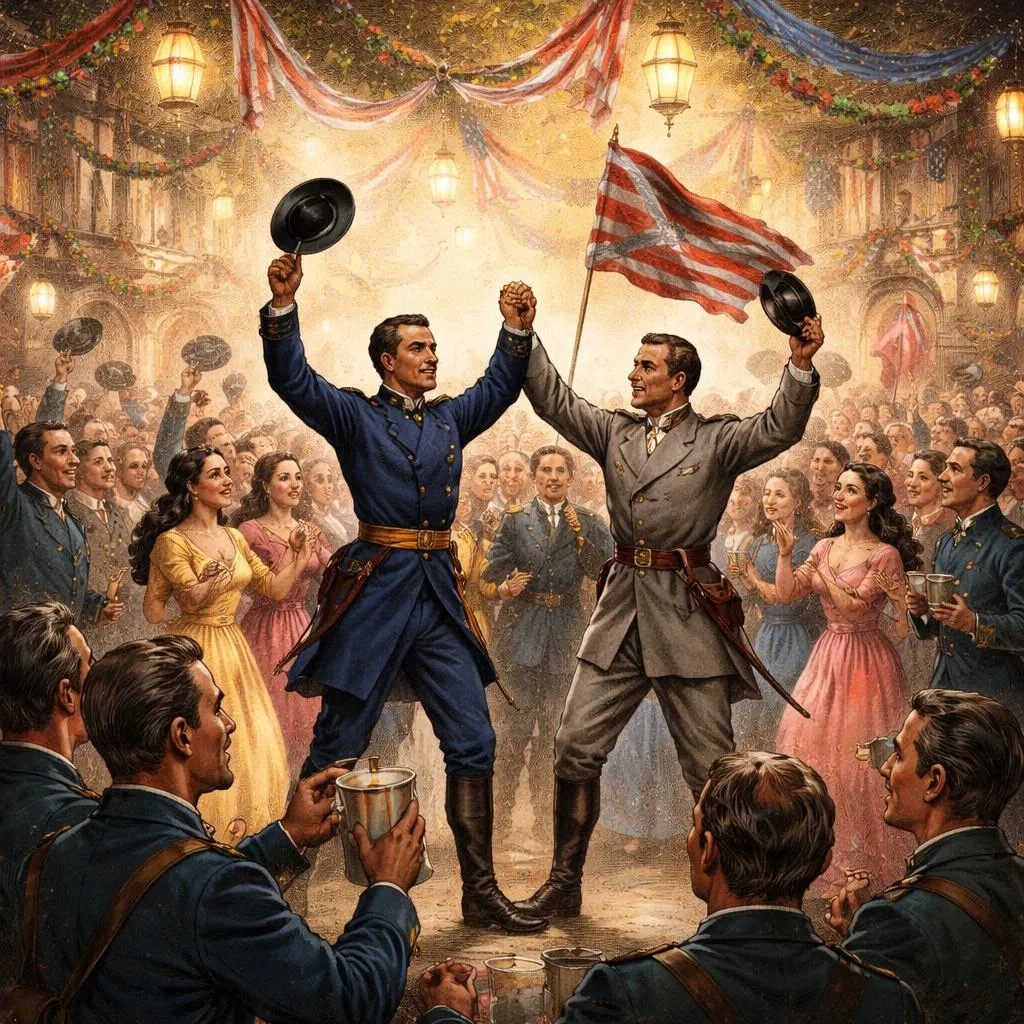

“‘We won’t go home till morning,’” sang the two counterfeit revellers, as they approached the fire of the bivouackers.
The four carousel’s sprang to their feet when the first strain reached their ears. They were not as intoxicated as they might have been, for they were able to stand with considerable firmness on theirfeet, after the frequency with which the bottle had been passed among them. They did not do what soldiers would naturally have done at such an interruption, grasp their muskets, and it was probable they had no muskets to grasp.
“‘We won’t go home till morning, till daylight doth appear,’” continued the two officers, without halting in their march towards the revellers. No weapons of any kind were exhibited; but the tipplers stood as though transfixed with astonishment or alarm where they had risen, but were rather limp in their attitude. They evidently did not know what to make of the interruption, and they appeared to bewaiting for further developments on the part of the intruders.
“It isn’t mornin’ yit, but we just emptied our bottle,” said Christy, with a swaggering and slightly reeling movement, and suiting his speech to the occasion. “How are ye, shipmates?”
“Up to G, jolly tars,” replied one of the men, with a broad grin on his face. “We done got two full bottles left, at your sarvice.”
“Much obleeged,” returned the lieutenant, as he took the bottle the reveller passed to him. “Here’s success to us all in a heap, and success to our side in the battle that’s go’n’on.”
“I’m with you up to the armpits,” added Graines, as another of the four handed him a bottle.
One sniff at the neck of the bottle was enough to satisfy Christy, who was a practical temperance man of the very strictest kind, and he had never drank a glass of anything intoxicating in all his life. The bottle contained “apple-jack,” or apple-brandy, the vilest fluid thatever passed a tippler’s gullet. He felt obliged to keep up his character, taken for the occasion, and he retained the mouth of the bottle at his lips long enough to answer the requirement of the moment; but he did not open them, or permit a drop of the nauseous and fiery liquor to pollute his tongue. It was necessary for him to consider that he was struggling for the salvation of his beloved country to enable him even to go through the form of “taking a drink.”
Graines was less scrupulous on the question of temperance, and he took a swallow of the apple-jack; but that was enough for him, for he had never tasted anything outside of the medicine-chest which was half as noxious. If he had been compelled to keep up the drinking, he would have realized that his punishment was more than he could bear. Fortunately the tipplers had no tumblers, so that the guests were not compelled to pour out the fluid and drink it off. All drank directly from the bottles, so that the two officers could easily conceal in the semi-darkness the extent of their indulgence.
“Who be you, strangers?” asked the man who had acted thus far as spokesman of the party.
“My name is Tom Bulger, born and brought up in the island of Great Abaco, and this feller is my friend and shipmate, Sam Riley,” replied Christy, twisting and torturing his speech as much as was necessary. “Now who be you fellers?”
“Born and fetched up in Mobile: my name is Bird Riley; and I reckon t’other feller is a first cousin of mine, for he’s got the same name, and he’s almost as handsome as I am. Where was you born, Sam?”
“About ten miles up the Alabama, where my father was the overseer on a plantation before the war,” replied Graines as promptly as though he had been telling the truth.
“Then you must be one of my cousins, for I done got about two hundred and fifty on ‘em in the State of Alabammy. Give us your fin, Sam.”
Bird Riley and Sam shook hands in due and proper form, and the relationship appeared to be fully established. The names of the three other revellers were given, but the spokesman was disposed to do all the talking, though he occasionally appealed to his companions to approve of what he said. It was evident that he was the leading spirit of the party, and that he controlled them. He was rather a bright fellow, while the others were somewhat heavy and stupid in their understanding. The bottles were again handed to the guests, both of whom went through the form of drinking without taking a drop of the vile stuff.
“What be you uns doin’ here?” asked Bird Riley, after the ceremony with the bottle had been finished.
“We was both tooken in a schooner that was gwine to run the blockade,” answered Christy. “We was comin’ out’n Pass Christian, and was picked up off Chand’leer [Chandeleur] Island, and fotched over hyer. We didn’t feel too much to hum after we lost our wages, and we done took awhale boat and came ashore here, with only one bottle of whiskey atweenus. That’s all there is on’t. Now, how comes you uns hyer?”
“I’m the mate of the topsail schooner West Wind, and t’others is the crew; all but two we done left on board with the cap’n,” replied Bird, apparently with abundant confidence in his newly found friends.
“You left her?” asked Christy.
“That’s just what we done do.”
“Where is the West Wind now?” inquired Christy, deeply interested in the subject at this point.
“She done come down from Mobile three days ago, and done waited for a chance to run the blockade. Her hole is fullo’ cotton, and she done got a deck-load too,” answered Bird Riley without any hesitation.
“Where does the West Wind keep herself now, Bird?”
“Just inside the p’int, astern of the Trafladagar.”
“The Trafladagar?” repeated Christy.
“That’s her name, or sunthin like it. I never see it writ out.”
“She’s a schooner, I reckon,” continued Christy, concealing what knowledge he possessed in regard to the vessel.
“She ain’t no schooner, you bet; she’s jest the finist steamer that ever runned inter Mobile, and they’ve turned her into a cruiser,” Bird Riley explained.
“How big is she?”
“I heerd some un say she was about eight hun’ed tons: an’ I’ll bet she’ll pick up every Yankee craft that she gits a sight on.”
“And you say the Trafladagar is at anchor off the p’int?” added Christy, not daring to call the steamer by her true name.
“That’s jest where she is; and the West Wind is hitched to her, like a tandem team,” replied Bird Riley. “Look yere, Tom Bulger, you don’t make love to that bottle as though you meant business. Take another drink, and show you done got some manhood in yer.”
The bottle went the rounds again, and the guests apparently took longpulls; but really they did not taste a drop of the infernal liquid.
“That’s good pizen, Bird Riley; but it is not jest the stingo that I like best,” said Christy, as he wiped his mouth with his sleeve in proper form, for he did not like the smell of the fluid lightning that clung to his lips.
“Whiskey suits me most; but they waste the corn makin’ bread on’t, and there ain’t much on’t left to make the staff of life. Howsomever, we don’t choke to death on apple-jack, when we can get enough on’t,” argued Bird Riley.
“Jest now you got a tandem team hitched up out on the Trafladagar and the West Wind,” continued Christy cautiously, and with apparent indifference, drawing the mate of the schooner back to the matter in which he was the most deeply interested. “What’s this team hitched up that way for? Is the steamer go’n’ to tow the schooner up to Mobile?”
“I reckon you’re a little more’n half drunk, Tom Bulger,” replied Bird Riley, with a vigorous horse laugh. “Tow the schooner up to Mobile! Didn’t I tell yer the Trafladagar’s been waiting here three days for agood chance to run out?”
“You said that as true as you was born,” added Graines, who thought it necessary to say something, for he had been nearly silent from the beginning.
“Sam Riley ain’t quite so drunk as you be, Tom Bulger; an’ he knows what’s what; and thar he shows the Riley blood in his carcass,” chuckled the mate.
“And you said the West Wind was loaded with cotton, in the hole and on deck,” added Graines, hoping to hurry the conference along a little more rapidly.
“That’s jest what I said. I reckon you ain’t much used to apple-jack, fur it fusticates your intelleck, and makes yer forget how old y’are. Come, take another, jest to set your head up right,” said Bird, passing the bottle to Christy, who was doing his best to keep up the illusion by talking very thick, and swaying his body about like a drunken man.
Both the guests went through the ceremony of imbibing, which was only a ceremony to them. The fire had exhausted its supply of fuel, and it was fortunate that the darkness prevented the revellers from measuring the quantity left in the bottles as they were returned to the owners, or they might have seen that the strangers were not doing their share in consuming the poison.
“Sam Riley does honor to the blood as runs in his body, for he ain’t no more drunk’n I am; an’ he knows what we been talkin’ about,” said the mate, who seemed to be greatly amused at the supposed effect of the liquor upon Christy. “You won’t know nothin’ about the Trafladagar or the West Wind in half an hour from now, Tom Bulger. I reckon it don’t make no difference to you about the tandem team, and to-morrer mornin’ you won’t know how the team’s hitched up.”
“I don’t think I will,” replied Christy boozily, as he rolled over on the sand, and then struggled for some time to resume his upright position, to the great amusement of Bird Riley and his companions. “But Sam Riley’s got blood in him, the best blood in Alabammy, and he kin tell you all about it if yer want ter know. He kin stan’ up agin a whole bottle o’ apple-jack.”
“I say, Cousin Bird, what’s this tandem team hitched up fer?” asked Graines, permitting his superior officer to carry out the illusion upon which he had entered, in order more effectually to blind the mate, and induce him to talk with entire freedom.
“I reckon you ain’t too drunk to un’erstan’ what I say, Sam, as t’other feller is.”
“I’m jest drunk enough to un’erstan’ yer, Cousin Bird; but I cal’la teI won’t know much about it by to-morrer mornin’,” added Graines.
“Let’s take another round, Sam; but I reckon Tom Bulger’s got more’n he can kerry now,” continued the mate.
Bird took a long draught from the bottle, and then passed it to hisguest. Three of the four revellers had already toppled over at full length on the ground; and Christy thought he could hurry matters by doing the same thing, and he tumbled over all in a heap. Graines drank nothing himself, though he contrived to spill a quantity of the fluid on the ground, so that it might not seem too light to his only remaining wakeful companion. The last dram of Bird had been a very heavy one, and the engineer realized that he could not hold out much longer.
“What’s that tandem team fer?” asked Graines, in the thickest of tones, while he swayed back and forth as Bird was doing by this time.
“The Trafladagar’s gwine to tow the West Wind out; and both on ’em’s sure to be tooken,” stammered the mate. “We uns don’t bleeve in’t, and so we runned away, and left Captain Sullendine to paddle his own punt. They get off at three in the morn in’.”
Bird Riley took another drink, and then he toppled over.
Background and Author Introduction
This passage is from a historical novel set during the American Civil War, a period marked by conflict, espionage, and blockade running. The story captures the tension and cunning involved in wartime operations, focusing on characters who use disguise and deception to gather intelligence. The author, writing in the 19th century, often explored themes of loyalty, courage, and the struggles faced by individuals caught in the turmoil of war. His vivid descriptions and realistic dialogue bring the era to life, making the story both educational and engaging for readers.
Detailed Interpretation and Significance
The scene depicts two officers infiltrating a group of drunken sailors to learn about enemy movements. Their careful act of pretending to drink while maintaining sobriety highlights themes of self-control, bravery, and intelligence work during wartime. The dialogue reveals the dangers of blockade running—a risky but essential activity for the Confederacy to receive supplies. The characters’ interactions also show camaraderie and the use of quick thinking to survive hostile environments.
This story segment teaches readers about the complexities of war beyond the battlefield, emphasizing the importance of strategy and mental strength. It also portrays the human side of soldiers and sailors, including their vulnerabilities and the bonds they form.
Lessons and Insights for Students
-
Courage and Self-Control: The officers demonstrate bravery by entering a dangerous situation and self-control by resisting temptation. Students can learn the value of staying focused on their goals even when faced with distractions or peer pressure.
-
The Power of Observation and Strategy: Success in difficult situations often depends on careful observation and planning. This story encourages critical thinking and the ability to adapt to changing circumstances.
-
Understanding History Through Stories: Reading historical fiction helps students connect emotionally with past events, making history more relatable and memorable.
-
The Importance of Friendship and Trust: Despite the dangers, the characters form bonds and rely on each other, showing how trust and teamwork are vital in challenging times.
Applying These Lessons in Daily Life
-
In Learning: Like the officers, students can practice self-discipline and focus, especially when studying or working on projects. Avoiding distractions and thinking strategically about how to approach tasks can improve outcomes.
-
In Social Situations: The story highlights the importance of understanding others and building trust. Students can apply this by being good listeners, showing empathy, and working cooperatively with peers.
-
In Facing Challenges: Life often presents unexpected obstacles. Developing courage and adaptability, as shown by the characters, helps students overcome difficulties and stay resilient.
Cultivating Positive Values from the Story
-
Honesty and Integrity: Even when pretending, the officers maintain their true purpose and values. Students should learn to be honest and uphold their principles.
-
Respect for Others: The interactions, though tense, are conducted with a level of respect. This teaches the importance of respecting different perspectives and backgrounds.
-
Perseverance: The story encourages persistence, showing that success often requires enduring hardship and staying committed.
Conclusion
This story segment offers rich material for young readers to explore historical events, character development, and moral lessons. By engaging with such narratives, students not only improve their reading skills but also gain insights into human nature and history. Encouraging them to reflect on these themes can foster empathy, critical thinking, and a deeper appreciation for the complexities of life and history.
