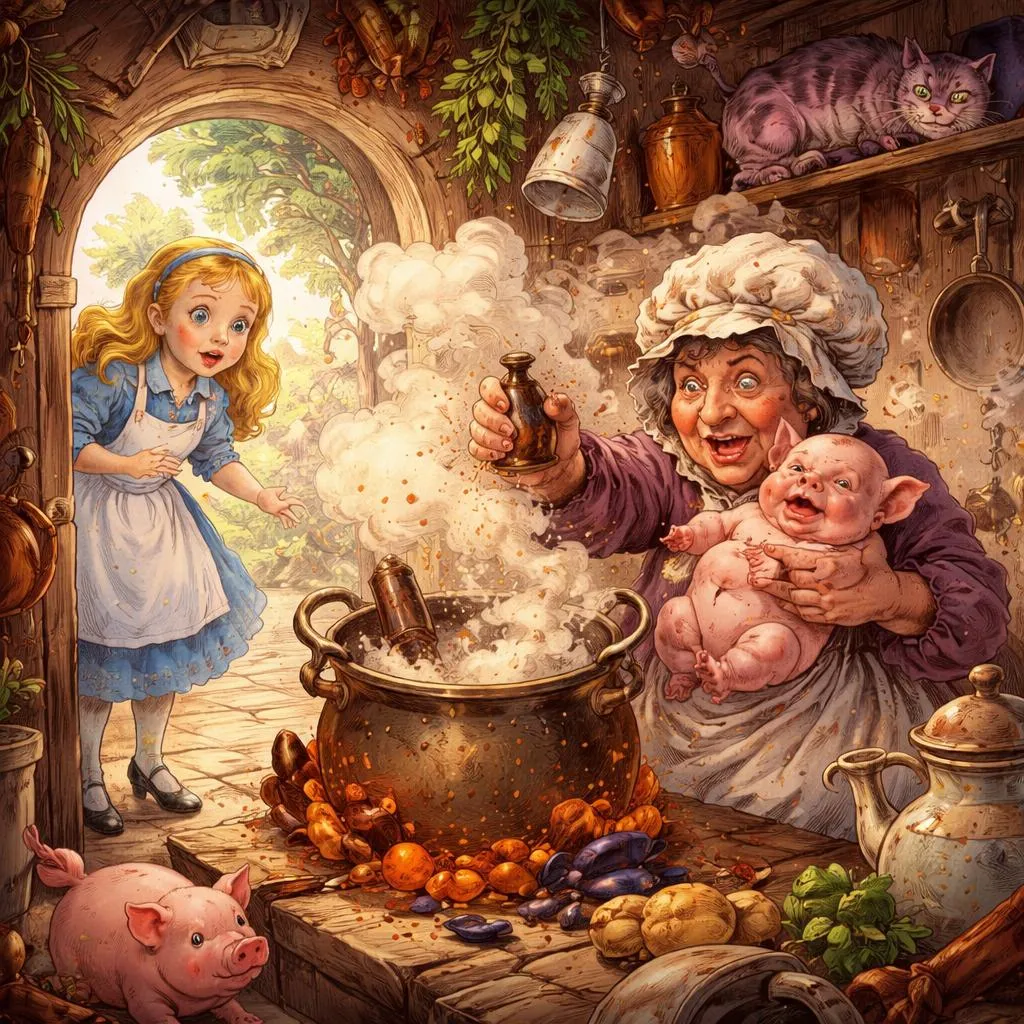

This passage is an excerpt from Alice's Adventures in Wonderland, a famous novel written by Lewis Carroll in 1865. The story follows a young girl named Alice who falls down a rabbit hole into a fantastical world filled with peculiar creatures and whimsical adventures. This particular scene introduces some of the quirky characters Alice meets, such as the Fish-Footman, the Frog-Footman, the Duchess, and the Cheshire Cat.
Background and Author Introduction
Lewis Carroll is the pen name of Charles Lutwidge Dodgson, an English writer, mathematician, and logician. He wrote Alice's Adventures in Wonderland as a children’s fantasy novel that has since become a classic of English literature. Carroll’s work is known for its playful use of language, logic, and imagination, blending nonsense and satire with deeper themes about identity, curiosity, and the absurdities of adult society.
The story was inspired by a real-life boat trip Carroll took with the three Liddell sisters, especially Alice Liddell, who became the model for the protagonist. Carroll’s narrative style combines dreamlike sequences with sharp wit, making it appealing to both children and adults.
Detailed Interpretation and Significance
In this passage, Alice encounters the peculiar servants of the Duchess’s household and witnesses the chaotic, nonsensical environment inside the kitchen. The characters behave in strange and illogical ways—the Footmen argue about the wording of an invitation, the Duchess mistreats her baby, and the baby eventually turns into a pig. The Cheshire Cat’s mysterious grin and cryptic conversation further emphasize the surreal and unpredictable nature of Wonderland.
This scene highlights several themes:
-
Absurdity and Nonsense: The illogical behavior of the characters and the bizarre events challenge the reader’s expectations of normality. This reflects the novel’s broader exploration of a world where rules are fluid and logic is playful rather than rigid.
-
Identity and Change: The baby’s transformation into a pig symbolizes the fluidity of identity in Wonderland. Alice herself is constantly changing size and questioning who she is.
-
Madness and Sanity: The Cheshire Cat’s declaration that “we’re all mad here” introduces the theme of madness as a relative concept, inviting readers to reconsider what is considered normal or sane.
Lessons and Insights for Students
Reading this passage and the novel as a whole offers many valuable lessons for young readers:
-
Curiosity and Exploration: Alice’s fearless curiosity drives her adventures. Students can learn the importance of asking questions, exploring new ideas, and embracing the unknown with an open mind.
-
Critical Thinking: The nonsensical conversations and illogical situations encourage readers to think critically about language, meaning, and assumptions. This skill is essential for problem-solving and understanding complex ideas.
-
Creativity and Imagination: The fantastical characters and settings inspire creativity. Students can be encouraged to use their imagination to think beyond conventional boundaries and express themselves in unique ways.
-
Understanding Different Perspectives: The diverse and often contradictory characters show that people (or creatures) can see the world very differently. This promotes empathy and tolerance for others’ viewpoints.
-
Dealing with Confusion and Uncertainty: Wonderland is a place where rules change and nothing is certain. Learning to navigate uncertainty with patience and adaptability is a useful life skill.
Applying the Story’s Spirit in Life and Learning
-
In School: Students can use Alice’s example to approach learning with curiosity and resilience. When faced with confusing subjects or challenging problems, they can remember that it’s okay to be puzzled and to keep asking questions.
-
In Social Situations: The story encourages openness to new friendships and understanding that people may act in unexpected ways. Like Alice, students can practice kindness and patience when interacting with others.
-
In Personal Growth: Alice’s journey is about self-discovery. Young readers can reflect on their own identities and values, learning that growth often involves change and sometimes feeling out of place.
Cultivating Positive Traits from the Story
-
Imagination: Encourage creative writing, drawing, or role-playing activities inspired by Wonderland’s characters and scenes.
-
Curiosity: Promote asking “why” and “how” questions, fostering a mindset of lifelong learning.
-
Resilience: Teach students to embrace mistakes and confusion as part of the learning process, just as Alice adapts to the strange world around her.
-
Empathy and Open-mindedness: Use discussions about the characters’ behaviors and motivations to develop understanding and acceptance of differences.
Conclusion
Lewis Carroll’s Alice's Adventures in Wonderland is more than just a whimsical children’s tale; it is a rich, layered narrative that challenges readers to think deeply about logic, identity, and society. For students and young readers, it offers a playful yet profound invitation to explore the world with curiosity, creativity, and courage. By engaging with the story’s themes and characters, they can develop important skills and values that will serve them well in school, friendships, and life beyond the page.
