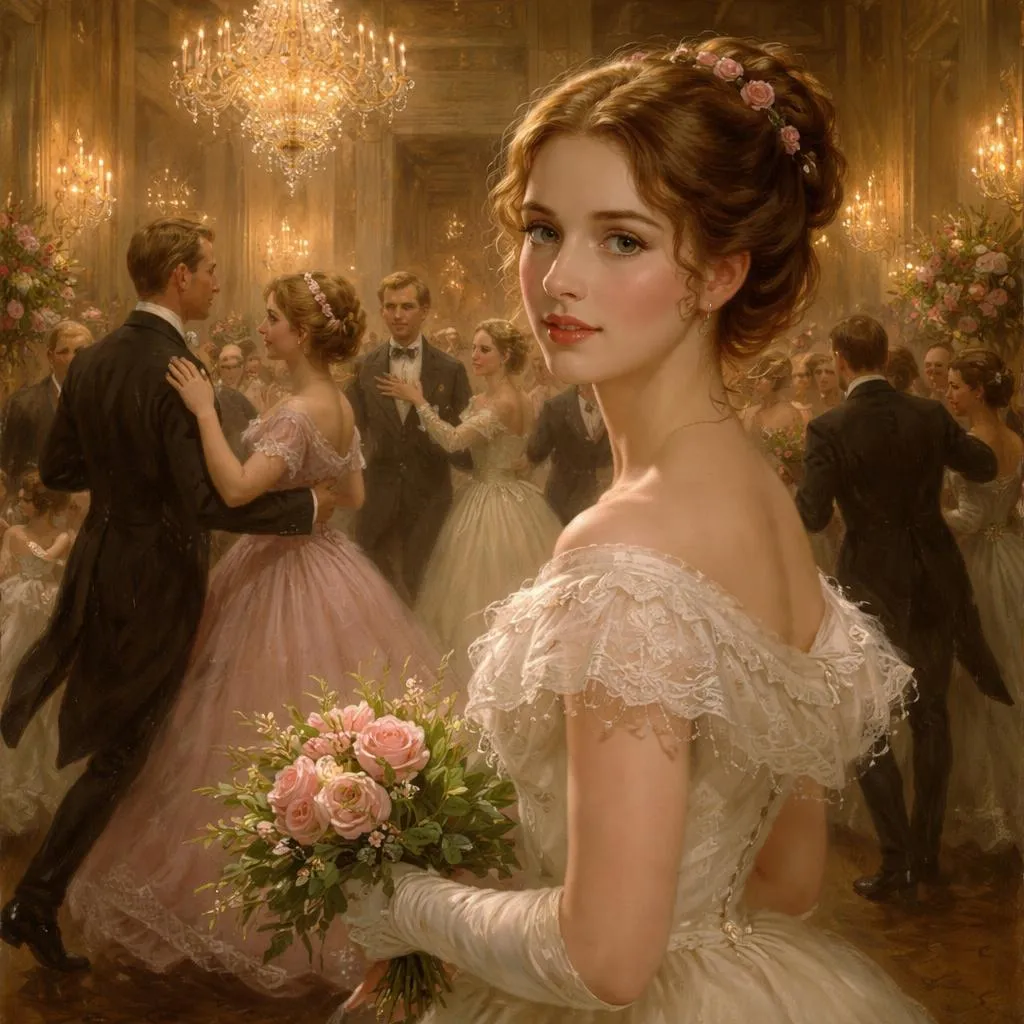

At eighteen, Miss Murray was to emerge from the quiet obscurity of the schoolroom into the full blaze of the fashionable world—as much of it, at least, as could be had out of London; for her papa could not be persuaded to leave his rural pleasures and pursuits, even for a few weeks’ residence in town. She was to make her debut on the third of January, at a magnificent ball, which her mamma proposed to give to all the nobility and choice gentry of O—– and its neighbourhood for twenty miles round. Of course, she looked forward to it with the wildest impatience, and the most extravagant anticipations of delight.
‘Miss Grey,’ said she, one evening, a month before the all–important day, as I was perusing a long and extremely interesting letter of my sister’s—which I had just glanced at in the morning to see that it contained no very bad news, and kept till now, unable before to find a quiet moment for reading it,—’Miss Grey, do put away that dull, stupid letter, and listen to me! I’m sure my talk must be far more amusing than that.’
She seated herself on the low stool at my feet; and I, suppressing a sigh of vexation, began to fold up the epistle.
‘You should tell the good people at home not to bore you with such long letters,’ said she; ‘and, above all, do bid them write on proper note–paper, and not on those great vulgar sheets. You should see the charming little lady–like notes mamma writes to her friends.’
‘The good people at home,’ replied I, ‘know very well that the longer their letters are, the better I like them. I should be very sorry to receive a charming little lady–like note from any of them; and I thought you were too much of a lady yourself, Miss Murray, to talk about the “vulgarity” of writing on a large sheet of paper.’
‘Well, I only said it to tease you. But now I want to talk about the ball; and to tell you that you positively must put off your holidays till it is over.’
‘Why so?—I shall not be present at the ball.’
‘No, but you will see the rooms decked out before it begins, and hear the music, and, above all, see me in my splendid new dress. I shall be so charming, you’ll be ready to worship me—you really must stay.’
‘I should like to see you very much; but I shall have many opportunities of seeing you equally charming, on the occasion of some of the numberless balls and parties that are to be, and I cannot disappoint my friends by postponing my return so long.’
‘Oh, never mind your friends! Tell them we won’t let you go.’
‘But, to say the truth, it would be a disappointment to myself: I long to see them as much as they to see me—perhaps more.’
‘Well, but it is such a short time.’
‘Nearly a fortnight by my computation; and, besides, I cannot bear the thoughts of a Christmas spent from home: and, moreover, my sister is going to be married.’
‘Is she—when?’
‘Not till next month; but I want to be there to assist her in making preparations, and to make the best of her company while we have her.’
‘Why didn’t you tell me before?’
‘I’ve only got the news in this letter, which you stigmatize as dull and stupid, and won’t let me read.’
‘To whom is she to be married?’
‘To Mr. Richardson, the vicar of a neighbouring parish.’
‘Is he rich?’
‘No; only comfortable.’
‘Is he handsome?’
‘No; only decent.’
‘Young?’
‘No; only middling.’
‘Oh, mercy! what a wretch! What sort of a house is it?’
‘A quiet little vicarage, with an ivy–clad porch, an old–fashioned garden, and—’
‘Oh, stop!—you’ll make me sick. How CAN she bear it?’
‘I expect she’ll not only be able to bear it, but to be very happy. You did not ask me if Mr. Richardson were a good, wise, or amiable man; I could have answered Yes, to all these questions—at least so Mary thinks, and I hope she will not find herself mistaken.’
‘But—miserable creature! how can she think of spending her life there, cooped up with that nasty old man; and no hope of change?’
‘He is not old: he’s only six or seven and thirty; and she herself is twenty–eight, and as sober as if she were fifty.’
‘Oh! that’s better then—they’re well matched; but do they call him the “worthy vicar”?’
‘I don’t know; but if they do, I believe he merits the epithet.’
‘Mercy, how shocking! and will she wear a white apron and make pies and puddings?’
‘I don’t know about the white apron, but I dare say she will make pies and puddings now and then; but that will be no great hardship, as she has done it before.’
‘And will she go about in a plain shawl, and a large straw bonnet, carrying tracts and bone soup to her husband’s poor parishioners?’
‘I’m not clear about that; but I dare say she will do her best to make them comfortable in body and mind, in accordance with our mother’s example.’
Background and Author Introduction
This excerpt is from a classic 19th-century novel that explores themes of social expectations, family duties, and personal growth. The story centers on Miss Murray, a young woman preparing to enter society through a debutante ball—a significant event marking a young lady’s introduction to the social elite. The narrative captures the contrast between the excitement of social life and the quieter, more grounded realities of family and personal responsibility.
The author, a prominent figure in Victorian literature, often wrote about the lives of women navigating the strict social codes of their time. Their works are known for keen observations of character and society, blending humor with serious reflections on human nature and social constraints.
Detailed Interpretation and Significance
This passage highlights the tension between youthful anticipation and mature responsibility. Miss Murray eagerly awaits her debut ball, symbolizing her entry into the fashionable world. Yet, through the dialogue with Miss Grey, we glimpse the practical realities behind such events—family ties, personal sacrifices, and the expectations placed on women.
The conversation about Miss Murray’s sister’s upcoming marriage to a modest vicar introduces themes of social class and personal happiness. The sister’s choice contrasts sharply with the glamorous debut ball, suggesting different paths women of that era might take. The discussion about the vicar’s character and lifestyle challenges superficial judgments, emphasizing virtues like kindness, wisdom, and contentment over wealth or appearance.
Lessons and Insights for Students
-
Understanding Social Expectations: The story offers a window into historical social customs, helping students appreciate how societal roles and expectations shape individual choices. Recognizing these influences encourages empathy and critical thinking about social norms today.
-
Balancing Ambition and Duty: Miss Murray’s excitement about the ball contrasts with her sister’s quieter, more responsible life. Students can learn about balancing personal dreams with family obligations and the importance of supporting loved ones.
-
Judging Character Beyond Appearances: The dialogue about Mr. Richardson teaches the value of looking beyond surface traits like wealth or looks to assess someone's true character—an essential lesson in developing meaningful relationships.
-
Appreciation of Different Life Paths: The story shows that happiness and fulfillment come in many forms, whether through social success or a simple, virtuous life. This broadens students’ perspectives on success and contentment.
Applying the Story’s Spirit in Daily Life
-
In School: Students can learn to respect diverse backgrounds and choices among peers, fostering an inclusive environment. They might also reflect on balancing academic goals with family and social life.
-
In Social Settings: The story encourages kindness and open-mindedness, reminding students not to judge others hastily based on appearances or social status.
-
In Personal Growth: Embracing both ambition and responsibility can help students develop maturity. They can aspire to personal achievements while remaining grounded and considerate of others.
Cultivating Positive Values from the Story
-
Empathy and Understanding: By seeing different perspectives within the story, students can practice empathy, understanding the challenges and joys others face.
-
Respect for Tradition and Change: The narrative shows respect for family and tradition, yet also hints at the possibility of personal choice and happiness beyond societal expectations.
-
Wisdom in Judgment: Encouraging students to look deeper than surface impressions fosters wisdom and better decision-making in friendships and future relationships.
-
Gratitude and Contentment: The sister’s acceptance of a modest but happy life invites reflection on gratitude for what one has and finding joy in simple things.
Conclusion
This story is more than a tale of a debutante ball; it is a rich exploration of social life, family bonds, and personal values. For young readers, it offers timeless lessons about character, empathy, and the diverse ways people find happiness. By engaging with these themes, students can develop a deeper understanding of themselves and the world around them, preparing them for thoughtful, compassionate lives.
