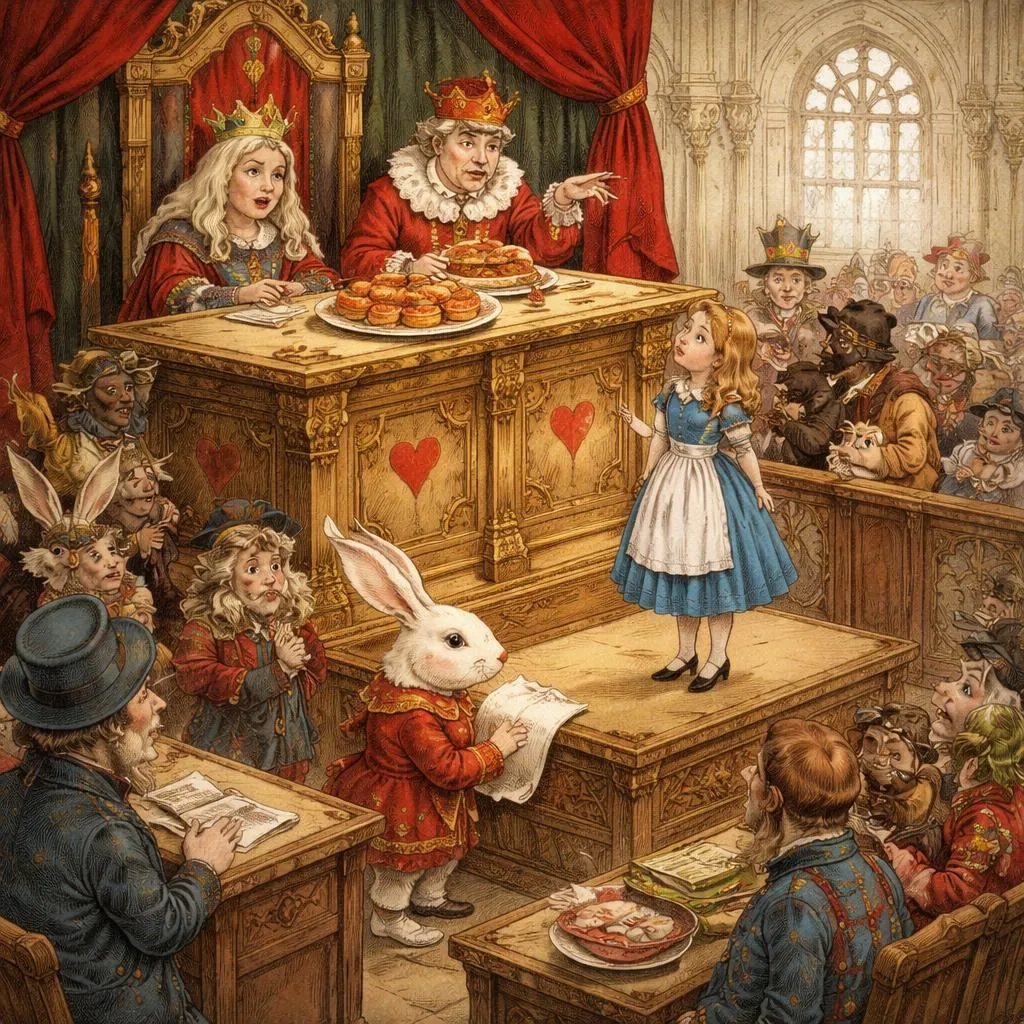

The passage above is an excerpt from Lewis Carroll's famous novel Alice's Adventures in Wonderland, specifically the scene depicting the trial of the Knave of Hearts. This whimsical and imaginative story has captivated readers of all ages since its publication in 1865. Below is an expanded discussion to help students and young readers better understand the background, themes, and lessons of this classic tale.
Background and Author Introduction
Lewis Carroll is the pen name of Charles Lutwidge Dodgson, an English writer, mathematician, and logician. He wrote Alice's Adventures in Wonderland originally as a story to entertain a young girl named Alice Liddell and her sisters during a boat trip. The novel is celebrated for its playful use of language, fantastical characters, and surreal settings. Carroll’s background in mathematics and logic is evident in the story’s puzzles and paradoxes, making it a rich text for both literary enjoyment and intellectual exploration.
Detailed Interpretation of the Story
In this courtroom scene, Alice finds herself in a bizarre trial where the Knave of Hearts is accused of stealing tarts. The characters include talking animals, anthropomorphic playing cards, and other fantastical creatures, all contributing to the absurdity and humor of the situation. The trial itself is a parody of real legal proceedings, highlighting the arbitrary and sometimes nonsensical nature of authority and justice.
The story uses satire to question rules and social norms. For example, the jurors writing down “stupid things” and the King’s irrational commands reveal how power can be misused or misunderstood. Alice’s growth and shrinking throughout the story symbolize the challenges of growing up and finding one’s place in a confusing world.
Themes and Significance
- Imagination and Creativity: Carroll’s Wonderland invites readers to explore a world where logic is turned upside down, encouraging creative thinking and imagination.
- Authority and Justice: The trial scene satirizes the legal system and authority figures, prompting readers to think critically about fairness and rules.
- Identity and Growth: Alice’s physical changes reflect the emotional and psychological growth experienced during childhood and adolescence.
- Language and Communication: The playful use of words, puns, and nonsensical dialogue showcases the flexibility and fun of language.
Lessons and Insights for Students
- Critical Thinking: The story encourages questioning authority and not accepting rules blindly. Students can learn to think independently and analyze situations critically.
- Embracing Change: Alice’s transformations teach that growing up involves change, sometimes confusing or uncomfortable, but it is a natural part of life.
- Creativity and Curiosity: Wonderland’s bizarre world inspires curiosity and creative problem-solving, valuable skills in learning and everyday life.
- Understanding Humor and Satire: Recognizing the humor in the story helps students appreciate different literary styles and the use of satire to convey messages.
Application in Daily Life
- In Learning: Students can use Alice’s curiosity as a model for exploring new subjects and asking questions rather than memorizing facts passively.
- In Social Situations: The story highlights the importance of standing up for oneself and speaking clearly, as Alice does when she challenges the absurdity of the trial.
- In Personal Growth: Accepting changes and challenges, like Alice’s size shifts, can help young people adapt to new environments and experiences with resilience.
Cultivating Positive Qualities from the Story
- Courage: Alice faces strange and intimidating situations without giving up, showing bravery in the face of uncertainty.
- Open-mindedness: The story’s surreal events encourage readers to be open to new ideas and perspectives.
- Sense of Justice: Despite the absurdity, Alice cares about fairness, a value students can adopt in their interactions.
- Playfulness: Maintaining a playful attitude toward learning and life can reduce stress and foster happiness.
Conclusion
Alice’s Adventures in Wonderland is more than just a children’s story; it is a rich literary work that offers deep insights into imagination, logic, and human nature. By reading and reflecting on this story, students can develop critical thinking skills, creativity, and a positive approach to growth and challenges. The whimsical trial scene, with its humor and absurdity, serves as a memorable example of how literature can entertain while also teaching important life lessons.
