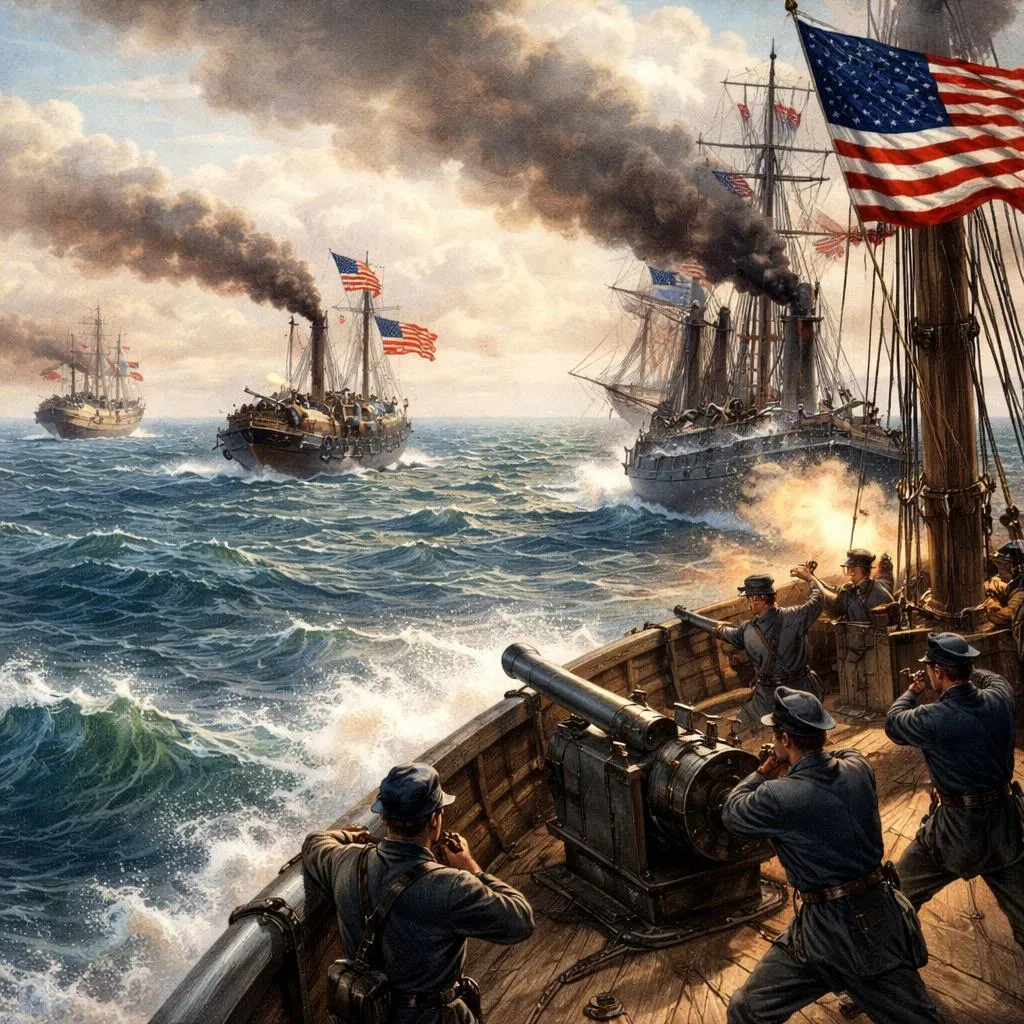

Captain Breaker had been in the main rigging with his night-glass, watching the movements of the chase; but he recognized the voice of Christy when he shouted to French to pick up the quarter-boat of the schooner, as he could no longer make out the Tallahatchie in the fog.
“Good-morning, Mr. Passford,” said he, as he met Christy when he descended from the rail. “I am glad to see you again.”
“Good-morning, Captain Breaker,” replied the lieutenant, as he took the offered hand of the commander. “I hope all is well on board, sir.”
“Entirely well, and your messenger came on board in good time, so that we were in position to get the first sight of the Trafalgar when she showed herself off Sand Island Lighthouse,” replied the captain, as he led the way to his cabin. “Mr. Ballard, keep a sharp lookout for the chase,” he added to the acting executive officer.
“Will you allow me to put on my uniform, Captain?” asked Christy. “I don’t feel quite at home on board the ship in the rigout I have worn all night.”
“Certainly; for I do not wish you to show yourself to the ship’s company while you look so little like a naval officer,” replied the captain, as he went to take another look at the darkness ahead.
The lieutenant hastened to his stateroom, and in a very short time he had washed off the smut from his face and hands, and dressed himself in his uniform, so that he looked like quite another person, Graines had gone to his room in the steerage for the same purpose, for neither of them desired to show himself as he had appeared before Captain Sullendine.
Christy hurried to the deck as soon as he had made the change, and met the commander on the quarter-deck. Lookouts were stationed aloft and on the top-gallant forecastle, and all hands were in a state of healthy excitement in view of the stirring event which was likely to transpire before the lapse of many hours; and doubtless some of the men were moved by the prospect of prize-money, not only from the proceeds of the sale of the steamer they were chasing, but from the full freight of cotton on board of the schooner, the deck load of which had been noted by some of the crew.
The schooner which had come so close aboard of the Bellevite was a mystery to all, from the captain down to the humblest seaman; but the American ensign over the Confederate flag had been observed by a few, and this settled her status. Not more than half of the seamen were aware that an expedition had left the ship at ten o’clock the evening before, and they had had no opportunity to notice the absence of the executive officer during the night; and even yet all hands had not been called, for the regular watch was enough to get the ship under way.
The commander conducted the executive officer to his own cabin, again reminding Mr. Ballard to keep a sharp lookout for the chase. Christy felt like himself again in his neat uniform, and his vigorous and well knit, as well as graceful form, did more to show off the dress than the dress did to adorn his person.
“I am very glad to see you again, Christy,” said Captain Breaker, seating himself and pointing to an arm-chair for the lieutenant, while he came down from the stately dignity of the commander of a man-of-war to the familiarity with which he treated his chief officer when they were alone. “I had no doubt that you would give a good account of yourself, as you always do. You were going on the enemy’s territory, and you were in peril all the time. Now you come off in a schooner, which appears to be loaded with cotton, and how or where you picked her up is a mystery to me;” and the commander indulged in a laugh at the oddity of the young officer’s reappearance. “Your messenger reported that the Trafalgar would sail at three o’clock in the morning, and I judge that she left at about that hour.”
“Within ten minutes of it, and probably made an arrangement with the commandant of the fort to that effect,” added Christy. “But they do not call her the Trafalgar now; though Weeks was not aware of the fact when I sent him on board. She is now the Tallahatchie, though I noticed that some in the vicinity of the fort still called her by her old name.”
“Never mind the name; she will answer our purpose as well under one appellation as another. When I asked your messenger about you and the other six men of your party, he was unable to give me any information in regard to your movements; and he could not tell me how you had ascertained the hour at which the steamer was to sail,” continued the captain.
“Graines and myself separated from the party as soon as we landed on the point; and we had obtained our information before we joined them again on the shore of Mobile Bay, sir. At the same time we had learned all about the West Wind”—
“The what?” interposed the commander.
“I mean the schooner West Wind, the one from which we came on board of the Bellevite, which was to be towed out by the Tallahatchie, and which was towed out by her till we on board of her cast off the towline.”
“Perhaps you had better narrate the events of your expedition seriatim, for all you say in this disconnected manner only thickens the mystery,” said the commander: and he knew that his officer had an excellent command of the English language, and could make a verbal report in a very attractive and telling style, though perhaps his fatherly interest in the young man had something to do with the matter.
Christy began his narrative with the departure from the ship, passing lightly over the minor details till he came to the meeting with the deserters from the West Wind, bivouacking in the hollow. He described the drinking bout which followed, in which he and Graines had pretended to join, stating the information he had obtained from them. He rehearsed a portion of Captain Sullendine’s speech, adding that most of his auditors were the seamen from the Bellevite, though he had sent four of them back to the ship before he reached the shore.
He detailed his interview with the master of the West Wind, explaining how he had shipped the new crew with him. The scenes in the cabin were described in full; in fact, every incident of any importance which had transpired during the night was related. The commander was deeply interested, and listened without comment to the narrative up to the moment when the narrator had come on board of the Bellevite. He was not sparing in his praise of the engineer, and separated what he had said and done as far as he could from his own words and actions.
The commander then questioned him in regard to the armament of the Tallahatchie, and he repeated the meagre information he had obtained from Bokes. Some conversation concerning Armstrong guns followed; but both of them were well posted in regard to this long-range piece. Christy read the satisfaction with which the captain heard his statements on his face.
A knock at the door of the cabin disturbed the conference, and the lieutenant was directed to open the door. The shaking and straining of the ship had for some time indicated that Paul Vapoor was fully alive to the importance of getting the Bellevite’s best speed out of her on the present occasion; and he did not intrust the duty to his subordinates. Christy opened the cabin door, and Midshipman Walters asked for the commander, and was admitted.
“Mr. Ballard directs me to inform you, sir, that we are gaining on the chase,” said the young officer. “The fog has lifted again, and we can make her out very clearly. The Holyoke has abandoned the chase, and appears to be headed for the schooner that came to on the starboard of the ship.”
“Tell Mr. Ballard to keep the ship as she is, headed for the Tallahatchie,” replied Captain Breaker.
“The Tallahatchie, sir?” queried the midshipman.
“Formerly the Trafalgar,” added the commander.
The young officer touched his cap and retired.
“This Captain Sullendine is still secured in his stateroom on board of the West Wind, is he?” asked the captain, rising from his arm-chair.
“He was when I left the schooner, sir,” replied Christy. “French, the captain of the forecastle, is in charge of the vessel, with orders to anchor her a couple of miles to the eastward of the lighthouse. I have already commended French to your attention, Captain, as a faithful and reliable man, and I think he deserves promotion.”
“Your recommendation will go a great way to procure it for him," added the commander with a significant smile.
“He is a thorough seaman, has been the mate of a large coaster, and would have become master of her if his patriotic duty had not led him to ship in the navy.”
“He is a resolute and brave fellow in action, as I have had occasion to observe, and I shall remember him. When you are writing to your father it would be well for you to mention him; and the thing will be done at your request if not at mine.”
“It certainly would not be done without your indorsement, for my father will not indulge in any favoritism aside from real merit," protested the lieutenant, with some warmth.
“You are quite right, Christy. We must go on deck now,” added Captain Breaker, as he moved towards the door. “You have been up all night, my boy; it will be some hours before we come within reach of the chase, and you can turn in and get a little sleep before anything stirring takes place on board.”
The excitement which had animated the young officer during the night had subsided with the rendering of his report, and the responsibility of a command no longer rested upon him, and for the first time since he embarked in the whaleboat, he began to feel tired and sleepy. He went on deck with the commander, and took a survey, first of the chase, then of the Holyoke, and finally of the West Wind.
Captain Breaker thought the Tallahatchie was about five miles distant. Seen through the glass, for the fog had all blown away, and the daylight had begun to obscure the stars, the steamer seemed to be doing her best. The Holyoke was headed to the eastward, evidently intending to chase the West Wind, for she could not yet make out her flags, indicating that she was already a prize. She need not have troubled herself to pursue the schooner if she had known the facts in regard to her, for she was entitled to a share of the prize as a member of the blockading fleet at the time of her capture. But she could prevent her from being retaken by any boat expedition sent from the shore, as her lonely position where the Bellevite had been for several days might tempt some enterprising Confederate officer to do.
Although the last heaving of the log showed twenty knots, it was a quiet time of the deck of the Bellevite, and all the excitement on board was confined to the engine and fire rooms. With sundry gapes Christy had taken in the situation, and then he concluded to avail himself of the commander’s permission to retire to his stateroom, where he was soon in a sound slumber.
Just before, Captain Breaker had retired to his cabin, where he had a chart of the Gulf of Mexico spread out on his table. Assuming the point where the Tallahatchie had changed her course to the south-west, he drew a line in that direction, and realized that the chase could not go clear of the Passes of the Mississippi River; and she was likely to sight some Federal steamer in that locality.
As the daylight increased the weather improved so far as the fog was concerned and it promised to be a clear day, for the stars had not been obscured at any time during the night. The only alternative the commander could see for the chase, as he studied the chart, was to go to the southward before he could sight the Pass à l’Outre. He was so confident that this must be his course, that he decided to take advantage of the situation, and he went on deck at once, where he ordered the officer of the deck to make the course south south-west.
Background and Author Introduction
This excerpt comes from a classic naval adventure story that captures the tension and excitement of sea battles during the era of steam-powered ships and sailing schooners. The story is set against the backdrop of the American Civil War, a time when naval blockades and daring expeditions were crucial to the war effort. The author, whose detailed narrative style and vivid descriptions bring the maritime world to life, was known for his ability to blend historical accuracy with thrilling storytelling. His works often highlight themes of bravery, loyalty, and strategic thinking, making them enduring favorites among young readers and history enthusiasts alike.
Detailed Story Analysis and Significance
The passage centers on Captain Breaker and Lieutenant Christy as they engage in a high-stakes naval chase involving the schooner Tallahatchie (formerly Trafalgar) and other vessels. The narrative unfolds with a mix of suspense, strategy, and character interaction, illustrating the complexities of naval warfare and the importance of leadership and quick decision-making.
Several key elements stand out in this story:
-
Leadership and Responsibility: Captain Breaker exemplifies calm and decisive leadership, balancing the need for vigilance with care for his crew. Lieutenant Christy’s transformation from a weary, disguised figure into a confident officer in uniform symbolizes the restoration of order and authority.
-
Courage and Resourcefulness: Christy’s daring infiltration into enemy territory and his ability to gather critical intelligence demonstrate courage and ingenuity, qualities essential for success in challenging situations.
-
Teamwork and Trust: The interactions among officers and crew members reflect the importance of trust and cooperation in achieving common goals, especially in dangerous environments.
-
Historical Context: The story provides insights into naval operations during the Civil War, such as blockades, prize money incentives, and the use of both steam and sail-powered vessels.
Lessons and Inspirations for Students
Students can learn a great deal from this story, not only about history but also about character and values:
-
Resilience in Adversity: Christy’s perseverance despite danger and fatigue teaches the value of resilience and determination when facing challenges.
-
The Power of Preparation: The careful planning and readiness of Captain Breaker’s crew highlight how preparation and attention to detail lead to success.
-
Integrity and Merit: The promotion recommendation based on merit, not favoritism, underscores the importance of fairness and earning respect through hard work and ability.
-
Strategic Thinking: The commander’s use of maps and anticipation of the enemy’s moves encourages critical thinking and planning skills.
Applying the Story’s Spirit in Everyday Life
-
In Learning: Students can emulate Christy’s curiosity and dedication by preparing thoroughly for their studies and being courageous in tackling difficult subjects.
-
In Social Situations: The story’s emphasis on trust and teamwork can inspire students to build strong, supportive relationships with peers and teachers.
-
In Personal Growth: The themes of courage and integrity encourage young people to stand up for what is right and to act responsibly even under pressure.
-
In Leadership: Whether in school projects or community activities, students can practice leadership by being calm, fair, and encouraging cooperation among group members.
Cultivating Positive Qualities from the Story
-
Bravery: Facing fears and stepping into new roles confidently, like Christy, can help students grow in self-assurance.
-
Discipline: Maintaining focus and composure, as shown by the officers, is key to achieving goals.
-
Empathy and Support: Recognizing and valuing the contributions of others, as Captain Breaker does with French, fosters a positive and inclusive environment.
-
Adaptability: Being ready to change plans and respond to new information, just as the crew adjusts their course, is an essential life skill.
Conclusion
This naval adventure story is more than an exciting tale of sea chases and wartime strategy; it is a rich source of lessons on courage, leadership, and integrity. By exploring its characters and themes, students can gain inspiration to face their own challenges with determination and fairness. The story encourages young readers to develop qualities that will serve them well in school, friendships, and future careers, making it a valuable addition to any educational curriculum.
