
Captain Breaker watched the Tallahatchie with the most earnest attention; and it was not five minutes after he had given out the new course before she changed her direction, though not to the south, but enough to carry her clear of the Passes of the Mississippi. Paul Vapoor was still crowding the engine to the utmost that could be done with safety, and he spent no little of his time in the fire room, personally directing the men in the work of feeding the furnaces.
It was evident to the commander that his ship was gaining on the Tallahatchie, at least a knot an hour, as he estimated it, and the chase could not now be more than four miles distant. This was within the range of her Armstrong gun, if it was of the calibre reported by Bokes, whose information was mere hearsay, and was open to many doubts.
“She is changing her course again, Captain Breaker,” said Mr. Ballard, who had been observing the chase with the best glass on board.
“Probably she has discovered a man-of-war in the distance,” added the captain.
“I cannot make out anything to the westward of her,” said Mr. Ballard, who had directed his glass that way.
“She knows very well that she is liable to encounter a Federal ship on the course she is running. How does she head now?”
“As nearly south as I can make it out.”
“Then we have made something on her by going to the south south-west in good season; and I am sorry I did not do it sooner,” replied the commander, as he went into a fine calculation, estimating sundry angles, and figuring on the gain he was confident he had already made.
“I think she is headed due south now, Captain,” said Mr. Ballard.
“So I should say, and we are headed a little too much to the westward. Make the course south by west half west, Mr. Ballard.”
This course was given to the quartermaster conning the wheel. For another hour the two steamers kept on the course taken, at the end of which time the captain believed they were within three miles of each other; and the appearance, as viewed by skilful and experienced officers, verified his estimate of the relative speed of both—that the Bellevite was gaining about a knot an hour on the chase.
They had hardly agreed upon the situation before a cloud of smoke was seen to rise from the waist of the Tallahatchie, followed by the report of a heavy gun. The projectile struck the water at least a quarter of a mile ahead of the Bellevite, at which the watch on deck gave a half-suppressed cheer.
“They must have better gunners than that indicates on board of that steamer, for she has been fitted out as a cruiser,” said the commander with a quiet smile.
Twenty minutes later another puff of smoke, followed by a second report, excited the attention of an officer on the deck of the loyal ship. The shot struck the water only a little less ahead of the ship than the former, and the crew gave a more vigorous cheer: but it was observed that it hit the sea a little on the starboard bow, so that if it had been better aimed it would not have reached the ship.
“She is wasting her ammunition,” said the captain. “She seems to be jesting, or else she is trying to frighten us.”
“I think it is some thing worse than that, Captain Breaker,” replied Mr. Ballard.
“What could be worse?”
“I am inclined to the opinion that she cannot swing the gun around so as to make it bear on an object so far astern of her as this ship is at the present moment.” said the lieutenant.
“He has an all sufficient remedy for that,” added the captain. “He can swing his ship’s head around so his gun will bear on us.”
“But that would cause him to lose a quarter of a mile or more of his advantage; and she seems to be more inclined to run away from the Bellevite than to fight her,” suggested the lieutenant.
“Call all hands, Mr. Ballard,” said the commander; and in a few minutes all the officers and seamen were at their stations.
The call awoke Christy from his slumber, which the report of the gun and the cheering of the men had failed to do. But he understood the summons, and thought the action was about to begin. He adjusted his dress and hastened to the quarter deck, where he reported in due form to the captain. Mr. Ballard was relieved of his duties as acting executive officer, and went to his proper station to take command of his division. Christy took a careful survey of the situation, and saw that the Bellevite had gained at least two knots on the chase. The Holyoke and the West Wind were no longer in sight, though the fog seemed to be still hanging about the entrance to Mobile Bay.
“The Tallahatchie has fired two shots at us, Mr. Passford; but she wasted her ammunition,” said the commander. “I am inclined to agree with Mr. Ballard that she cannot swing her Armstrong gun so as to cover the Bellevite.”
“She has stopped her screw, sir!” exclaimed the first lieutenant, who was looking at the chase through the best glass.
“Make the course west, Mr. Passford!” said the captain with energy.
“Quartermaster, make it west!” shouted Christy.
“West, sir!” repeated the quartermaster, as he caused the helmsmen to heave over the wheel.
Directing his glass to the chase again, Christy saw the Tallahatchie swing around so that she was broadside to the Bellevite. Almost at the same moment the smoke rose from her deck, and the sound of the gun reached the ears of the officers and crew. The shot passed with a mighty whiz between the fore and main mast of the ship, cutting away one of the fore topsail braces, but doing no other damage. The seamen cheered as they had before. The Tallahatchie started her screw as soon as she had discharged her gun, and resumed her former course, the Bellevite doing the same.
If the loyal ship had not promptly altered her course, the projectile would have raked her, and must have inflicted much greater injury in the spars and rigging. But both vessels promptly resumed their former relative positions, though the Tallahatchie had lost some of her advantage by coming to, while her pursuer had only made a small circuit without stopping her engine for a moment.
“If she does that again, Mr. Passford, we must be ready to return her fire,” said the captain. “Have the pivot gun ready, and aim for her Armstrong, which seems to be sufficiently prominent on her deck to make a good target.”
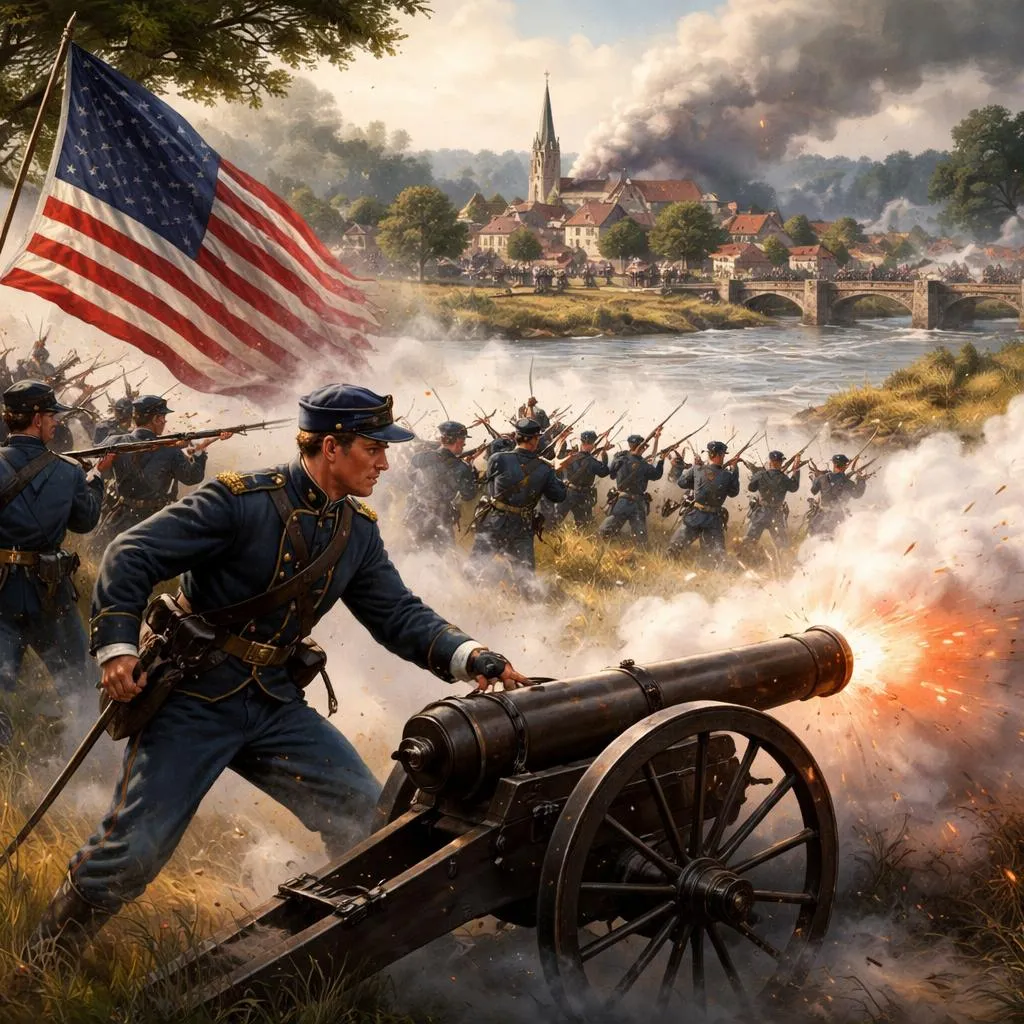
Christy hastened forward, and gave the order to Mr. Ballard, in whose division the great Parrot was included. The signal was promptly given for manning the gun, and seventeen men immediately sprang to their stations. The men were armed with cutlasses, muskets, battle-axes, pistols, and pikes, which were so disposed as to be in readiness for boarding the enemy, or repelling boarders.
“A solid shot, and aim at the pivot gun of the enemy,” said Christy in a low tone to the second lieutenant, who had the reputation of being an expert in the handling of guns of the largest calibre.
There were two captains to the pivot gun, one on each side, stationed nearest to the base of the breech. Seventeen men were required to work the pivot gun, whose duties were defined in the names applied to them, the powderman being the odd one. The first and second captains were numbers one and two; the odd numbers being on the right, and the even on the left of the piece: number three was the first loader, four the first sponger, five the second loader, six the second sponger, seven the first shellman, eight the second shellman, nine the first handspikeman, ten the second handspikeman, eleven the first train tackleman, twelve the second train tackleman (the last two at the breech, next to the captains), thirteen first side tackleman, fourteen second side tackleman, fifteen first port tackleman, sixteen second port tackleman.
The gun crew had been frequently drilled in the management of the piece, and the men were entirely at home in their stations. Other hands had been trained in serving the gun, so that the places of any disabled in action could be replaced. The service at the Parrot was not all that was required of the men forming the gun crew, for each was also a first or second boarder, a pumpman, or something else, and to each number one or two weapons were assigned, as musket and pike, sword and pistol, battle-axe. When the order to board the enemy was given, every man knew his station and his proper officer.
“Silence, men!” commanded the second lieutenant, “Cast loose and provide!”
These orders were repeated by the first captain of the gun. It is his duty to see the piece cleared and cast loose, and everything made ready for action. He and the second captain “provide” themselves with waist belts and primers, and the first with some other implements. But the handling of one of these great guns is about as technical as a surgical operation would be, and it would be quite impossible for the uninitiated to understand it, though it is every-day work to the ordinary man-of-war’s-man.
Prompted by the executive officer, who had been further instructed by the captain, all the series of steps had been taken which put the piece in readiness to be discharged, and all that remained to be done was to adjust the aim, which is done by the first captain. At this time the distance between the two ships had been considerably reduced. The captain and the first lieutenant were closely watching the chase with glasses.
The crew of the Tallahatchie could be seen at work at the long gun, and another shot from it was momentarily expected. The instant the bow of the enemy began to swerve to port, the captain of the Bellevite gave the order to put the helm to starboard. Almost at the same instant the enemy stopped her screw, swung round and fired her long gun. The projectile crashed through the bulwarks between the foremast and top-gallant forecastle, wounding two men with the splinters which flew in every direction.
Dr. Linscott and his mates had established themselves in the cockpit, to which the wounded are conveyed, in action, for treatment. The two men who had been injured by the splinters were not disabled, and they were ordered to report to the surgeon. Before the enemy could resume her course, the captain of the pivot gun had caught his aim, and discharged the Parrot. All hands watched for the result of the shot, and the glasses of the captain and the first lieutenant were directed to the chase.
She was near enough now to be observed with the naked eye with tolerable accuracy, and a shout went up from the men at the pivot gun, in which the rest of the crew on deck joined, as they saw that the shot had struck the midship gun of the enemy, or very near it; and this was the point where old Blumenhoff, the captain of the gun, had been directed to aim. He was a German, but he had served for twenty-one years in the British navy, and had won a brilliant reputation in his present position.
It could not be immediately determined whether or not the Armstrong had been disabled. The Tallahatchie had swung round again and resumed her flight; but her commander must have realized by this time that he was getting the worst of it. Paul Vapoor had not left his post in the engine and fire room, to ascertain how the battle was going, but still plied all his energies in driving the Bellevite to the utmost speed she could possibly attain. The log was frequently heaved, and the last result had been sent down to him by Midshipman Walters, and it was twenty-one knots.
During the next hour the long gun of the enemy was not again discharged, and the officers of the loyal ship were assured that it had been rendered useless by Blumenhoff’s only shot.
Background and Author Introduction
This exciting naval chase scene is from a classic maritime adventure novel, a genre popular in the 19th century that captured the imaginations of young readers with tales of courage, strategy, and the perils of the sea. The story likely comes from an author well-versed in nautical life, possibly someone who served in the navy or spent much time aboard ships. Such authors aimed to bring realism and thrilling action to their readers, painting vivid pictures of naval warfare and the challenges faced by sailors.
The narrative centers on Captain Breaker and his ship, the Bellevite, as they pursue the Tallahatchie, a steamer fitted out as a cruiser. The story highlights the strategic thinking, leadership, and bravery required in naval engagements, as well as the technical knowledge needed to operate complex weaponry and manage a ship under pressure.
Detailed Interpretation and Significance
The passage illustrates a tense and suspenseful naval pursuit, emphasizing themes of vigilance, quick decision-making, and teamwork. Captain Breaker’s careful observations and calculations show the importance of intelligence and anticipation in overcoming an opponent. The crew’s readiness to respond to commands, their discipline in manning weapons, and their courage in the face of danger reflect values of loyalty and duty.
The detailed description of the pivot gun crew and their roles educates readers about the complexity of naval warfare and the importance of each individual’s contribution to the collective effort. The story portrays not only the physical challenges of battle but also the mental acuity and coordination required to succeed.
Lessons and Insights for Students
-
Strategic Thinking and Problem Solving: Captain Breaker’s ability to analyze the situation, predict the enemy’s moves, and adjust his tactics teaches students the value of critical thinking and adaptability in challenging situations.
-
Teamwork and Leadership: The story highlights how every crew member, from officers to gunners, plays a vital role. Effective leadership motivates and organizes the team, while each individual’s skill and cooperation contribute to success. This is a valuable lesson for group projects and social interactions.
-
Courage and Responsibility: The sailors face danger bravely, fulfilling their duties despite risks. This encourages students to face their own challenges with courage and a sense of responsibility.
-
Technical Knowledge and Preparation: Understanding the operation of the ship’s guns and the importance of drills shows that preparation and learning technical skills are crucial for effective performance. Students can relate this to the importance of studying and practicing skills in school and life.
Applying the Story’s Spirit in Daily Life
-
In Learning: Like the crew preparing and practicing their roles, students should prepare thoroughly for exams and projects, understanding that knowledge and practice lead to confidence and success.
-
In Social Situations: Leadership and teamwork from the story can inspire students to be supportive friends and responsible group members, helping others and working together to achieve common goals.
-
In Overcoming Challenges: The courage displayed by Captain Breaker and his crew can motivate students to face difficulties—whether academic, personal, or social—with determination and calmness.
Cultivating Positive Values from the Story
-
Discipline: The disciplined response of the crew to commands teaches the importance of self-control and following through on responsibilities.
-
Respect for Roles: Recognizing that every role matters encourages respect for others’ contributions, fostering empathy and cooperation.
-
Strategic Patience: The captain’s careful planning before engaging the enemy shows that patience and thoughtful action often lead to better outcomes than rash decisions.
Conclusion
This naval adventure not only entertains with its vivid action and suspense but also offers rich lessons in leadership, teamwork, courage, and strategic thinking. By reflecting on the story, students can gain inspiration to develop these qualities in their own lives—whether in school, friendships, or future careers. The tale reminds us that success often depends on preparation, cooperation, and the bravery to face challenges head-on.
