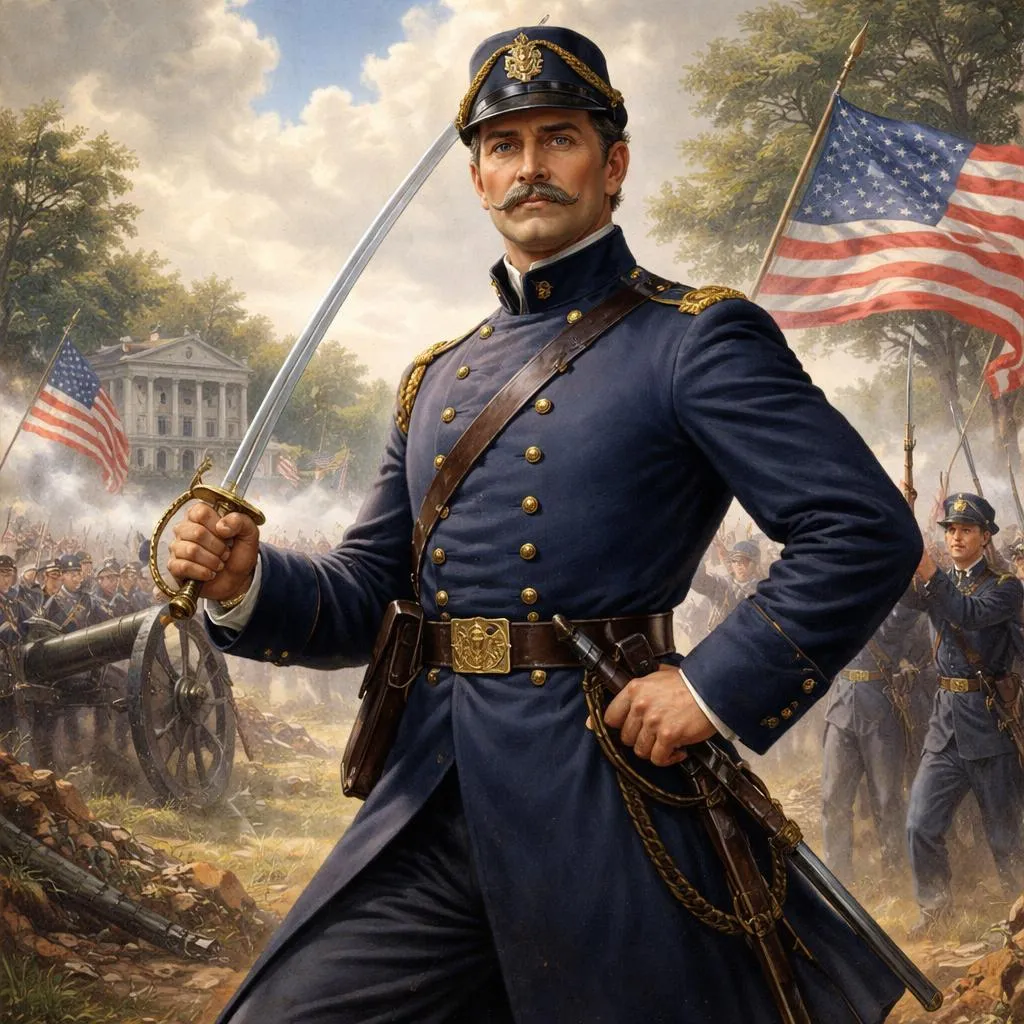

As soon as the battle on the deck of the Tallahatchie had been decided, Graines, in command of the flanking party, had returned to the engine room of the Bellevite. He and his men had fought bravely and effectively in the action, though the full effect of the movement under his charge could not be realized in the change of circumstances. The engine of the ship had now cooled off, and Paul Vapoor hastened to the deck to see his friend and crony, the news of whose wound had been conveyed to the engine room in due time.
He was heartily rejoiced to find that it was no worse, and he had news for the patient. Just before the burial of the dead he had been sent by the commander to examine and report upon the condition of the engine of the prize. Captain Rombold had protected it with chain cables dropped over the side, so that it remained uninjured, and the British engineers declared that it was in perfect working order.
“But whom do you suppose I saw on board the prize, Christy?” asked the chief engineer, after he had incidentally stated the condition of the engine.
“I cannot guess; but it may have been my cousin Corny Passford, though he has always been in the military service of the Confederacy,” replied the wounded lieutenant.
“It was not Corny, but his father,” added Paul.
“His father!” exclaimed Christy. “Uncle Homer Passford?”
“It was he; I know him well, for I used to meet him at Glenfield in other days. I am as familiar with his face as with that of your father, though I have not seen either of them for over three years.”
“Where was he? What was he doing?” asked Christy curiously.
“He was just coming up from below; and Mr. Hungerford, the second lieutenant, told me he had been turned out of the captain’s cabin, which had been made into a hospital for the wounded,” added Paul. “I had no opportunity to speak to him, for he averted his gaze and moved off in another direction as soon as he saw me. He looked pale and thin, as though he had recently been very sick.”
“Poor Uncle Homer!” exclaimed the lieutenant. “He has been very unfortunate. The last time I saw him, I conducted him to my father’s place at Bonnydale, after he had been a prisoner on board of the Chateaugay. He was on parole then, and I suppose he and Captain Rombold were both exchanged.”
“Doubtless he will tell you all about it when you see him, as you will soon.”
“He had his eyes opened when he passed through New York City with me, for he did not find the grass growing in the streets, as he had expected, in spite of all I had said to him at sea. He was astonished and confounded when he found business more lively than ever before there; but he remained as virulent a rebel as ever; and I am sure he regards it as a pious duty to stand by the Southern Confederacy as long as there is anything left of it. I know no man more sincerely religious than Uncle Homer.”
“He is as good a man as ever walked the earth,” added Paul heartily.
“For his sake, if for no other reason, I shall rejoice when this war is over,” said Christy, with a very sad expression on his pale face.
“Was Mr. Graines of any use to you on deck, Christy?” asked the chief engineer, as he turned to take his leave.
“He behaved himself like a loyal officer, and fought like a tiger on the deck of the Tallahatchie. I shall give a very good report of him to the captain for his conduct in the action, and for his valuable services in the expedition last night. I did not over-estimate him when I selected him for both of the positions to which he was appointed.”
“He wants to see you, and I told him he should come on deck when I returned,” added Paul, as he took the hand of Christy and retired.
“How do you feel now, Mr. Passford?” asked Captain Breaker, coming to his side the moment the chief engineer left him.
“I feel quite weak, but my arm does not bother me much. The Confederate surgeon did a good job when he dressed it,” replied Christy with a smile.
“I will get him to send you a second dose of the restorative that strengthened you before,” said the commander, as he pencilled a note, which he tore out of his memorandum book, and sent it by Punch to Dr. Davidson.
“Mr. Vapoor brought me a piece of news, Captain,” continued Christy. "Uncle Homer Passford is on board of the Tallahatchie.”
“Your uncle!” exclaimed the commander. “I supposed he was still on parole at the house of your father.”
“I did not know to the contrary myself, for I have had no letter from my father for a long time. He and Captain Rombold must have been exchanged some time ago. Mr. Vapoor says my uncle looks pale and thin, as though he had recently been very sick.”
“I am very sorry for him, for he was the equal of your father in every respect, except his loyalty to his true country,” added the captain.
“Poor Uncle Homer!” exclaimed Christy, as he wiped a tear from his eye. “He was the guest of Captain Rombold; but he has been turned out of his cabin to make room for the wounded.”
“Dr. Linscott with his two mates has gone to the assistance of Dr. Davidson, whose hands are more than full, and perhaps he will see your uncle. Where is he now?” inquired the captain.
“Mr. Vapoor saw him on the deck, but he did not speak to him, for Uncle Homer avoided him. The ward room of the prize has at least two wounded officers in it, and I don’t know how many more, so that my poor uncle has no place to lay his head if he is sick,” said Christy, full of sympathy for his father’s brother.
“That will never do!” exclaimed the commander bruskly. “He shall have a place to lay his head, sick or well. Captain Rombold occupies one of the staterooms in my cabin, and your uncle shall have the other.”
“But where will you berth, captain?” demanded Christy.
“No matter where! I will go and find your uncle at once;” and Christy saw him next mounting the gangway steps.
The commander had no difficulty in finding the gentleman he sought; for he was wandering about the deck of the prize, and no one seemed to take any notice of him. He had been the honored guest of Captain Rombold, though he had hardly shown himself on deck since the steamer left Mobile, and few of the ship’s company seemed to know who he was.
“Good-morning, Colonel Passford,” said Captain Breaker, as he confronted him in the midst of the ruins of the spare wheel, the wrecks of the mizzen mast, and the bulwarks on the quarterdeck.
“Good-morning, Captain Breaker,” replied the planter, taking the offered hand of the commander, with a feeble effort to smile. “Of course I knew that you were near, for you have given abundant proofs of your presence on board of this vessel.”
“But we meet now as friends, and not as enemies. I know that you have done your duty to your country as you understand it, and I have done the same,” continued the commander, still holding the hand of the colonel.
“You have been very kind to Captain Rombold, Gill informs me, and”—
“He set the example for me, and I have striven to follow it,” interposed the captain. “But his generosity was first exercised in behalf of your nephew, Christy.”
“The steward informed me that Christy had been wounded; and Captain Rombold assured me that the Tallahatchie was captured in consequence of a very daring act on the part of my nephew,” added the planter.
“I should not state it quite so strongly as that, though his action certainly enabled us to capture the ship sooner, and with less loss on our part than would otherwise have been the case. As to the ultimate result of the battle, Captain Rombold and myself would disagree. But with your assent, Colonel Passford, I think we had better cease to discuss the action, which is now an event of the past. I am informed that you have been compelled to leave the captain’s cabin.”
“And I cannot find a resting place in the ward room or steerage,” added the planter.
“I have come on board of the prize to invite you to share my cabin with Captain Rombold, for I have two staterooms,” said Captain Breaker, suddenly changing the subject of conversation.
“You are very kind, my dear sir; but your arrangement would incommode yourself,” suggested the colonel.
“My cabin is quite large, and I shall be able to make ample accommodations for myself,” persisted the commander, as he took the arm of the planter. “Permit me to conduct you to your new quarters.”
“As I am once more a prisoner”—
“Hardly,” interposed the captain, as he led the planter to the gangway, “I shall regard you as a non-combatant, at least for the present; and I desire only to make you comfortable. The flag-officer must decide upon your status.”
Colonel Passford allowed himself to be conducted to the deck of the Bellevite; and he was no stranger on board of the ship, for when she was a yacht he had made several excursions in her in company with his family. The first person he observed was his nephew, seated in his arm-chair where he could overlook all that took place on the deck. He hastened to him, detaching his arm from the hand of the captain, and gave him an affectionate greeting.
“I was very sorry to learn that you were wounded, Christy,” said he, holding the right hand of the young officer.
“Not badly wounded, Uncle Homer,” replied Christy. “I hope you are well.”
“I am not very well, though I do not call myself sick. Have you heard from your father lately, Christy?” asked his uncle.
“Not for a long time, for no store-ship or other vessel has come to our squadron for several months, though we are waiting for a vessel at the present time. You look very pale and thin, Uncle Homer.”
“Perhaps I look worse than I feel,” replied the planter with a faint smile. “But I have suffered a great deal of anxiety lately.”
“Excuse me, Colonel Passford, but if you will allow me to install you in your stateroom, you will have abundance of time to talk with your nephew afterwards,” interposed Captain Breaker, who was very busy.
“Certainly, Captain; pardon me for detaining you. I am a prisoner, and I shall need my trunk, which is in my stateroom on board of the Tallahatchie. Gill will bring it on board if you send word to him to do so,” replied the colonel.
He followed the captain to his cabin. The door of the Confederate commander’s room was open, and the planter exchanged a few words with him. He was shown to the other stateroom, and Punch was ordered to do all that he could for the comfort of the passenger. Captain Breaker spoke a few pleasant words with the wounded commander, and then hastened on deck.
Mr. Ballard, the second lieutenant, had again been duly installed as temporary executive officer; Mr. Walbrook had been moved up, and Mr. Bostwick, master, had become third lieutenant. As usual, the engineers were Englishmen, who had come over in the Trafalgar, as well as the greater part of the crew, though the other officers were Southern gentlemen who had “retired” from the United States Navy. The foreigners were willing to remain in the engine room, and promised to do their duty faithfully as long as their wages were paid; but Leon Bolter, the first assistant engineer of the Bellevite, was sent on board of the prize to insure their fidelity.
Ensigns Palmer Drake and Richard Leyton, who were serving on board of the steamer while waiting for positions, were sent to the Tallahatchie, the first named as prizemaster, and the other as his first officer, with a prize crew of twenty men, and the two steamers got under way.
Background and Author Introduction
This excerpt is from a historical naval story set during the American Civil War, a period marked by intense conflict between the Union and the Confederacy. The story revolves around the capture of a ship called the Tallahatchie and the complex relationships between officers and family members caught in the war. The narrative highlights themes of loyalty, duty, and the human cost of war.
The author, writing in a style typical of 19th-century adventure and war novels, combines detailed descriptions of naval operations with personal drama. Such stories were popular for their thrilling depictions of courage and honor amid warfare, offering readers both excitement and moral reflection.
Detailed Interpretation and Significance
The story presents a vivid picture of naval warfare, emphasizing bravery and strategic thinking. Characters like Graines and Christy demonstrate loyalty and courage, fighting fiercely despite injuries and hardships. The presence of family members on opposing sides, such as Uncle Homer Passford, adds emotional depth, showing how war divides even close relatives.
The narrative also explores themes of compassion and respect between enemies. Captain Breaker’s kindness in offering his cabin to Colonel Passford, despite their opposing allegiances, illustrates a code of honor that transcends conflict. This highlights the complexity of human relationships during war, where respect and humanity persist even amid violence.
Lessons and Insights for Students
-
Courage and Loyalty: The characters’ dedication to their duties, even when wounded or facing great danger, teaches the importance of standing firm in one’s responsibilities and beliefs.
-
Compassion in Conflict: Captain Breaker’s treatment of Colonel Passford shows that kindness and respect should be maintained, even toward those considered adversaries. This is a valuable lesson in empathy and fairness.
-
Family and War: The story reveals how war can strain family bonds, encouraging readers to appreciate peace and the value of family unity.
-
Resilience: Despite injuries and setbacks, characters continue to fulfill their roles, demonstrating resilience and determination—qualities essential for overcoming challenges in life.
Application in Daily Life and Learning
-
In School: Students can learn to be courageous in facing academic challenges and loyal to their principles, just as the characters remain committed to their causes.
-
In Social Settings: The story encourages treating others with kindness and respect, even when disagreements arise, fostering better communication and understanding.
-
In Personal Growth: Resilience shown by the characters can inspire students to persist through difficulties, whether in learning new skills or managing personal problems.
Cultivating Positive Values from the Story
-
Honor and Integrity: Emulate the characters’ sense of duty and honesty in everyday actions.
-
Empathy: Practice understanding others’ perspectives, even those different from your own.
-
Bravery: Take initiative and face challenges confidently, learning from setbacks rather than being discouraged.
-
Respect for Family and Friends: Value relationships and work to maintain harmony, especially during difficult times.
By studying stories like this, young readers can develop a deeper appreciation for history, human nature, and moral values, which will help them grow into thoughtful, courageous, and compassionate individuals.
